Royal Exchange Manchester

The Rolling Stone

Unknown

24/04/15

Royal Exchange, Manchester

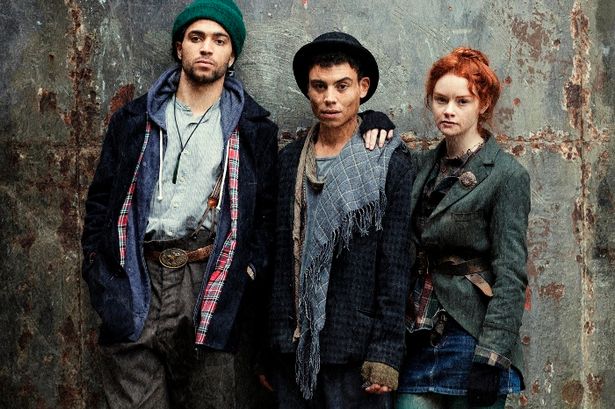
Receiving its World Premiere at the Exchange, The Rolling Stone by Chris Urch has a short run here before transferring to the West Yorkshire Playhouse. It’s a story torn straight from the headlines. In the opening scene, two young men recline beside a lake on their first date – they chat, flirt and eventually kiss. Nothing at all out of the ordinary – except this is Uganda where homosexuality is expressly forbidden and transgressors face life imprisonment and ostracisation. Dembe (Sule Rimi) has fallen in love with young doctor, Sam (Robert Gilbert) who has an Irish father and a Ugandan mother. They both know that their relationship must be kept under wraps – particularly since Dembe’s older brother, Joe has recently been ordained as a church minister for their small community. But the local newspaper, ‘The Rolling Stone’ is always on the lookout for those people it likes to tag as ‘deviants’… and there’s a terrible price to pay if your name appears on their list…

There’s a great play to be written about this subject, but sadly, The Rolling Stone isn’t quite it. Despite excellent acting from the six-strong cast and some rousing acapella singing, the play’s characters are rarely allowed to rise above the two-dimensional; it’s hard to believe that they have another life outside of the story and everything we learn about them, seems designed merely to power the narrative. There are, however, some good scenes along the way. The playful opening hints at depths hidden beneath the surface, even if it never actually uncovers them; Joe’s vitriolic sermon condemning homosexuality makes for uncomfortable viewing and the play ends on a moment of high tension, where we realise the full implications of Dembe’s situation – but I wanted to know so much more about his family relationships and that didn’t really come across.

The Rolling Stone tells an important story, one that deserves to be heard by the widest possible audience and I’m glad that it has been written, (glad too that The Exchange deemed it worthy of production) but this must count only as a partial success. It continues here until the 1st of May.

3 stars

Philip Caveney
Anna Karenina

OnyUhiaraAsAnnaKarenina

24/03/15

Royal Exchange, Manchester

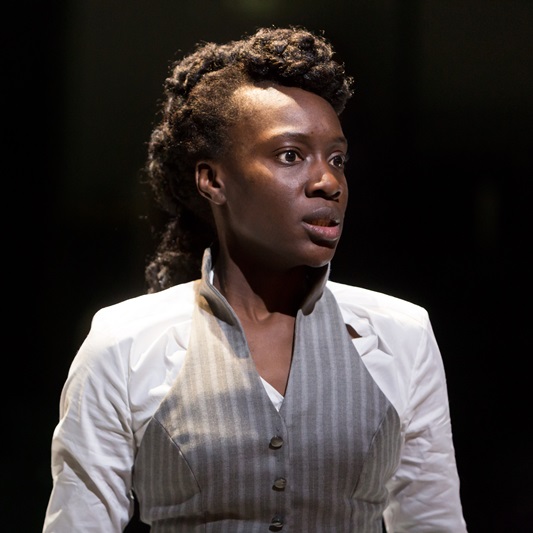
Tolstoy’s classic tale of blighted love gets a stripped-down, eclectic interpretation at the Exchange, replete with multi-ethnic casting and a selection of accents that range from deepest cockney to broad Scottish. Adapted by Jo Clifford, this co-production with the West Yorkshire Playhouse casts Oblonsky (Ryan Early) as the play’s occasional narrator. Rakish and dissolute though he may be, (Early’s playful performance is one of the production’s strongest cards) he’s also the only character here who actually seems to be enjoying himself. Elsewhere all is woe and misery.

Anna (Ony Uhiara) is a faithful and dutiful wife, happy with her marriage to the older Karenin (Jonathan Keeble) until she sets eyes upon the dashing Count Vronsky (Robert Gilbert), the moment accentuated by the use of a dazzling spotlight beamed in from outside the performing area. She embarks on an affair which will have catastrophic consequences for her and those around her. Production designer Joanna Scotcher has chosen a minimalistic set, through which run a set of train tracks along which a pair of tables are pushed backwards and forwards across a central pit of earth. Through the course of the action, the latter is used to represent the earthy attributes of the likeable but muddled Levin (John Cummins), the grubby stigma attached to a married woman carrying on so brazenly and it even provides the opportunity for Karenin to (quite literally) sling some mud at his unfaithful wife. It could be argued that this symbolism is somewhat overused (and it must have been a nightmare for the play’s costume department!) but it would have been nice to see a couple of bigger set-pieces along the way – the death by train that kicks proceedings off is criminally understated and the famous horse race that is the story’s centrepiece requires all our powers of imagination to envisage.

That said, this is an accessible production of what can, in the wrong hands, be a rather ponderous story. Clifford’s skilful script clearly delineates the various strands of the tale and over the space of nearly three hours, proceedings never lose pace. It’s interesting to note that six members of the same cast will be taking on the Bruntwood Prize-winning play The Rolling Stone from Tuesday 21st of April.

4 stars

Philip Caveney

Scuttlers

JS55497410

10/02/15

Royal Exchange Theatre, Manchester

A brand new play that explores the origins of Manchester’s original street gangs, Scuttlers by Rona Munro, is set in the year 1885, but incorporates echoes of the city’s more recent riots. It’s a big, urgent production, stunningly choreographed by Eddie Kay of Frantic Assembly and featuring a cast of over 40 young actors, who race restlessly back and forth across the Exchange’s circular set, propelled along by Denis Jones’ pulsing, electronic score, which incorporates the clanks and rattles of  machinery.

In the heat of summer, two street gangs are edging closer and closer to violent confrontation. The Bengal Street Tigers, led by Sean (Bryan Parry) are preparing to take on their sworn enemies, the Prussia Street gang. Former Tiger, Joe (Tachia Newall) is now a respectable soldier and the father of a baby with local nurse Susan (Anna Krippa), but he has changed his allegiance and now supports Prussia Street. Meanwhile, ‘Tiger cubs’ Margaret, Polly and new girl Theresa, are every bit as committed to their gang as any of their male counterparts. Then along comes Thomas (David Judge) a seemingly mild-mannered lad, but one who is determined to emulate his dead father and be the ‘King’ of Bengal Street. When the cotton mill that employs virtually everyone in Ancoats closes for a three day break, it’s clear that a final showdown is long overdue…

Scuttlers has much to recommend it, though the story itself has an overly familiar feel and the tragic conclusion isn’t really the shocking surprise it ought to have been. It also doesn’t help that some of the dialogue is occasionally swamped by the score, but that’s doubtless something that will improve as the production settles into its stride. Production wise, there are some real delights here. I loved the central ‘loom’ design that could be adapted to provide suggestions of other locations and the unexpected appearance of a rain storm with real water, definitely had the ‘wow’ factor. I also loved the play’s conclusion as a stream of restless walking characters segued into the present, period clothing giving way to hoodies, trainers and mobile phones.

This is strident exciting theatre, well-suited to a younger audience, which I hope it manages to connect with. I only wish the storyline was as innovative as the wonderful choreography and theatrical effects.

3.7 stars

Philip Caveney

Cat on a Hot Tin Roof

Unknown

Royal Exchange Theatre, Manchester

14/11/14

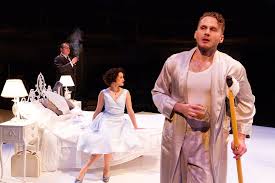
James Dacre’s production of Cat on a Hot Tin Roof is assured and confident, aided not inconsiderably by Mike Britton’s simultaneously stark and sumptuous set. The oppressive heat of the American Deep South is almost palpable, despite the cold reality of a November evening in Manchester. The lazy whirring of the inevitable ceiling fans and the glare of imagined sunshine from the gloss-white floor combine to create a drunken, languorous atmosphere seething with repressed emotion: the calm that comes before the storm.

Last night’s performances were solid: if Marian Gale (as Maggie) took a while to settle into the rhythm of her desperate stream of words, she made up for it in later scenes, where the raw emotion of unrequited love was beautifully expressed. Big Mama (Kim Cresswell) was a suitably unpleasant recipient for Big Daddy (Daragh O’Malley)’s crass indifference; Matthew Douglas and Victoria Elliott, as Mae and Gooper, provided a welcome respite from the play’s essential brutality, with their obnoxious brood of no-neck singing brats (think Sound of Music without the heartwarming stuff). The scenes where Brick (Charles Aitkin) was lying on the floor at Big Daddy’s feet, helpless without either his literal or his alcoholic crutch, brought home the importance of Williams’s theme: if Brick’s love for Jack Skipper had been allowed to thrive in the open, how much less destructive for all concerned.

Cat on a Hot Tin Roof is undoubtedly a miserable play, with little in the way of relief, and this production was certainly not to everybody’s taste last night. Three people sitting behind us left during Act 1 (one of them actually exiting through the set) to go for a cigarette, although they (unlike the couple sitting next to us) did at least return for the second act. Still, somebody in the audience clearly liked it enough to start taking photographs towards the end; the flash was distracting for us in the audience; goodness knows how irritating it was for the actors trying to focus on their lines.

All in all, this was an interesting – if ultimately unexciting – production. A faithful representation of a strange and turbulent play.

3.2 stars

Susan Singfield

Around The World In 80 Days

10435070_10204518047729805_4711626084637840170_n

19/07/14

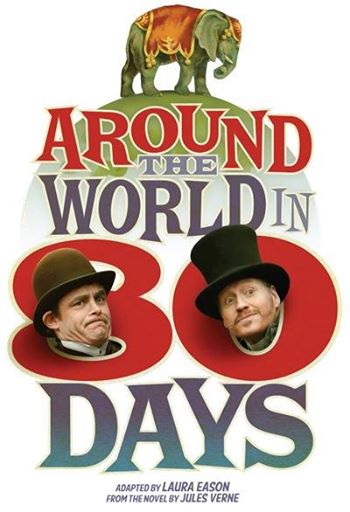
Around The World In 80 Days (Royal Exchange Theatre, Manchester) is a brilliant adaptation of Jules Verne’s classic novel, expertly pitched to appeal to the widest possible audience. I can’t remember when I last laughed so hard (and so often) at a theatrical presentation. Of course, any production of this story is going to stand or fall on the quality of its Passepartout and here, he’s played by Michael Hugo, who clowns (and occasionally improvises) his way through a breathless series of set-pieces, whilst maintaining an assured partnership with Andrew Pollard’s stiff-upper-lipped Phileas Fogg.

Though undoubtedly the star here, Hugo is only the jewel in a supremely talented cast. Six other actors take on all the remaining roles, which averages out at around twenty characters apiece! Between them they take on accents, characters and at one point even submit some breathtaking gymnastics. The constantly changing locations are achieved with a minimum of fuss and the use of some everyday objects – in one scene a (surprisingly convincing) Indian elephant is expertly conjured with the use of a grey raincoat and some sound effects.

And it doesn’t stop there. At various points we share the experience of travelling by train, ocean liner and ice sledge and it really feels like we’re doing it! Throughout proceedings, Hugo maintains a fabulous rapport with the audience, at one point even involving younger members to help him to evoke the feel of a ship at sea. A scene where he channels his inner Jackie Chan to offer some kung-fu style choreography was a particular delight. At the play’s conclusion the applause was absolutely ecstatic and little wonder, as this is a production that seems intent on redefining the word ‘entertainment.’ If you see only one play this summer, I urge you not to miss this. It really is THAT good. Those of you with young children can confidently take them along in the certain knowledge that they won’t be bored for a moment.

5 stars

Philip Caveney