Roger Deakins

Empire of Light

03/01/23

Cineworld, Edinburgh

Sam Mendes’ Empire of Light is essentially a passionate love letter to the cinema, the kind of film that could have created with me – or somebody very like me – in mind

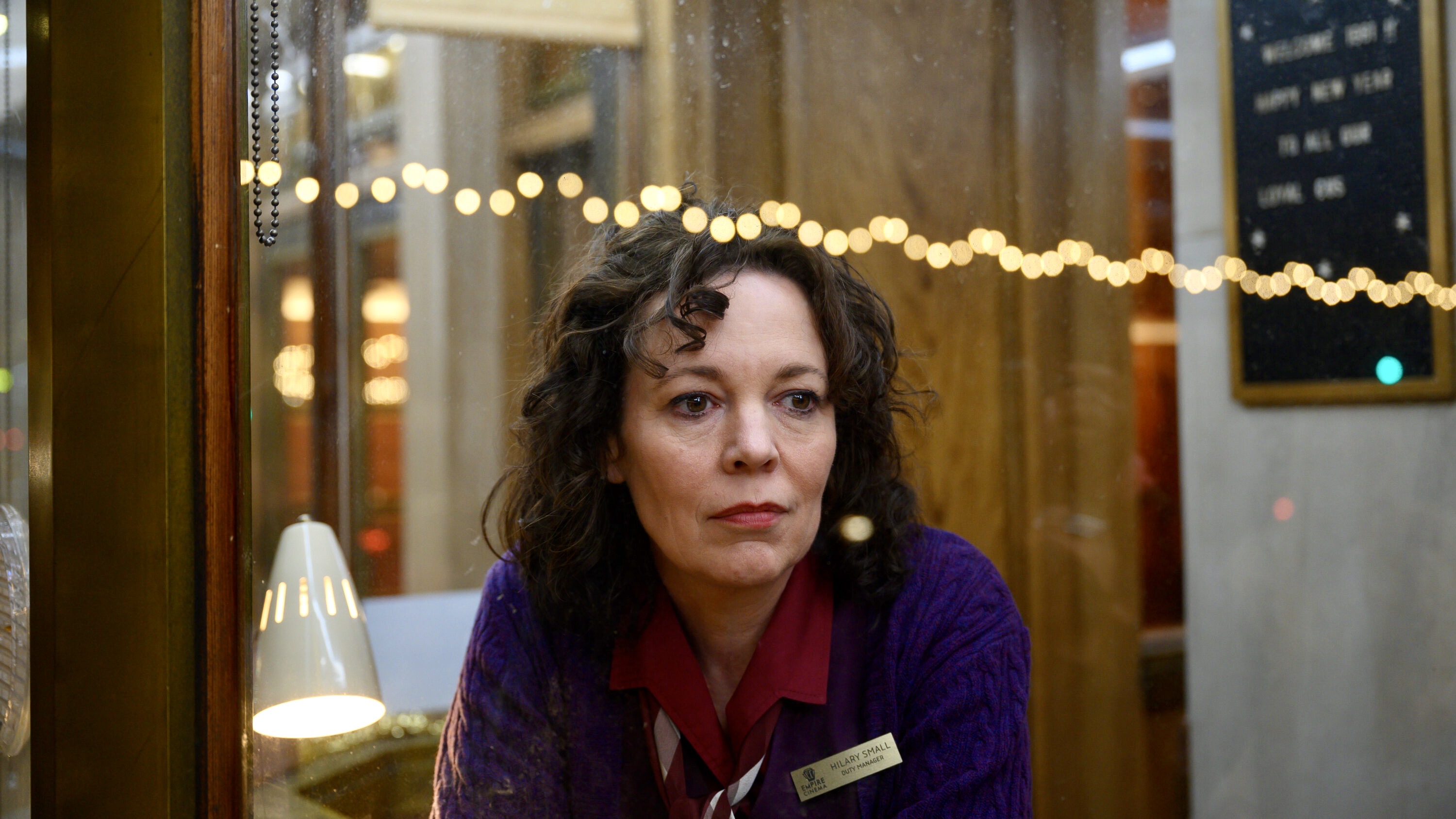
It’s 1981 and, somewhere on the south coast of England, the Empire cinema, a magnificent but now somewhat dilapidated Art Deco picture house, proudly announces its current offerings: The Blues Brothers and All That Jazz. Filmed on location in Margate, the atmosphere of the era is convincingly evoked, right down to the last detail. Here is the age of Thatcherism, a time when fascism, in the form of skin head culture, was in the ascendent. But, within the sheltering walls of the Empire, deputy manager Hilary (Olivia Colman) and her team of social misfits seem inured to change, even though two of their four screens are now permanently closed.

Hilary is occasionally expected to find time to pop up to the office of sleazy manager, Mr Ellis (Colin Firth) – for a joyless sexual fumble on his desk. Ellis is married and it’s supposed to be a secret but – of course – the others are well aware of what’s going on. A change is signalled by the arrival of new employee, Stephen (Micheal Ward), a handsome young Black man with a liking for Two Tone music. When Hilary shows Stephen around the derelict, pigeon-infested ballroom on the top floor, something clicks between them…

At a time when streaming is increasingly becoming the norm, it seems doubly poignant when projectionist Norman (Toby Jones) explains how moving pictures employ a simple trick to deceive the viewer’s eyes into thinking they are watching something more than a long series of still photographs. We occasionally see him in his booth, the walls plastered with images of movie stars from across the eras, meticulously directing images from his 35 mm reels onto a giant screen. The moment is mesmerising and it’s a timely reminder that cinema itself is in danger of suffering the fate of the dinosaurs.

Beautifully shot by Roger Deakins and written by Mendes, Empire of Light is compelling, and at times overpoweringly poignant. I almost get tired of praising Olivia Colman, but – from Tyrannosaur onwards – she has offered up a series of extraordinary screen performances and Hilary may be her best character yet. She’s complex and unpredictable, vacillating from joyful enthusiasm to vengeful anger. You believe in her implicitly and, furthermore, I’ve rarely seen mental illness presented with such skill, such gentle acceptance. Much of this is due to Mendes’ nuanced script, and the fact that the director’s own mother struggled with her mental health may have instructed his writing. Stephen too is a compelling character, somehow managing to operate through the hateful levels of racism he experiences on a daily basis, keeping his gaze firmly fixed on a brighter future.

This charming and affecting movie has me entranced from its opening shot to its final frame and I suspect that anybody with a genuine love of film is going to have a similar experience. Go and see it – in the cinema, please!

5 stars

Philip Caveney

1917

10/01/20

Blame Orson Welles. 

In his 1958 film, Touch of Evil, he decided to kick proceedings off with a twelve minute continuous tracking shot and, in doing so, opened future filmmakers up to the idea of what might be done with the concept once technology had made it easier to accomplish such marvels. 

In 2016, Sebastian Schipper finally took the idea to its logical conclusion with his low-budget thriller, Victoria, a nail biting two hours and 18 minutes filmed in one continuous take. Surely, there was nowhere else left to go?

Clearly, nobody told Sam Mendes. 1917, based on stories told to him by his grandfather, a World War 1 veteran, isn’t quite a single take movie – it really couldn’t be, not on the scale envisaged for this epic drama – but it is composed of several lengthy tracking shots, cunningly spliced together to make it look like a seamless sequence. There’s only one (intentionally) obvious cut in its entire run, which – given the story’s circumstances – seems entirely justified. 

There’s no time wasted on needless exposition. We are quickly introduced to the two protagonists who will lead us through the story. They are Blake (Dean-Charles Chapman) and Schofield (George MacKay), two young soldiers, who – within minutes of the film opening – have been charged with a monumental task: to travel miles across enemy-occupied territory to call off a planned attack by another division, set to occur the following morning. Aerial surveillance has exposed the endeavour as a carefully laid trap, the Germans forces giving the appearance that they are in retreat when, in fact, they are primed to exact a punishing slaughter. To add extra jeopardy to the situation, Blake’s older brother is serving with the battalion that is about to go over the top. If the message doesn’t get through in time, sixteen hundred men will be needlessly massacred…

And, in terms of plot, that’s all you need to know. With the clock ticking, the two men set off along the crowded trenches until they reach the final outpost and are obliged to walk across no-man’s land, weighed down by the awful knowledge that every moment of delay brings disaster a step closer.

Roger Deakins’ cinematography is a thing of wonder. I soon forget the gimmick (because a gimmick; it most certainly is) and find myself caught up in the almost unbearable suspense of the situation. 

This is a war movie that feels horribly immersive. The distance between the screen and my seat seems non-existent and I am in those trenches along with the protagonists, wading through mud and across rat-ravaged corpses. I am dodging bullets and bursts of shrapnel; I am shivering with cold and running frantically past blazing buildings, stranded amidst the architecture of a world gone mad. Yes, this is undoubtedly a technological marvel but, more importantly, it is a riveting, pummelling experience that drives home the horror and futility of war. Lest I make it all sound unbearable, let me add that there are a couple of instances of unexpected beauty in this film, scenes where elements of nature and the resilience of humanity shine like jewels amidst the smoke and devastation.

A whole host of top-flight actors put in cameos as commanding officers, but it’s the two young leads who carry this film and it’s easy to see why it has already earned itself a well deserved ‘best picture’ award at the Golden Globes. 

For all the razzmatazz of its structure, it’s inevitably story that comes first and this delivers at every level, resulting in the first truly unmissable film of 2020.

5 stars

Philip Caveney