Riley Keough

Sasquatch Sunset

15/06/24

Cameo Cinema, Edinburgh

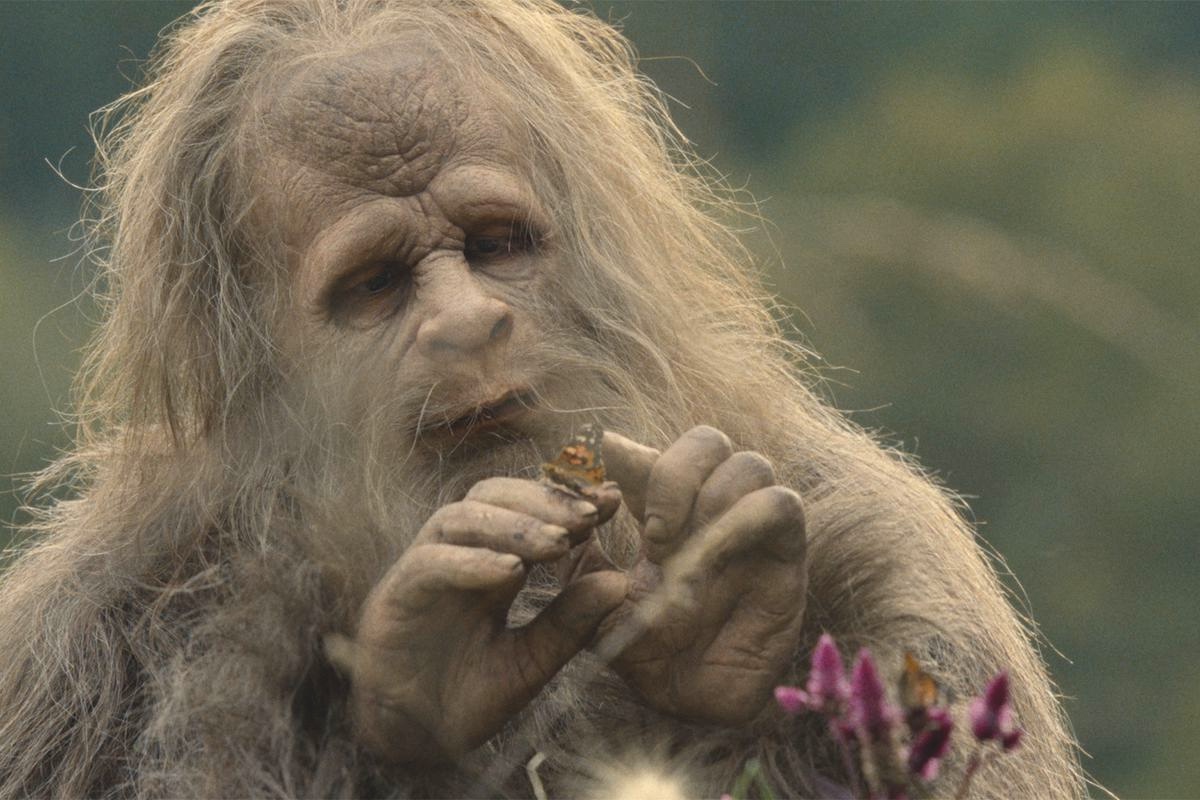
There’s a charming idea at the heart of Sasquatch Sunset, which follows, season by season, a year in the lives of four sasquatches (sasqui?). They live in a remote forest somewhere in North America. There’s an alpha male (Nathan Zellner), a beta male (Jesse Eisenberg), a pregnant female (Riley Keough) and a child (Christophe Zajac-Denek) and the four of them amble around the forest, foraging for food, attempting to procreate and every night constructing a crude shelter in which to sleep. They also spend time thumping tree trunks with branches in an attempt to contact others of their species – with no success.

The conceit of this film, conceived and directed by Nathan and David Zellner, is to treat it with all the seriousness of a nature documentary and, as our four protagonists go about their shuffling business in the tranquility of various woodland settings, there are indeed moments of wry amusement and occasionally some suspense as they stumble into peril.

The creature makeup is pretty convincing – though the film’s budget clearly didn’t extend to making a new-born sasquatch look convincing – and there are surely some cogent observations about the process of survival that can easily be extended to endangered species in the real world. Sasquatch Sunset is, I suppose, an allegory and it doesn’t take a Sherlock Holmes to work out what it’s really about.

But ultimately, there isn’t really enough here to fill the film’s (relatively short) running time and, by the halfway mark, I find myself longing for some more progression. Though the film flirts with the possibility of the creatures encountering humans, this never happens. It would have made an excellent short but, to my mind at least, as a feature-length movie it feels like an interesting failure.

2.8 stars

Philip Caveney

The Devil All the Time

23/09/20

Netflix

Imagine the vibrant Americana of the Coen Brothers, twisted into a seething vat of venomous corruption and you’ll pretty much have the measure of The Devil All the Time. Directed and co-written by Antonio Campos and based on a novel by Donald Ray Pollock (who serves as our narrator), this is a multi-layered, labyrinthine slow-burner of a film, where a whole string of characters are linked by a series of weird coincidences. In Pollock’s bleak world view, the blame for most of the evil that plagues humanity can be laid squarely at the door of organised religion.

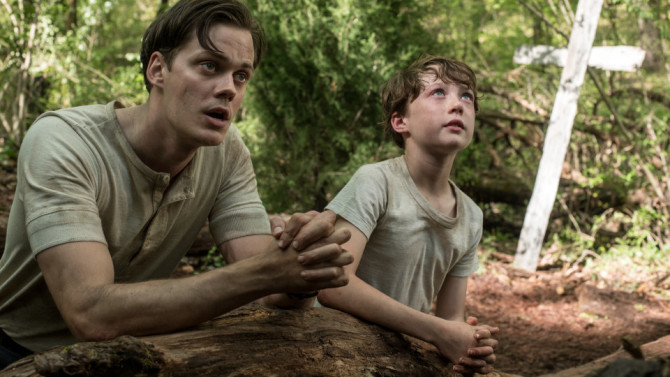
The central character, Arvon Russell (Tom Holland), is one of the few sympathetic human beings in this narrative, and even he is someone given to Old Testament levels of brutality towards anyone who wrongs his much-loved step sister, Lenora (Eliza Scanlen). Arvon’s violent tendencies stem from the treatment he received from his God-fearing Dad, Willard (Bill Skarsgard), who very much believed in the eye-for-an-eye approach and whose treatment of the family pet is particularly hard to stomach. Lassie Come Home, this really isn’t.  

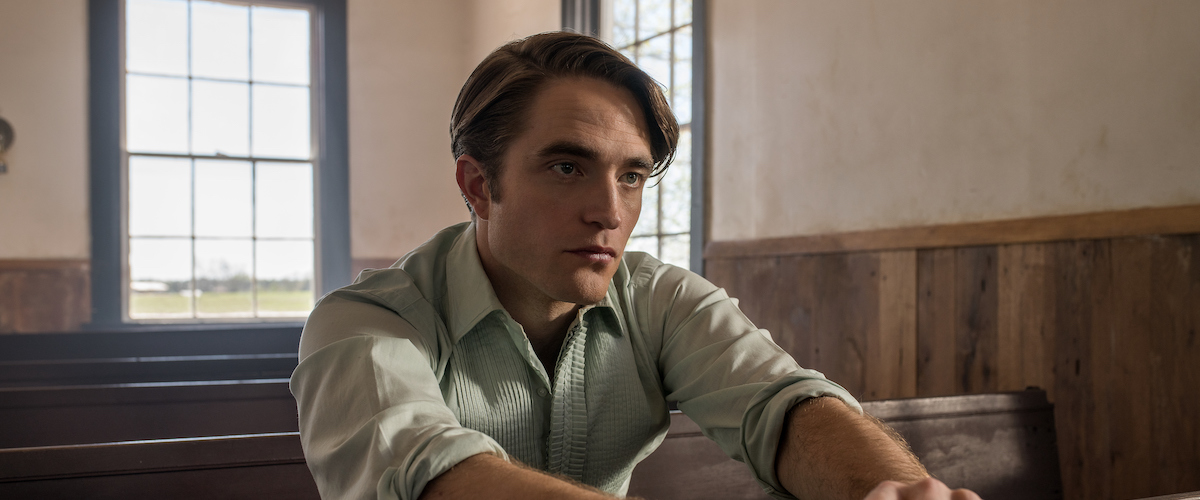
Elsewhere, we encounter the Reverend Preston Teagarden (Robert Pattinson), a sleazy preacher with a predilection for seducing young girls: crooked cop Lee Bodecker (Sebastian Stan) who’ll do whatever is necessary to further his ambitions, and a particularly vile couple, played by Jason Clarke and Riley Keough, who get their kicks from picking up young male hitchhikers…

On paper, it all sounds rather relentless but, unfolded as it is in a slow, measured narrative, it’s a surprisingly powerful brew. As Arvon is led inexorably deeper and deeper along the path to retribution, I find myself gripped right up to the final credits. It helps that a whole menagerie of talented actors submit nuanced performances here, particularly Holland who proves beyond a shadow of a doubt that there’s a lot more to him than slinging webs.

This may not be to everybody’s taste. As a vision of the United States, there’s little here resembling any kind of hope for the country’s collective soul. Indeed, it is a tale so excoriating, so morally bankrupt, that you can only feel a nagging worry for the society that spawned it. 

The Devil All the Time is a Netflix original, ready to watch whenever you have the time, or the nerve, to take it on.

4.2 stars

Philip Caveney

It Comes at Night

11/07/17

What is the disease that’s afflicting America? In Trey Edward Schults’ stylish dystopian fear-flick, it appears to be an airborne virus that’s decimating the population, and isolating survivors. Joel Edgerton stars as Paul, an ex-history teacher holed up in his family home with his wife, Sarah (Carmen Ejogo) and their teenage son, Travis (Kelvin Harrison Jr.). They’re paranoid and distrustful, trapped in their sealed sanctuary, donning gas masks and carrying guns whenever they’re compelled to venture into the outside world.

Staggering into this powder-keg of neuroses is Will (Christopher Abbott), desperately seeking shelter for his young family. He, his wife, Kim (Riley Keough), and their infant son, Andrew (Griffin Robert Faulkner), are reluctantly invited to move in, albeit with very strict parameters. But things are bound to go wrong.’Trust no-one,’ Paul tells Travis. ‘You can’t trust anyone except your family.’ Suspicion and wariness pervade every interaction: it’s a recipe for disaster.

The film is fiercely intense. Okay, so the allegory isn’t particularly subtle: the fear and ‘othering’ of outsiders is, in fact, the disease – and it’s the same one that’s afflicting the real America today. Scare-mongering about refugees, seeking to impose travel-bans: these isolationist behaviours do not auger well. Without trust and cohesion, society can’t work.

It’s a tightly crafted film, with a real sense of claustrophobia throughout. Kelvin Harrison Jr. is particularly mesmerising as the teenage boy, struggling to mature in a disintegrating world with no peers with whom to compare experiences.  And I like that there are no ‘baddies’ here, just individuals seeking to protect themselves and their families, unwittingly destroying all that they hold dear. As their circle shrinks ever smaller, there is less and less to hold on to, and the ending (which I won’t spoil here) is beautifully bleak.

This is a sly, thought-provoking little film, with plenty to ponder and discuss after the credits roll.

4.2 stars

Susan Singfield