

Richard E Grant

Nuremberg

22/11/25

Cineworld, Edinburgh

It’s 1945 and, in the midst of the chaos following the end of World War 2, Reichsmarshall Herman Göring (Russell Crowe) surrenders to American troops (although he makes it blatantly clear that he still expects them to carry his suitcases). When the news reaches United States Supreme Court Justice Robert Jackson (Michael Shannon), he begins to draw up plans for an International Military Tribunal, which will charge Göring and other surviving Nazi leaders with war crimes – and what better place to enact this than in the venue where the late Adolf Hitler held his infamous rallies in the 1930s?

Jackson takes a leave of absence from the supreme court and meets up with British prosecutor, Sir David Maxwell Fyfe (Richard E. Grant), who will assist him in trying the case. He also enlists the services of army psychiatrist, Douglas Kelly (Rami Malek), who – assisted by German-English translator, Sergeant Howie Triest (Leo Woodall) – will attempt to get to know Göring and the other captured Nazi leaders before the trial begins. Maybe the old proverb about knowing your enemies will be useful. Besides, Kelly has ideas about writing a best-selling book afterwards.

He begins to make progress with Göring and tells himself that the two of them have established the basis of a genuine friendship – but he will come to learn that Göring has his own agenda…

Nuremberg, written and directed by James Vanderbilt, has some big boots to fill. Many people remember Stanley Kramer’s 1961 movie, Judgement at Nuremberg, long regarded as a cinematic milestone – and I have to admit that, based on his recent screen outings, I have big doubts about Russell Crowe taking on such a difficult role. So I’m both surprised and delighted to say that I’m impressed by the film and by Crowe’s performance which captures Göring’s smirking, confident persona with genuine skill. Shannon is quietly magnificent in his role and Grant is handed a fabulous cameo courtroom scene, which he handles with his usual aplomb. Malek is often accused of over-acting but he does a good job here too, showing how Kelly’s ambitions destroy his own future.

I won’t pretend that this is an easy watch. The latter stages of the trial include the showing of genuine footage from concentration camps and there’s been no attempt to soften or obscure the devastating images they contain. I spend much of the film fighting back tears as I watch the horrors unfold. But the scenes are shown so unflinchingly to make a really important point: that the evils that men do are not carried out through devotion to a cause, nor for the greater good of the world. Such crimes are enacted because of greed, and because there are people who see such brutality as merely a means to an end, a way to further their own unspeakable agendas.

So my advice would be to steel yourselves and go and see Nuremberg. Then think about where the world is now – and how perilously close we are to allowing such horrors to proliferate once again.

4.4 stars

Philip Caveney

Saltburn

22/11/23

Cineworld, Edinburgh

Emerald Fennell’s second film shares some DNA with her debut: they’re both stories of revenge writ large, of simmering grievance metamorphosing into violence. But, while Promising Young Woman was an out-and-out success, Saltburn is more of a mixed bag.

Oliver (Barry Keoghan) is a fish out of water at his Oxford college. Not only has he made the terrible faux pas of devouring every book on the summer reading list, he’s also got a Scouse accent and his tuxedo is rented. “The sleeves are too long,” sneers his tutorial-mate, Farleigh (Archie Madekwe). “Still, you almost pass.” Frustrated by his outsider status and bored rigid by Jake (Will Gibson), apparently the only other non-posh person in the city, Oliver becomes obsessed with Felix (Jacob Elordi), insinuating himself into the young aristocrat’s circle. Felix warms to Oliver, taking him under his wing and inviting him to spend the summer at his family home. Oliver is delighted: the titular Saltburn is a bastion of excess and he is more than ready to indulge himself. But, as the weeks slip by and real life looms, things begin to take a darker turn…

The first third of this film is anachronistic. It’s supposed to be set in 2006, but the Oxford we see here feels like a throwback to the 1920s. Although there’s no denying that the university is still disproportionately posh, by the time the movie’s events occur, about 50% of Oxford undergraduates came from state schools (the figure is 68% now) – and, even among those who were privately educated, only a tiny number were as privileged as Felix and his friends. I find myself rolling my eyes at the idea that Oliver and Jake might stand out amongst their peers, or that anyone would notice them enough to bellow “scholarship boy” as they pass by. It’s unnecessary too: Oliver’s desire to move in Felix’s orbit doesn’t need to be dependent on the absence of any other working or middle-class people.

When the action moves to Saltburn, things improve dramatically – although the sense of stepping back in time might be heightened if Fennell were more effective in capturing the early noughties in the opening stretch. Here we meet Felix’s parents, Sir James (Richard E Grant, on top form) and Elspeth (played with obvious glee by Rosamund Pike). “Mummy” is the best thing about the whole movie, delightfully lacking in self-awareness, blithely callous in every word and deed. She gets the funniest lines too, and Pike delivers them with deadly precision: when Elspeth hears of her erstwhile friend’s death, for example, she responds with a scathing, “She’ll do anything to get attention.”

If the revenge, when it comes, is faintly ridiculous, then it’s found a suitable home in Saltburn, where everything is magnified, where there’s too much space, too many artefacts, too many people and too much money. The house and grounds provide a perfect backdrop for this illustration of careless privilege, and Linus Sandgren’s cinematography is almost hallucinogenic, reinforcing the sense of dislocation from the outside world.

Of course, there are many ways to read this sly, allusive story, with its Brideshead references and satirical tone. The most generous interpretation is that the joke is on the upper classes, depicted here as shallow and vacuous, playing games with other people’s lives to relieve their louche ennui. But it also comes across as a warning to the toffs to beware the pesky proles. Give us an inch and we’ll take a mile; we just don’t know our place. Fennell (whose own rarefied life is far closer to the Cattans’ than to Oliver’s) reveals an unfortunate blind spot when it comes to class. Elspeth references Pulp’s Common People early on, refuting the idea that the lyrics refer to her. “No, it wasn’t based on me. She had a thirst for knowledge. I’ve never wanted to know anything.” But there are a few lines later in the song that are perhaps more relevant: “Like a dog lying in a corner, they will bite you and never warn you. Look out! They’ll tear your insides out.” There appears to be an underlying (perhaps unconscious) snobbery at play.

Despite its dodgy subtext, Saltburn is a curate’s egg of a movie, with some very good parts indeed, and the final sequence – set to Murder on the Dancefloor – is utterly glorious. I look forward to what Fennell does next, albeit with some trepidation.

3.3 stars

Susan SIngfield

The Lesson

24/09/23

Cineworld, Edinburgh

The Lesson is one of those films that’s hugely enjoyable while you’re watching it, but falls apart when you try to analyse it – a bit like the airport novels its antihero, JM Sinclair, so witheringly disparages.

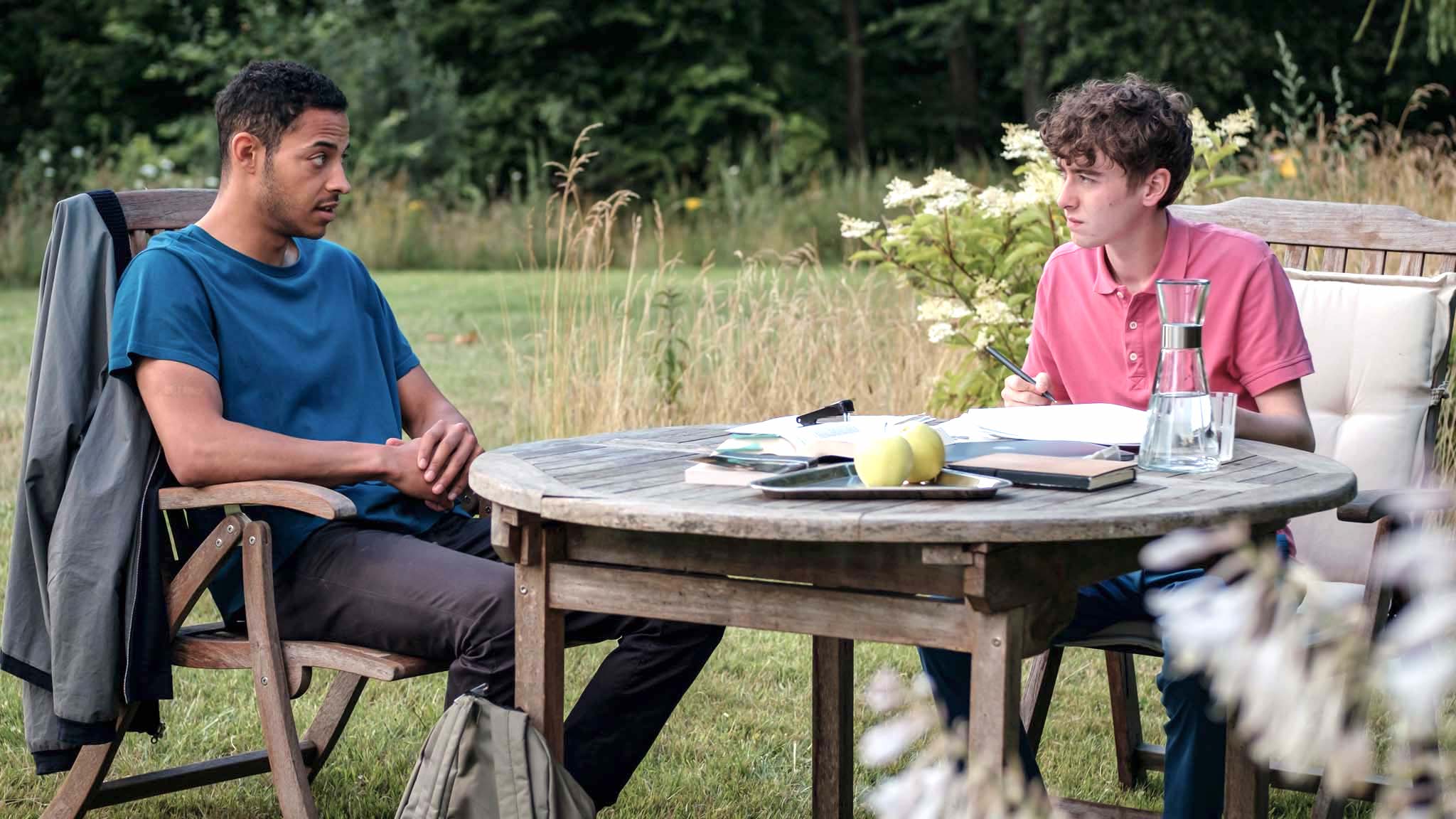
Sinclair (Richard E Grant) is a novelist of some renown – indeed, he is the subject of Oxford graduate Liam (Daryl McCormack)’s PhD thesis – but it’s been five years since he published anything. Since the death of his elder son, Felix, JM has been struggling; he writes daily, late into the night, but he just can’t finish his latest book. Meanwhile, his wife, Hélène (Julie Delpy), is determined that their younger son, Bertie (Stephen McMillan), should get into Oxford to study English literature, a feat which – despite his expensive schooling and obvious intelligence – can apparently only be accomplished by hiring a private tutor.

Enter Liam.

At first, the job seems like a dream come true. The Sinclairs live in the lap of luxury, their large country home filled with impressive artwork and attentive staff. Liam lodges in the guest house, swims in the lake, eats dinner with his idol and gets on well with Bertie; he even has time to finish his own first novel. But JM turns out to be a bruising presence and the family bristles with unhappy secrets; it doesn’t take long for the idyll to sour.

McCormack is a mesmerising screen presence (he surely has a big career ahead of him) and Grant, of course, is never less than interesting. Delpy imbues Hélène with an unsettlingly dispassionate and watchful air, while McMillan plays the innocent very convincingly – so that, no matter what chicanery is exposed, there’s someone we want to see being saved.

Director Alice Troughton does a good job of building the suspense: there’s a genuine sense of threat and the character dynamics are nicely drawn. The script, by Alex MacKeith, has some excellent moments, but also throws up some problems, not least the improbability of Liam’s ability to remember every word he’s ever read, on which the plot hinges. What’s more, although there are some genuine surprises, the main reveal is obvious from very early on, and there are several other details that just don’t ring true.

All in all, although The Lesson has its moments, it doesn’t quite live up to the movie it could be.

3.1 stars

Susan Singfield

Can You Ever Forgive Me?

02/02/19

Can You Ever Forgive Me? is a fascinating tale, as much about the spurious nature of ‘worth’ as it is a personal memoir of triumph and degradation. We enter the obscure world of literary memorabilia, where trite postcards or carelessly dashed-off letters command big bucks, just so long as they’re written by a person of note. A thank you card from Noël Coward? That’ll be six hundred dollars, please. And if Coward didn’t actually write it? Well, what’s the difference, really?

Lee Israel, played here with real aplomb by Melissa McCarthy, is a biographer, justifiably proud of her published work, but dismayed to see her stock falling. Having hit the dizzy heights of the New York Times Best Sellers list with her 1980 book about Dorothy Killigan, she’s devastated when her next project, about Estée Lauder, is a flop. Her bitchy agent, Marjorie (Jane Curtin), stops taking her calls, and laughs openly at Lee’s ideas for future work. Unable to afford the vet’s fees for her beloved cat – or, indeed, to pay her rent – Lee starts to look for other ways to turn a buck.

Israel is a complex character: prickly, tough-talking and isolated, proud of her abilities but unsure of how to make them pay. She’s not especially likeable: she drinks too much; she’s sarcastic; her apartment is filthy and covered in cat shit. And, when the going gets tough, she turns to crime. It’s to McCarthy’s great credit that she imbues the troubled author with enough pathos and vulnerability that we find ourselves rooting for her, willing her to find a way out of her situation. This is helped in some measure by Israel’s putative (and fictional) relationship with a sweet-natured bookseller, Anna (Dolly Wells), which allows us to see how self-destructive Israel is, and how lonely she makes herself.

Still, every crook needs a partner in crime, and Israel’s is Jack Hock, a drinking buddy with whom she develops a friendship of sorts. It’s great to see Richard E. Grant back in a role he can relish (because, let’s face it, he’s not been given much to get his teeth into since Withnail), and he certainly makes the most of the opportunity to show off his acting chops. This is true of McCarthy too, whose performance here has far more depth and subtlety than most of the rumbustious comedic turns she’s previously been noted for.

Israel’s aptitude for forgery is rooted in her real writing skills, and she takes a perverse pride in possessing a wit caustic enough to pass for Dorothy Parker’s, arch enough to pass for Coward’s. There’s a sense here of a woman taking revenge on a literary world that has spurned her, exposing the stupidity of the very people who say she’s not good enough. Director Marielle Heller does a good job of quietly teasing out these themes, and the film is tightly constructed, with every scene earning its place.

Can You Ever Forgive Me? is a first-rate movie and one which is, ironically, likely to make the value of an authentic Lee Israel forgery soar. Now, where can I get hold of a typewriter?

4.3 stars

Susan Singfield


The Nutcracker and the Four Realms

11/11/18

It’s early November and I’ve just been to see what is, for me, the first Christmas-themed movie of the year. Perhaps it’s more of a reflection on me than the season in question, but it still feels much too soon. However, I buckle myself in and watch Disney’s latest release, The Nutcracker and the Four Realms. The first thing to say about the film is that it’s undeniably opulent. The screen virtually pulsates with light and colour and general sparkliness. Overall, however, it puts me in mind of a gigantic glittering Christmas bauble, delightful to look at – but completely empty at its core.

This is the story of Clara Stahlbaum (McKenzie Foy), a teenage girl still mourning the recent death of her mother and feeling somewhat aggrieved when her gloomy father (Matthew MacFadyen) expects her to attend the huge Christmas ball they go to every year and look as though she’s enjoying herself. Before they leave for the ball, Mr Stahlbaum hands out presents to Clara and her siblings, gifts that have been left for them by their mother, who, it turns out, was an inventor. Clara is bequeathed some kind of a jewelled egg with a lock on it – but alas, there’s no key. However, if anyone knows how to unlock the egg’s secret, it’s the mysterious toymaker, Mr Drosselmeyer (Morgan Freeman), who’s hosting the ball tonight.

At the party, there’s a hunt for the various gifts that Mr Drosselmeyer has created for the visiting children. In search of her own present, Clara follows a length of ribbon out into the garden, through a maze and into a mysterious alternate world, where lie the Four Realms of the title. She soon discovers that her late Mother once ruled as Queen here. Now, with the help of Nutcracker Soldier, Philip (Jaden Fowara-Knight),  ‘Princess Clara’ has to resolve a quarrel that has plunged the different realms in to war.

There’s a ridiculously starry cast involved in these shenanigans  – Keira Knightly as Sugarplum, Helen Mirren as Mother Ginger and Richard E Grant as er… Shiver. Lots of other big names make fleeting appearances too, albeit for no good reason. The special effects are, of course, beautifully realised, but there’s little contrast between the magical world and the one that Clara has recently vacated. Furthermore, there’s no disguising the fact that this is just sumptuous fluff that doesn’t manage to field one single, original idea, repeatedly falling back on over-used fridge magnet messages – ‘the power is within you, Clara… you just need to learn to love yourself…’ and so on and so forth. Ad infinitum.

Look, I fully appreciate that this film isn’t aimed at somebody like me and, if I were an eight-year-old child, it’s quite possible I’d emerge from this feeling that I’d been thoroughly entertained. As it stands, I find TNATFR as tedious as its overworked title. There is a nice ballet sequence to accompany the end credits but, since members of the audience decide to chatter all the way through it, that’s a little squandered too.

A treat for young children only. Accompanying adults (and even discerning teens) might prefer to seek out something more original for their festive entertainment.

2.8 stars

Philip Caveney


Withnail and I

22/05/18

It’s always interesting to revisit an old favourite. You’re never entirely sure how well it’s going to hold up after the passage of so many years. Withnail and I (1987), shown here in a spanking new high resolution print, is a good case in point. I saw it on its first release when working as a reviewer for Manchester’s City Life Magazine and fully remember being absolutely blown away by it, laughing hysterically from start to finish. Though I’ve seen it a few times on TV over the years, it is great to have the opportunity to watch it again, as it was always intended to be seen.

Set in 1969, at the fag end of the hippie movement, it concerns two ‘resting’ actors residing in a dilapidated London flat, both of them dreaming of theatrical success and in the meanwhile going about the nearly full time task of getting themselves thoroughly wasted. After which, needing a break, they go on holiday in the country ‘by mistake.’

The role of Withnail provided Richard E. Grant with a stunning cinematic swansong and launched him on a long and varied career which continues to this day (though it’s sobering to reflect that in everything he’s done since, he never again had a role as downright memorable as this one). As his friend and flatmate, Paul McGann is so much more than just a foil. His bleak voiceovers are the glue that holds this shambolic series of misadventures together and his total incomprehension of his friend’s selfish, venal and manipulative habits is always a source of considerable merriment. Whilst we’re handing out the plaudits, let’s not forget Ralph Brown’s inspired turn as drug dealer and philosophiser Danny, which also provided him with a career high. Most telling of all, can there be any other film that features so many downright quotable one-liners? I seriously doubt it.

If there’s a problem with viewing a film that is so  ‘of its time’, it inevitably comes with the late Richard Griffiths’ portrayal of the predatory Uncle Monty, a rich homosexual who has set his sites on ‘I’ and means to have him by any means at his disposal. There’s nothing wrong with Griffiths’ performance, of course. Like most of his screen work,  it’s exemplary and he somehow manages to evoke genuine sympathy for a tragic character who is, more than anything else, lonely – but all that talk about buggery by force does make you feel rather uncomfortable. Is the film homophobic? Yes, undoubtedly – and I’m quite sure that, were it being shot in this day and age, writer/director Bruce Robinson would be obliged to rein in certain aspects of his script. Sadly, Robinson too never fulfilled the potential he demonstrated here – How To Get Ahead in Advertising, also starring Grant, was a much-anticipated misfire and the two films he’s made since then have failed to demonstrate his flair for whip-smart dialogue.

Ultimately, Withnail and I still works, even if – these days – I’m laughing more from familiarity than anything else. How great it would be to go back and view it, once again, for the very first time. It may, with the gift of hindsight, be a flawed classic – but a classic it undoubtedly remains.

4.5 stars

Philip Caveney


Their Finest

16/04/17

Ah,the British movie – still out there and still fitfully showing occasional signs of life, thank goodness. And trust me, films do not come much more British than Their Finest. (Terrible title, by the way, but based on a book called Their Finest Hour and a Half, which frankly isn’t very good either). However, the resulting film is much better than either title might lead you to expect.

It’s the early 1940s and London is suffering the worst excesses of the Blitz. Catrin Cole (Gemma Arterton) arrives for an interview at the Ministry of Information (Film Division) thinking that she’s applied for nothing more than a secretarial post, but she soon learns that she will be expected to write the ‘slop’ for the informational films the unit is currently producing. Slop, by the way, is the far from sympathetic term for anything uttered by the female actors in the films. Furthermore, Catrin is told, she obviously can’t be paid the same money as ‘the chaps in the unit’, but £2 a week sounds attractive to her, because she’s currently paying the rent on the flat she shares with her partner.

Ellis (Jack Huston), is a struggling artist who was badly injured in the Spanish Civil War and who moonlights as an (unpaid) ARP warden. The problem is he doesn’t much like the fact that Catrin is the money earner.  She finds herself seated at a desk next to opinionated young writer, Tom Buckley (Sam Claflin) and she’s soon caught up in the struggle to get across a woman’s point of view into the scripts they are producing. It’s clear too that Catrin and Sam are probably made for each other, if they would only realise it. Then, the unit’s boss, Roger Swaine (Richard E Grant), announces that a more ambitious project is in the pipeline – a true life story set against the turmoil of the evacuation of Dunkirk…

OK, there’s nothing particularly ground-breaking about this film, though it does have some decent ammunition in its armoury, not least the presence of Bill Nighy as over-the-hill actor, Ambrose Hilliard. Nighy’s scenes are probably worth the price of admission alone. He is fast approaching the role of National Treasure, an actor for whom the term ‘louche’ seems to have been specially created. His outrage at being asked to play the role of alcoholic old timer, Uncle Frank, is a joy to behold.

There are other pleasures too. The recreations of London during the blitz are nicely done, Arterton is as charming as ever and the film excels at demonstrating the arbitrary nature of life during wartime. A scene where Catrin chances on the aftermath of the bombing of a department store is very affecting. To lighten the mood, there are hilarious clips from the feature film that the unit is making, complete with dodgy miniature boats, unconvincing glass paintings of the evacuated troops and even the terrible acting of American war hero, Wyndham Best (Hubert Burton), drafted in to the movie to try and encourage the Yanks to engage with the war, raised a chuckle to two. And, just in case I’m in danger of painting this as a total laughter fest, the film also manages to lob in an unexpectedly heartbreaking emotional grenade that consequently had me in floods of tears.

All in all, this is a delightful film, well worth seeking out.

4.3 stars

Philip Caveney

Logan

03/03/17

Like many other cinema-goers, I’m getting close to superhero overload. Much as I enjoyed the output of Marvel and DC in my comic-reading childhood, the plethora of recent movie adaptations is starting to feel oppressive. But the trailer for Logan suggests that writer/director James Mangold’s take on the X-Men saga has something fresh to offer, so I resolve to give it a chance. And it’s largely a good call.

Unlike most other superheroes, Logan – or Wolverine to use his stage name – has only ever been portrayed by one actor, Hugh Jackman. Here, the term ‘super’ hardly applies because we see him towards the end of his career, a battle-scarred, embittered survivor, addicted to alcohol and prescription drugs and barely holding down a job as a stretch limo chauffeur. (A scene where he is called upon to drive a rowdy hen party is particularly effective – has it really come to this?)

Oh sure, he can still sprout a set of quality steak knives from his knuckles when circumstances dictate it but even this causes him considerable pain. His old mentor, Professor Charles Xavier (Patrick Stewart) is also in a bad way, semi-senile and afflicted by violent fits that cause all manner of problems (and not just for him). The two former X-Men live in a secret desert hideaway, tended by their albino mutant servant, Caliban (Stephen Merchant making a credible stab at a sort-of straight role). Caliban’s super power is that he has a highly developed sense of smell, which let’s face it, as super powers go is somewhat underwhelming, but he’s also a dab hand with an electric iron, which means that Logan always has a clean, pressed shirt to wear for work.

Things get complicated when Logan is introduced to Laura (Dafne Keen) a child who has been transformed by evil scientist, Dr Rice (Richard E. Grant), using genetic surgery so that she’s now a chip off the old adamantium block, with all the same skills as Wolverine and a tendency to kick off at the least provocation. She is, in the weirdest possible way, Logan’s daughter. It turns out that there’s a whole bunch of genetically modified kids on the run and Dr Rice and an army of gun-wieldng henchmen are determined to recapture them. Bred originally as super-soldiers, they have proved to be failures (too ‘human’) and now need to be eliminated. Logan has little option but to lend them his support.

Much running, leaping and fighting ensues. Logan’s habit of shish-kebabbing the heads of his enemies is particularly grisly and the film occasionally hangs on to its 15 certificate by the skin of its teeth, but the various chases and skirmishes are skilfully devised and genuinely exciting, even if it feels as though the film would benefit from being twenty minutes shorter. Like most movies of the genre, it also features a plot hole the size of Sumatra. If Dr Rice is such a genius, why hasn’t he realised that sending in a hundred men armed with conventional weapons isn’t the best way to go when a single adamantium bullet would stop Logan in his tracks once and for all? But that, I suppose, would be a very short and very unsatisfying story.

As it stands, Logan is an effective metaphor for the process of ageing and, in a strange way, an elegy for the superhero concept itself. Mangold has taken some bravura risks with the X-Men format here and they largely pay off, making this one of the most watchable of Marvel’s recent endeavours. I’ve only one real complaint. The trailer uses Johnny Cash’s fabulous version of Hurt by Nine Inch Nails to great effect. As the credits roll on Logan, we’re fobbed off with a different and far less appropriate Cash song and this feels like a bit of a missed opportunity.

But musical misgivings aside, this is well worth your time and money.

4 stars

Philip Caveney