Rebecca Hall

Godzilla X Kong: The New Empire

03/05/24

Cineworld, Edinburgh

I am in the unusual position of having seen a Godzilla film recently and in the even more unusual position of having actually enjoyed it (Godzilla Minus One, thanks for asking). Today I am at something of a loose end, so I think, why not check out Godzilla X Kong: The New Empire? After all, it’s just opened to impressive box office returns and hey, how bad can it be? The answer to that question is ‘very bad indeed’ and I seriously doubt that anybody who has shelled out to see this incomprehensible twaddle has left the screening thinking, ‘well, that was entertaining.’

Kong is currently living in Hollow Earth, where life seems to consist of fighting the various weird creatures that live down there and occasionally eating them. He’s also suffering from a very bad toothache. His antics are being closely monitored by Scientist Dr Ilene Andrews (Rebecca Hall, looking vaguely embarrassed and doubtless wistfully thinking about the serious acting career she previously enjoyed). Meanwhile, Godzilla is up on the planet’s surface, occasionally letting off steam by wrecking whichever city happens to get in his way and taking the occasional nap in the Coliseum in Rome. For some inexplicable reason, the earth’s inhabitants seem to approve of him, despite the fact that he must be inadvertently killing hundreds of them every time he knocks down a block of flats. Go figure.

Andrews enlists a veterinarian, Trapper (Dan Stevens), to take care of Kong’s bad tooth and a podcaster, Bernie Hayes (Brian Tyree Henry), for no apparent reason other than to occupy the position of comic relief, while she wanders from location to location in true Basil Exposition style, explaining what’s going on. As the plot is needlessly complicated, these skills are in demand. Inexplicable happenings include her adopted daughter, Jia (Kaylee Hottle), the only surviving member of a Hollow Earth tribe, picking up what appear to be distress signals from deep underground; the presence of an (admittedly cute) baby Kong; and a tribe of giant apes in the underworld who are being ruled by a cruel dictator called The Scar King. In one scene, Dr Andrews looks at some carvings on a wall and is able to extrapolate an entire story from them in a matter of moments. Ah, the benefits of an education!

None of this makes any sense but it doesn’t actually matter, because what the film mostly boils down to is a series of extended ape vs reptile punch-ups that go on for just about forever. Weta studios have produced some brilliant CGI creations here, there’s no doubt about that, but if any member of their team has ever heard the adage that ‘less is more,’ there’s no evidence of it. The fight sequences (and there are a lot of them) are interminable, the screen filled with roaring, bellowing close ups of either Mr Kong or Mr Godzilla (though it should be said that the latter has much less to do than his simian adversary). Sometimes they fight each other, other times they fight as a kind of tag team as they take on Scar King and his followers. If roaring and bellowing is your go-to, then this could just be the perfect film for you. If not, then maybe give it a swerve. I wish I had.

I can’t stop thinking that this truly dreadful farrago must have cost millions of dollars to produce and that half a dozen low-budget films – with credible storylines – could have been produced in its place. For my money, Godzilla X Kong is just an empty exercise, full of sound and fury, signifying nothing.

1.5 stars

Philip Caveney

Passing

10/11/21

Netflix

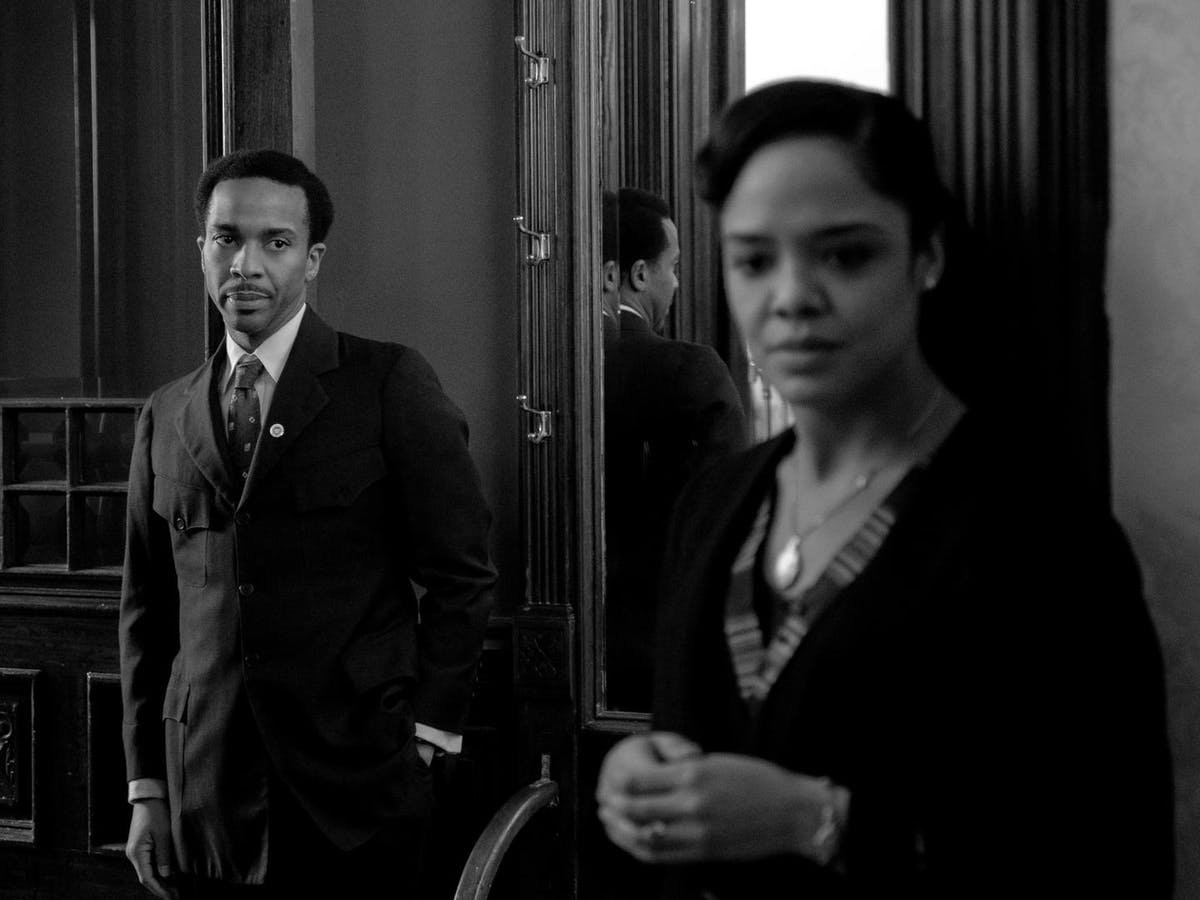
Passing marks the directorial debut of actor, Rebecca Hall (she also wrote the script), and it’s a project that’s been in gestation for more than a decade, inspired by her first reading of Nella Larsen’s source novel. Hall, it turns out, has some experience of the subject matter. Her own grandfather, a light-skinned African-American, often passed himself of as white back in his youth and so, to Hall, the book consequently felt like his story. Set in the 1920s and evocatively filmed by Eduard Grau in (appropriately enough) black and white, Passing unfolds its story at a sedate pace. For once, I don’t find myself grumbling about having to watch this on a small screen, because the film is intimate and compelling enough to hold my attention throughout.

Rene (Tessa Thompson) is a well-to-do Black woman, the wife of successful doctor, Brian (André Holland). Rene occasionally passes herself of as white in order to gain access to the ritzy New York hotels and restaurants she likes to frequent, and that’s what she’s doing when we first encounter her. Sitting in a swish dining room, she is astonished to be greeted by a white woman as though she’s an old friend. Except this isn’t a white woman: it’s her old school chum, Clare (Ruth Negga), who she hasn’t seen in years and who has taken the art of ‘passing’ to the extreme. With her elaborately coiffed blonde hair and carefully rehearsed mannerisms, Clare has erased all traces of her former self. What’s more, she is now married to successful white businessman, John (Alexander Skarsård), who – it turns out – is a bluntly spoken racist, and has no idea about Clare’s origins.

Understandably horrified, Rene excuses herself and tries to forget the encounter, but soon learns that Clare is not a character who’s ready to be conveniently brushed under the carpet. It’s not long before she turns up at Rene’s house and begins to inveigle her way into her former friend’s life, charming Rene’s husband, her two boys, her maid and just about everyone else she is introduced to. Only Rene’s writer-friend, Hugh (Bill Camp), seems to see through her meticulously rehearsed charm-school routines. But then, as a novelist, he’s well attuned to the concept of spinning stories.

As Clare exerts her hold over Rene’s world, so Rene begins to perceive an unspoken threat that lies behind her old friend’s vacuous smile…

This is an accomplished film is so many ways. I love the ambiguity of it. Seen entirely from Rene’s point of view, we’re never entirely sure if Clare really is the threat she appears. Could it be that she has been acting a part for so long, she’s no longer conscious of how avariciously she presents herself? She clearly hankers after the kind of life her deception has denied her – but how far would she be willing to go to reclaim it? Are Rene’s fears merely a product of her mounting paranoia?

Nothing here seems set in stone; indeed, even the film’s tragic conclusion leaves us with many unanswered questions.

Thompson is terrific as the troubled Rene, and Negga wonderfully enigmatic as Clare. The era is convincingly evoked and it’s so refreshing to see a cinematic story about the pervasiveness of racism, even for those Black people not living in grinding poverty. My only issue with the film is the overuse of a jazz-inflected piano motif, which, though appropriate for the 1920s, becomes an irritating ear worm by the time I’ve heard it for the fifteenth time. It’s a minor quibble.

Passing is a fascinating story, effectively told and what’s more, as a debut feature, it’s no mean achievement.

4 stars

Philip Caveney