Rebecca Ferguson

The Girl on the Train

10/10/16

The Girl on the Train‘s transition from page to screen was inevitable: Paula Hawkins’ novel has been a huge hit, its popularity earning its author over ten million dollars, and pretty much guaranteeing that this film adaptation will attract a large audience.

It’s a thriller, of sorts, unpicking the tangled lives of three women. Rachel (Emily Blunt) is a tragic figure, an alcoholic, obsessed with her ex-husband, Tom (Justin Theroux), and the baby she never had. Anna (Rebecca Ferguson) is Tom’s new wife, and Megan (Haley Bennett), is a neighbour who works as Tom and Anna’s nanny  (yes, they do have a baby) and seems to have the perfect life – at least, as far as Rachel can tell from what she glimpses from the train. Let’s be honest, the story stretches credulity at times, and it’s kind of irritating that the women are all defined by their motherhood – or lack thereof. It verges on the histrionic in places, and there are moments where it lacks pace or drive. But, where it works, it does work well.

There’s a change of location: we’re in New York instead of London, but this isn’t detrimental to the film. In fact, the cinematography is lovely; the contrasts between the urban mayhem and the glassy smoothness of the lake help add a layer of eeriness and tension to the piece. And the shift is only geographical: the social and sexual mores of affluent white suburbanites seem similar in both locales.

Emily Blunt in particular deserves some accolades: she absolutely convinces as the drunken, broken Rachel, desperately searching for a way back to herself. And there’s a stellar supporting cast, including the ever fabulous Allison Janney and the ‘why-doesn’t-she-do-more?’ Lisa Kudrow.

Overall, then, it’s kind of… okay. There’s a soggy middle section where your mind might wander, but you’ll be pulled back in for the rather racier (if somewhat predictable) ending.

If you liked the book, you’ll probably like this.

3.8 stars

Susan Singfield
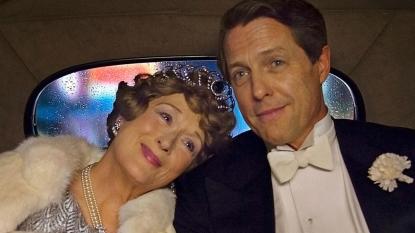
Florence Foster Jenkins

Florencefirststill-xlarge

16/05/16

The last time we saw the chameleon that is Meryl Streep in a musical role it was in Rikki and the Flash, where she managed to utterly convince as an ageing rocker with a troublesome daughter. The titular Florence Foster Jenkins is something else entirely. Streep plays a genuine historical character who lived only for music and who enacted a whole series of infamous concerts during the 1940s.

She was remarkable for a variety of reasons. As a teenager, she’d been a musical prodigy but an unwelcome dose of syphilis, passed on to her by her first husband when she was eighteen, had left her incapable of playing the piano. Her only other option was to sing and luckily for her, she had inherited her father’s fortune and was able to fund a series of private concerts. The reviews were generally favourable, largely because of the sterling efforts of her second husband, former actor St Clare Bayfield (played here with great charm by Hugh Grant) who smoothed his wife’s path by bribing reviewers and ensuring that she never ever witnessed people laughing at her – something they were likely to do, because of course, she couldn’t carry a tune to save her life.

The film opens with her auditioning for an accompanist and she soon settles on Cosme McMoon (a beautifully understated turn by Simon Helberg) who finds himself conflicted by his desire to play good music and his understandable horror at the noises he hears coming from the mouth of Ms Jenkins. The situation is manageable when the concerts are kept small and intimate but when on a whim, Jenkins books herself a performance at Carnegie Hall in front of an audience of 3000, it’s clear that Bayfield and McMoon are going to have a more difficult job on their hands. And to compound matters, she’s only gone and made a blooming record!

This is a slight but perfectly judged film, skilfully directed by Stephen Frears and built around a wonderful comic performance from Streep. If you think there’s not much humour to be milked from such a tragic premise, don’t be fooled – you’ll laugh your way through much of this and towards the end, you’ll almost certainly be close to tears. The script, by Nicholas Martin, is adept at confounding your expectations. Bayfield, who at first appears to be an unspeakable cad (he led a double life, living with a young woman, Kathleen (Rebecca Ferguson)) clearly did love his wife and lavished great care and attention on her at every turn, unlike musical virtuosos such as Arturo Toscanini and Carlo Edwards, who happily took a series of cheques from her but never once turned up to show their support.

In an age where the likes of The X Factor and BGT have elevated the championing of musical mediocrity to an art form, Jenkins’ story seems a particularly prescient one – and for Streep’s performance alone, this is worth seeking out.

4.2 stars

Philip Caveney

Mission Impossible: Rogue Nation

MV5BMTQ1NDI2MzU2MF5BMl5BanBnXkFtZTgwNTExNTU5NDE@._V1_SX214_AL_

02/09/15

We were far too late getting on to this – largely because an entire month of reviewing at the Edinburgh Fringe left us with too little time to actually make it to the cinema: a sorry state of affairs. Rogue Nation is the latest improbably titled instalment in Tom Cruise’s evergreen TV spy spinoff and as the series goes, it’s one of the better efforts – an adrenalin fuelled romp with an outrageously daft plot and a whole heap of inexplicable gadgetry to help the IMF team achieve their goals.

The film starts as it means to go on with the throttle wide open. Ethan Hunt attempts to board a plane… after it’s taken off. (Don’t try this at home. That’s my old stamping ground of RAF Wittering hundreds of feet below, by the way and yes, that is Cruise clinging on to the side of the plane. Nobody can say he doesn’t earn his millions.)

Hunt is on the trail of a mysterious organisation called The Syndicate, who have dedicated themselves to the eradication of the IMF and who are headed up by evil villain, Solomon Lane (a deeply creepy Sean Harris.) As Hunt hurtles around the world, evading assassins and leaping athletically from very high buildings, back at base, Brandt (Jeremy Renner) is engaged in a more pedestrian battle as grumpy CIA man, Alan Hunley (Alec Baldwin) attempts to get the Impossible Missions team shut down. It seems he finds them a bout too reckless for his liking. Soon Hunt is pretty much out there on his own, aided only by his hapless bessie mate, Benjie (Simon Pegg, who must be relieved to add a much-needed hit to his CV) and by the mysterious Ilsa Faust (Rebecca Ferguson) who keeps popping up just in time to save Hunt’s life.

It’s fairly pointless to go into the plot. Most of it is unfathomable and all of it is unlikely, but it’s presented with enough tongue-in-cheek brio to suspend your disbelief. There’s an ingenious set piece at the Vienna opera house, while an underwater sequence where Hunt has to hold his breath for three minutes wracks up the tension to an almost unbearable degree. On the downside, there’s a  motorbike/car chase that seems a tad perfunctory this time around, but that’s a minor quibble. Overall, this is a superior slice of entertainment, which should keep you riveted till the final credits. And of course it still features Lalo Schifrin’s sinewy, unforgettable theme tune, which is a thriller all by itself.

What else can I say? Mission accomplished.

4.2 stars

Philip Caveney