Ralph Ineson

The Fantastic Four: First Steps

24/07/25

Cineworld, Edinburgh

The world of superhero movies has become an unpredictable place. DC’s recent Superman film was dismissed as a sprawling mess by the majority of critics (me included), but proved to be a palpable hit with the public – which makes me somewhat nervous to announce that, for my money, Marvel’s latest offering is the studio’s best effort since Guardians of the Galaxy. Which probably earns it a one way ticket to ignominy.

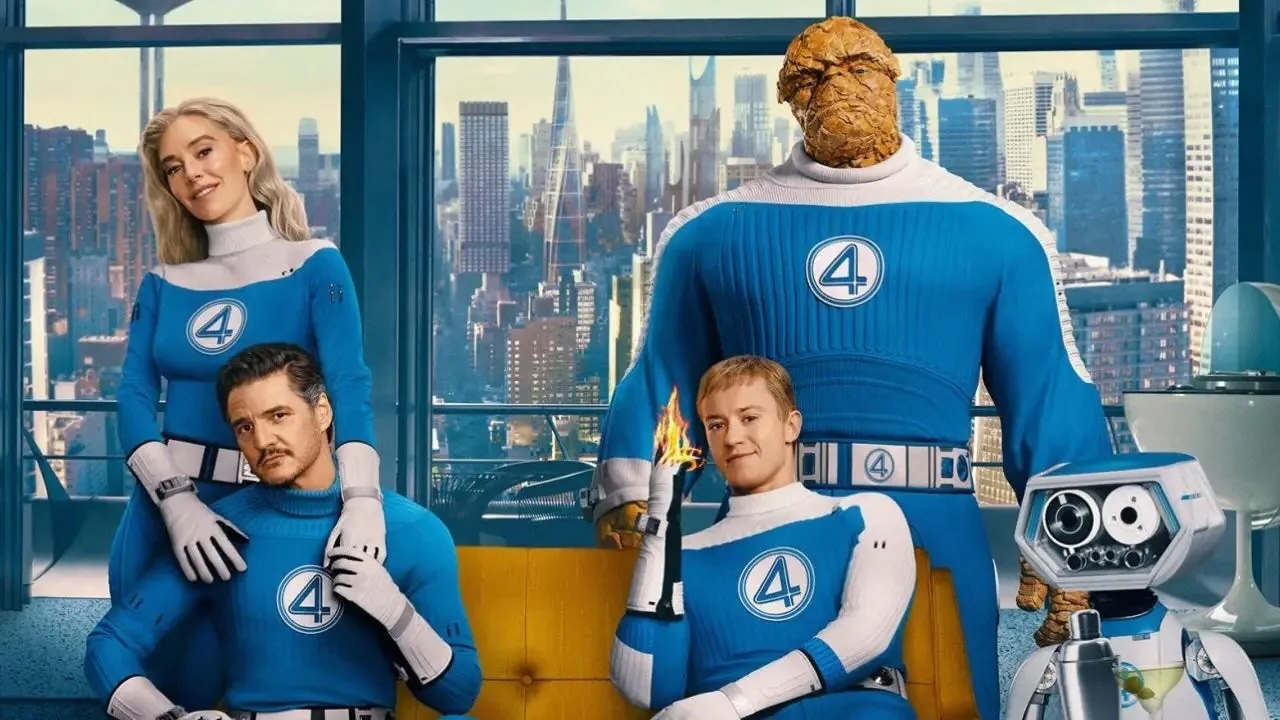
Stan Lee and Jack Kirby’s first superhero team, The Fantastic Four, have had a pretty rocky ride on the big screen. Previous attempts to capture their antics have been met with howls of derision from Marvel fans and a distinct lack of bums on seats at the box office. First Steps might suggest an origins movie, but this film begins four years after the space flight that dramatically changed the lives of its four crew members. That mission is only alluded to in a brief television interview, introduced by Ted Gilbert (Mark Gatiss). Now, Reed Richards (Pedro Pascal), Sue Storm (Vanessa Kirby), Johnny Storm (Joseph Quinn) and Ben Grimm (Ebon Moss-Bachrach) have been widely accepted as the Earth’s protectors. But, in a shot of realism rarely seen in this genre, married couple Reed and Sue are about to have their first child and are going to have to learn to go about their super-business with a baby on board.

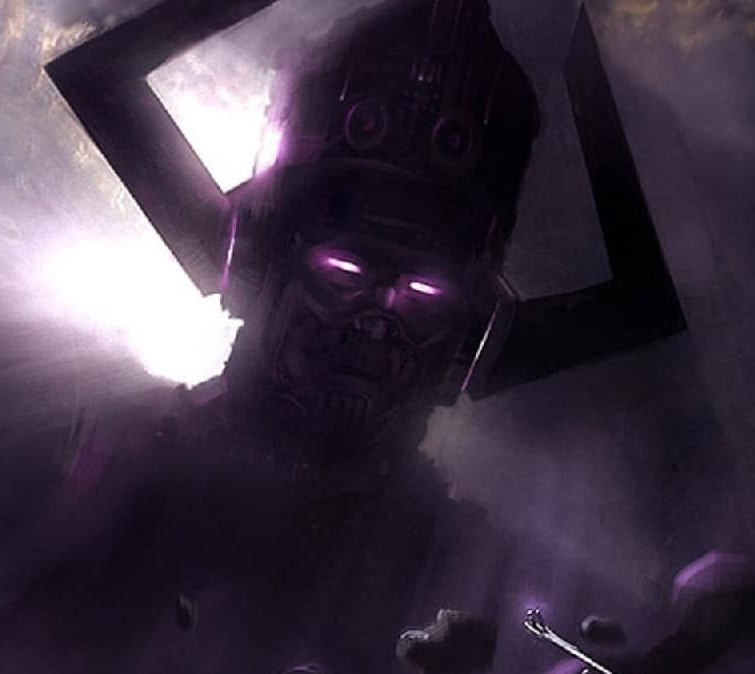
New York City receives an unexpected visit from Shalla-Bal (Julia Garner as the ex-girlfriend of The Silver Surfer, Stan Lee’s oddest hero), who points out that Earth is soon to be… ahem… eaten by Galactus (Ralph Ineson). He’s a suitably gargantuan alien, who has already gobbled up several other luckless planets and has made sure to leave room for pudding. It’s up to the four superheroes to devise a plan to save the world and carry it out, whilst taking care of new arrival, baby Franklin.

So… no pressure.

While the storyline is as batty as we’ve come to expect from Marvel, what really works here is the film’s overall aesthetic, which locates the story in an alternate nineteen-sixties (the era in which the source comics were conceived and created). The ensuing world-building is delightful, with that kooky style applied to every last detail. This results in a futuristic world where, for instance, mobile phones don’t exist. Cinematographer Jess Hall ensures that everything is filmed in vivid, eye-popping hues, while director Matt Shakman keeps the action propulsive enough to ensure that audiences don’t have time to consider how silly the storyline is.

The characterisations of the four leads are nicely handled, particularly by Pascal, who makes his Reed Richards a nerdy number-cruncher, who loves nothing better than scribbling equations on a chalkboard. The dialogue achieves just the right mix of funny and heartfelt, even if it did take seven writers; and for once, there aren’t too many characters to get a handle on. While I generally complain when everything comes down to a climactic punch-up – and this film is no exception to the rule – this one doesn’t overstay its welcome and, in its final furlong, manages to crank up some genuine moments of suspense. Mission accomplished.

So yes, it’s been a while since I enjoyed a Marvel movie to this degree. We’ll see how it fares over the following weeks but, in my humble opinion, First Steps deserves to succeed. Make sure you stay in your seats for the mid-credit sequence announcing… well, you’ll have to go and see for yourselves.

4.2 stars

Philip Caveney

The Green Knight

02/10/21

Amazon Prime

Has there ever been a more divisive movie than The Green Knight?

Unceremoniously pulled from its intended theatrical release and plonked onto Amazon Prime, it’s interesting to look at the audience reviews, which feature a plethora of five star ratings and an equal number of one stars. The latter break down into three distinct groups. Many people decry that the film is simply ‘too dark’ for their modest screens – and I have to agree that, if ever a film demanded to be seen at the cinema, this is the one.

More worrying are the blatantly racist comments about the casting of Asian actor, Dev Patel, as the ‘quintessential British hero’ Sir Gawain. But this is a work of chivalric fiction, written anonymously in the fourteenth century. It’s not as if director, David Lowery set out to do a biopic about Winston Churchill. Gawain could be played by any actor and Patel is terrific in the role.

The third strand is the most baffling: people complaining that, over the film’s two hour duration, ‘absolutely nothing happens’ – even though most of them casually add that they stopped watching after twenty minutes or so! The truth is that a lot happens in this film, even if the story unfolds at a leisurely pace, and what happens is fascinating stuff, open to a viewer’s own interpretation.

Our hero is the nephew of The King (Sean Harris), and we’re first introduced to Gawain as a slovenly layabout, happily carrying on with commoner Essel (Alicia Vikander), but, despite her entreaties, showing no inclination to marry her. One Christmas Eve, Gawain is summoned to a feast at the castle where he is invited to sit at his Uncle’s side. At this point, there’s an unexpected visitor, the titular Green Knight (Ralph Ineson). He rides in and issues a playful challenge. If any man will face him in combat, he will offer them the chance to strike him with a sword. But in one year’s time, that man must present himself to the Green Knight and receive the same treatment in return. Gawain recklessly steps up to the plate and, no doubt fuelled by a little too much alcohol, lops off the knight’s head, thinking perhaps that it will end there – whereupon the ancient warrior picks up his severed bonce and gleefully rides away.

One year later, as Christmas looms, Gawain is understandably nervous. After some procrastination, and girdled by a protective belt fashioned by his witchlike mother (Sarita Chowdhury), he sets off for the Green Chapel to meet with his adversary.

A classic quest dutifully unfolds. On his travels, Gawain meets with a duplicitous young thief (Barry Keoghan), a talking fox, and a mysterious lord (Joel Edgerton). He also has a close encounter with the lord’s wife – also played by Vikander – who tests Gawain’s mettle as a ‘gallant knight’…

The Green Knight is a splendid film. I love the gorgeous cinematography, its grubby depiction of a medieval world. I enjoy the various themes that criss-cross throughout the story. Here is a profound meditation on death, on coming of age, on the need for a brash young man to find his maturity. It explores the constant struggle between pagan beliefs and the rising power of Christianity (note how the Green Knight is depicted as the Green Man of mythology). I love the strange hallucinogenic interlude where Gawain encounters a race of giants and I marvel at the fact that, hours after the credits have rolled, we’re still discussing the meaning of some of the film’s weirder moments.

Of course this won’t be for everyone. And of course, some will see it as pretentious. But in many ways, The Green Knight is one of the most original films I’ve ever seen. It should have had its proper chance to dazzle us on the big screen.

4.6 stars

Philip Caveney

The Witch: A New England Folktale

MV5BMTY4MTU2NjMyNV5BMl5BanBnXkFtZTgwMzUwMDk4NzE@._V1_UX182_CR0,0,182,268_AL_maxresdefault

17/03/16

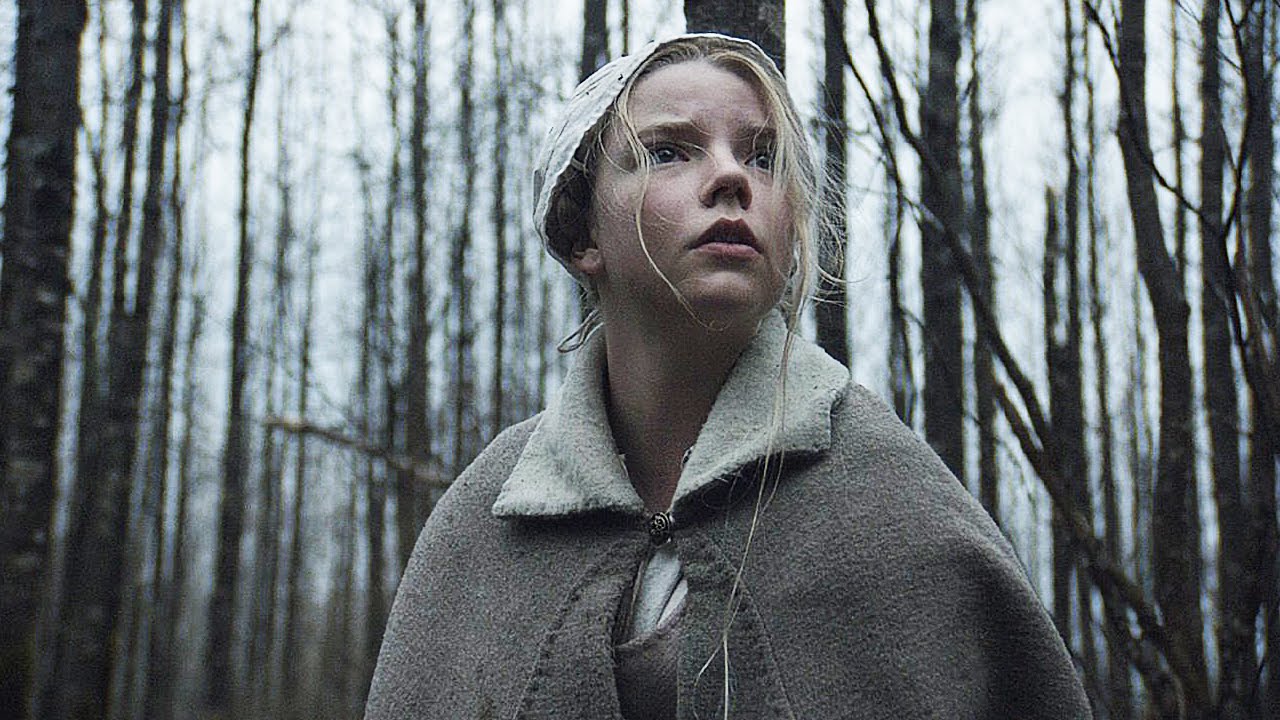
New England, 1630. William (Ralph Ineson) is so pious he’s even managed to incur the wrath of the Puritan community in which he and his family reside and finds himself summarily banished. Undeterred, he packs up his wife and five children into a rickety wooden cart and heads off into the wilderness, eventually arriving at a remote plot of land bordering a forest where he sets up home. Before anyone can say, ‘bad idea,’ the family’s youngest son, a baby, disappears and since he was under the care of eldest daughter, Thomasin (Anya Taylor-Joy), she is largely held responsible. The family assume a wolf has taken her but the audience has already witnessed the baby’s rather grisly demise, so we know that there’s something very unpleasant lurking in the undergrowth, something decidedly witch-shaped. There’s also ‘Black Philip,’ a he-goat, who definitely knows rather more than any ordinary goat should.

Writer/director Robert Eggar’s low-budget tale sets itself some awkward elements to overcome. For one thing, the dialogue is rendered in authentic Olde English, with lashings of thees and thous and while this is probably more accurate than having the characters speak in a more contemporary way (as Arthur Miller did, in The Crucible, the masterpiece to which this story will inevitably be compared) it does make for difficult viewing, as does the funereal pace at which much of the action unfolds. Though the film successfully creates an atmosphere of steadily mounting dread, it’s never in the least bit scary. Ultimately, this seems to be all about the perils of religion. Poor William is so intent on begging God’s forgiveness for every little misdemeanour, he rather overlooks the bigger picture, until of course it all goes horribly pear-shaped – the eldest son encounters something worrying in the forest, the remaining kids start having fits and their mother, Katherine (Kate Dickie) finds herself breast-feeding a crow. And the inevitable question remains; is Thomasin as innocent as she seems to believe she is?

The Witch has arrived garlanded with acclaim and to be fair, it’s a creditable full length debut by Eggars, but it is at its strongest when (like The Crucible) it is ambiguous. Scenes that confirm our worst fears rather seem to undermine the film’s creepy intentions. So while I would encourage anyone to go and see this, to judge for themselves, I have to confess to being a little disappointed with the end product.

3.8 stars

Philip Caveney