PPP

Cheapo

07/10/25

Traverse Theatre, Edinburgh

Last time we saw this play – back in December – I was a little confused by the title. This version comes with a strapline that makes things a whole lot clearer – “Cheapo: chess slang for a primitive trap, often set in the hope of swindling a win from a lost position.”

Cheapo‘s previous appearance at the Traverse was part of the annual 4PLAY programme, where four new plays are showcased over four nights. It was our favourite of last year’s quartet, and I’m delighted to have the chance to watch this new iteration.

Katy Nixon’s script still resonates: her writing is spare and succinct, capturing the teenage characters’ raw emotions with devastating precision.

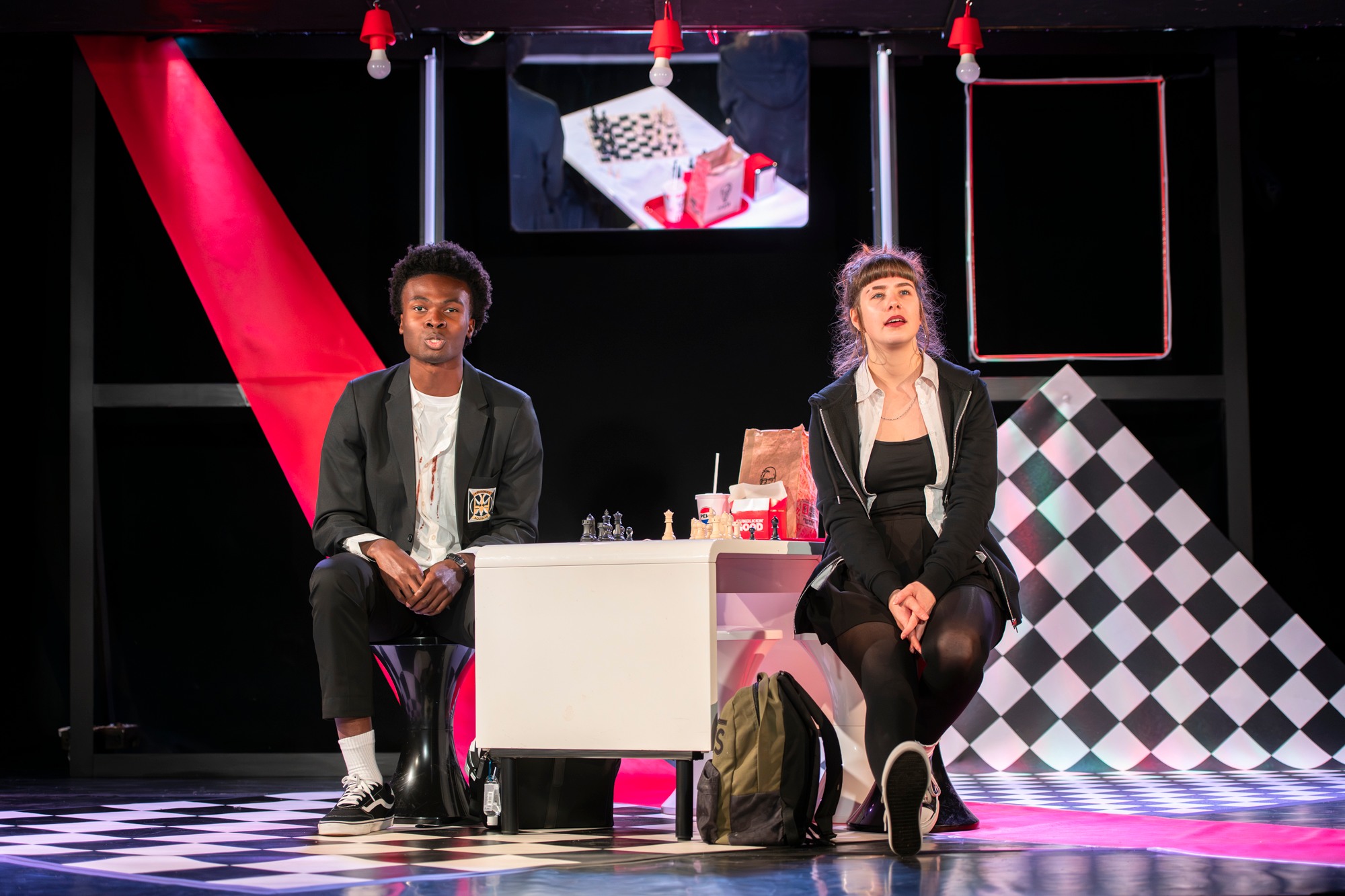
And their emotions are very raw. At a recent party, something dreadful happened to Kyla (Yolanda Mitchell) and she needs Jamie (Testimony Adegbite) to help her deal with the fallout. But Jamie isn’t prepared to renege on what he’s told the police – and he doesn’t understand why Kyla wants him to. In a not-especially-subtle-but-nonetheless-effective metaphor, they play a game of chess, arguing about their possible moves while fighting to avoid checkmate. The mounting tension is expertly undercut by some quirky flights of fancy, as the duo imagine how their lives might have played out in alternate universes – before coming back down to earth with a bump, still mired in the nightmare of their current reality.

The set, by Gillian Argo, is boldly emblematic: a crooked panel of black and white checkered flooring spreads up on to the wall, mirroring the chess board Jamie places on the table. A red carpet appears to signal the dangerous path the pair are on; again, the colour is repeated, this time in the takeaway food cartons that litter the table. It’s cunningly designed, with monochrome stools resembling giant pawns and strip lights that double as, um, light sabres.

Brian Logan is in the director’s chair this time, and the piece is perfectly paced, with long moments of stillness and contemplation punctuating the frenetic teenage energy. The movement is dynamic and I especially enjoy the dance sequences, as well as the way Kyla moves like a chess piece in the imaginary court scene.

Adegbite and Mitchell are perfectly cast: his earnest geek nicely contrasting with her streetwise façade. The exploration of misogyny and racism feels credibly rooted in their characters’ teenage experience, and their respective vulnerabilities and coping mechanisms are skilfully embodied.

Despite dealing with distressing themes, Cheapo is a witty and enjoyable piece of theatre, provocative but ultimately hopeful, that red carpet perhaps signifying something more positive than it first appears: an escape route for our young protagonists.

4.7 stars

Susan Singfield

Wasps

25/03/25

Traverse Theatre, Edinburgh

Cameron Forbes’ Wasps, the latest offering from A Play, A Pie and A Pint, buzzes along busily, like its  hymenoptera lookalike. Anchored by a gutsy performance from Yolanda Mitchell, this tragic coming-of-age monologue has quite a sting in its tail (sorry, not sorry).

Teenager Rianne (Mitchell) just wants to fit in. At school, she’s perfected the art of invisibility: if she dresses right, wears her make-up exactly so, earns just enough detentions, she can move through the corridors without attracting any attention at all. But there are downsides to never being seen. For one thing, her crush, Oran, doesn’t seem to realise she exists. And for another, not even her best friend notices when her life implodes…

I’m not usually a fan of so-called inspirational quotations but “what doesn’t kill you makes you stronger” serves as a pretty decent précis of Wasps‘ central message. And I mean that in a good way. Rianne faces some really serious problems – including a confrontation with her spheksophobia -which she has to dig deep to face up to. And yes, she emerges battle-scarred, but at least she’s no longer desperate to disappear. She’s bolder, braver and ready to take up space. A bit more… wasp-like.

Director Lesley Hart ensures that the pace never flags, so that the play has a convincingly propulsive teenage energy, and Mitchell does a wonderful job of conveying both Rianne’s turbulent emotions and her evident disdain for many of the people in her life, evinced by her scathing impressions of them.

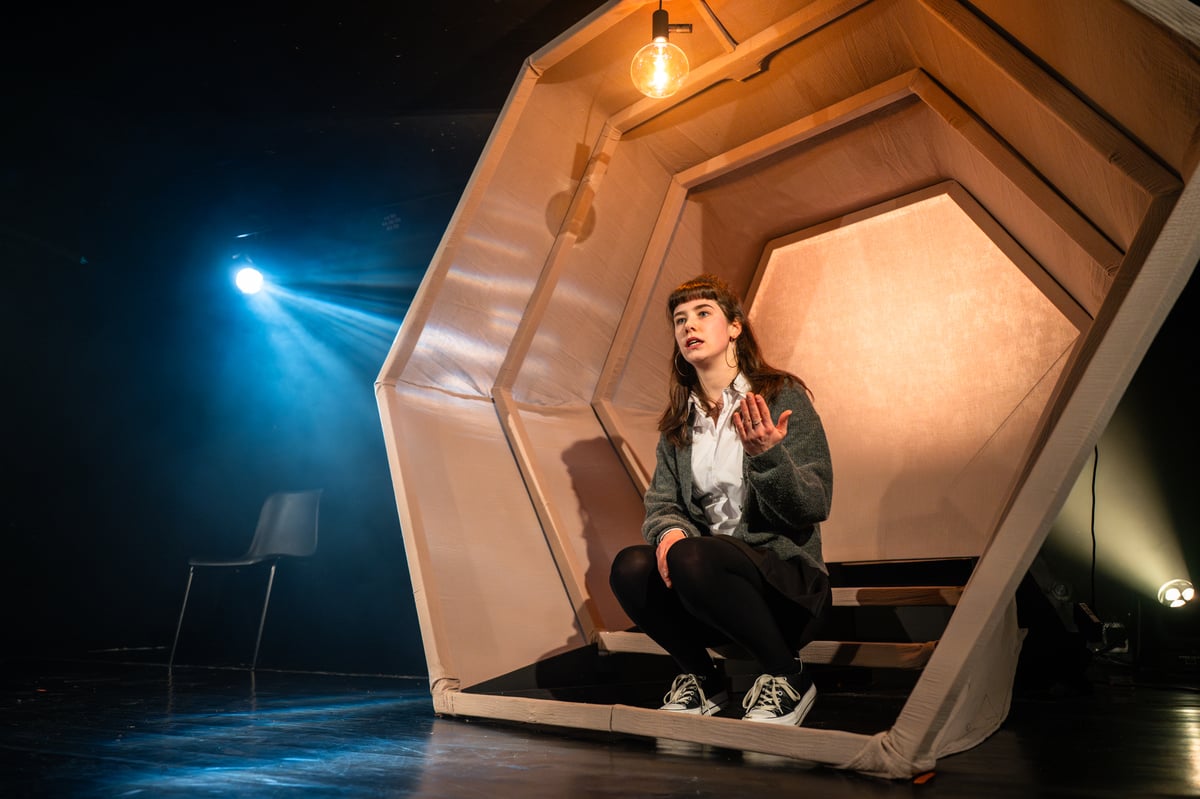
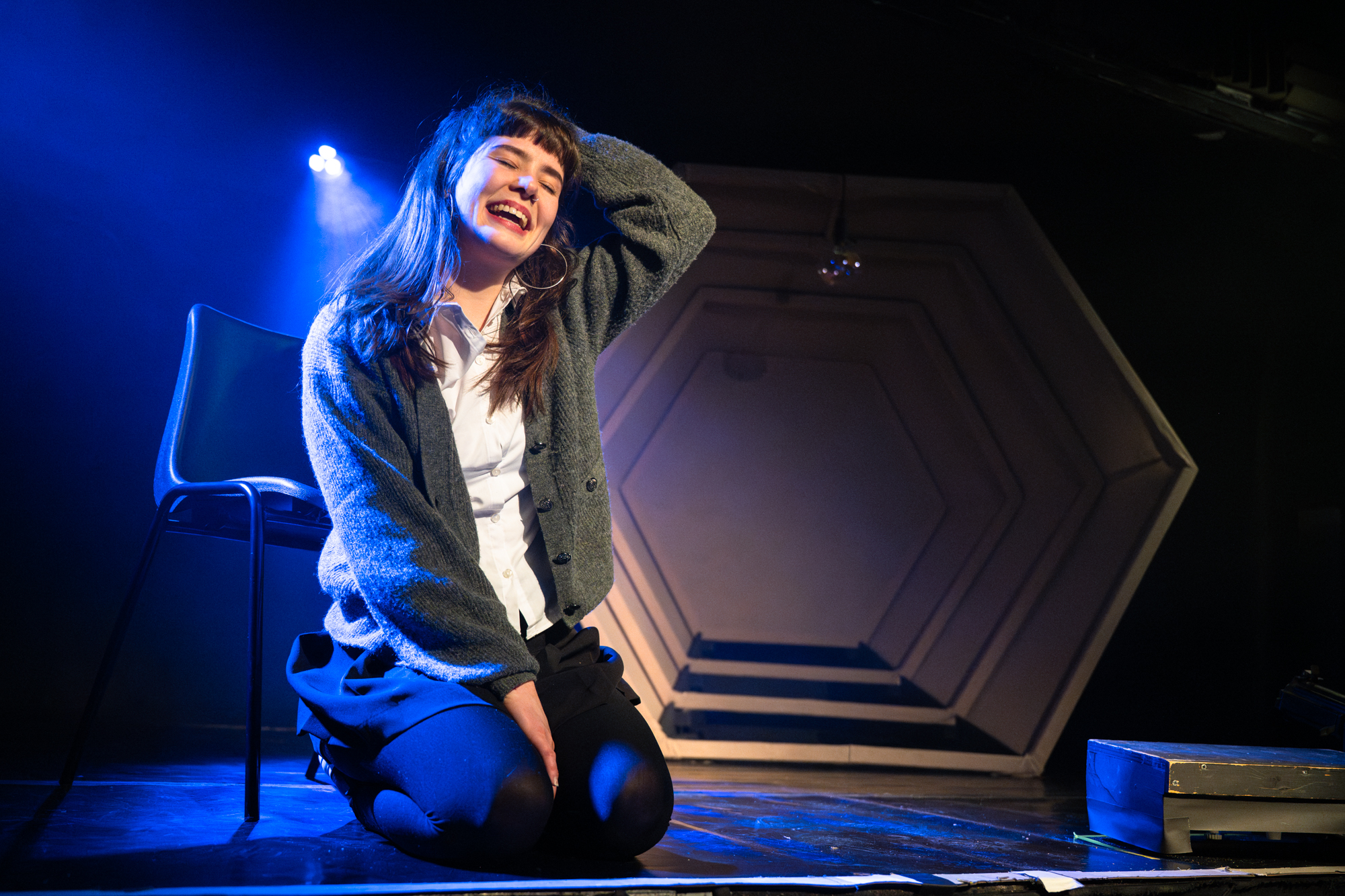
Gillian Argo’s set is visually arresting. I like the hexagonal construction, suggestive of a wasp’s nest, and the flickering projections of the worker wasps . However, I’m not always fully convinced by the wasp analogy; the comparison is perhaps stretched a little too thin. I’m also left with a couple of nagging questions about the plausibility of some of what occurs. (I can’t elucidate without spoilers but let’s just say that, though social care in the UK is undoubtedly in dire straits, Rianne is a vulnerable child and her situation would surely be flagged up; she wouldn’t be left to deal with it entirely alone.)

Nonetheless, this is a sprightly, engaging piece of drama, with some lively writing and a spirited delivery – a worthy addition to the PPP canon.

4 stars

Susan Singfield

Lost Girls/ At Bus Stops

15/10/24

Traverse Theatre, Edinburgh

Lost Girls/At Bus Stops is my favourite so far in this PPP season: I love the marriage of Róisín Sheridan-Bryson’s fragmented, non-linear writing with Laila Noble’s kinetic direction. 

At its heart there’s a simple will-they/won’t they love story. Ever since Jess (Catriona Faint) approached Iona (Leyla Aycan) at a bus stop with a flyer for a Fringe show several years ago, the two have been friends, meeting up every August to make the most of the Festival buzz, weaving their way from show to bar to show again, navigating the crowds, the hills, the closes, the booze. On the surface, theirs is an easy alliance, born of a shared hedonism and an openness about who they are. Underneath, they’re a mess of repressed longing, each too nervous to risk their precious friendship by declaring how they really feel. And this time, with Iona about to leave for pastures new, there’s an added pressure. If neither of them makes a move, it’ll be too late.

Sheridan-Bryson’s script skips nimbly between dialogue and narration, the protagonists referring to themselves in both third and first person, almost mythologising the city, their accounts of various Edinburgh nights colliding as they disagree about details and bring different moments to the fore. The disrupted timeline mirrors a real-life conversation, almost stream-of-consciousness in its construction, bouncing back and forth through their shared memories.

The two actors portray the contrasting characters with aplomb, Aycan’s gentle stillness a perfect foil for Faint’s more manic, agitated demeanour. As Jess reacts to the pressure by downing drink after drink, snogging random men and trying to start fights, Iona – while matching her on the booze front – is altogether calmer, trying time and again to make Jess stop and talk, to say the things they need to say. Their emotions are palpable and it’s impossible not to feel engaged, not to sit silently urging them to take the plunge. 

Zephyr Liddell’s set is simple but effective, the grimy bus stop and disco lights echoing the superficial glamour of a sequin-clad performer in an archetypal dingy Fringe venue. 

Sheridan-Bryson pulls off the difficult task of creating a play that is at once meta-theatrical and down-to-earth, complex in structure but easy to follow. It’s an impressive piece of work. 

4.6 stars

Susan Singfield

Burning Bright

07/03/23

Traverse Theatre, Edinburgh

This latest season of A Play, A Pie and A Pint promises to be a good ‘un. Hot on the heels of last week’s sprightly Until It’s Gone comes Burning Bright, Áine King’s apocalyptic depiction of the climate crisis engulfing us. It’s no surprise to learn that this play won the 2022 David MacLennan award: it’s evocative and visual, a big story told in small fragments, as economical as poetry.

We are presented with three disparate narratives, linked by an over-arching theme of environmental collapse. Suzanne Magowan is a TV journalist desperately chasing a story about Australian wildfires, more interested in saving her career than in saving the earth. Hannah Jarrett-Scott plays a grief-stricken young woman with an eco-tourism business, taking rich adventurers on her boat, The Ice Princess, to see the polar ice caps before they’re gone. And Adam Buksh is a survivor: he’s escaped floods and tigers in his native India, and now he’s navigating racism on his Glasgow street.

The performances are all strong, the characters compellingly portrayed, and the writing is gorgeously cinematic – the image of a blazing horse, for example, is horribly mesmerising. Roxana Haines (director), Gemma Patchett and Jonny Scott (designers) achieve astonishing things with a tiny stage and a minimal set, so that it’s easy to suspend my disbelief and accept that I am, simultaneously, in the Arctic, Australia, Scotland and India, witnessing fire, floods and melting ice caps.

The conceit works to emphasise the ubiquity and urgency of climate breakdown. Even these characters, closer to the epicentres of disaster than most of us, are each only aware of one aspect of the problem. But here in the audience, we are shown the cumulative effect: their monologues are tangled and entwined, so that we see their interdependence and the extent of the catastrophe that’s looming over us. The image is there throughout, cleverly captured in the juxtaposition of the encroaching wave of plastic waste that dominates the set, and the tiny dinghy representing our precarious position.

Burning Bright is a superbly accomplished piece of theatre, skilfully illuminating why climate change is an issue we can’t afford to ignore.

4.7 stars

Susan Singfield

Until It’s Gone

28/02/23

Traverse Theatre, Edinburgh

This sprightly two-hander packs a lot into its fifty-minute running time. Until It’s Gone is the first of 2023’s A Play, a Pie and a Pint offerings, and it’s a corker: Alison Carr’s tight and cleverly-crafted script imagines a future where all of womankind have disappeared, and men are left to make the best of a world without them. In stark contrast to Charlotte Perkins-Gilman’s Herland, where women have created a female Utopia, this male-only Scotland is a dystopian mess, its citizens desperate for the women to return from their unspecified and unexplained exile.

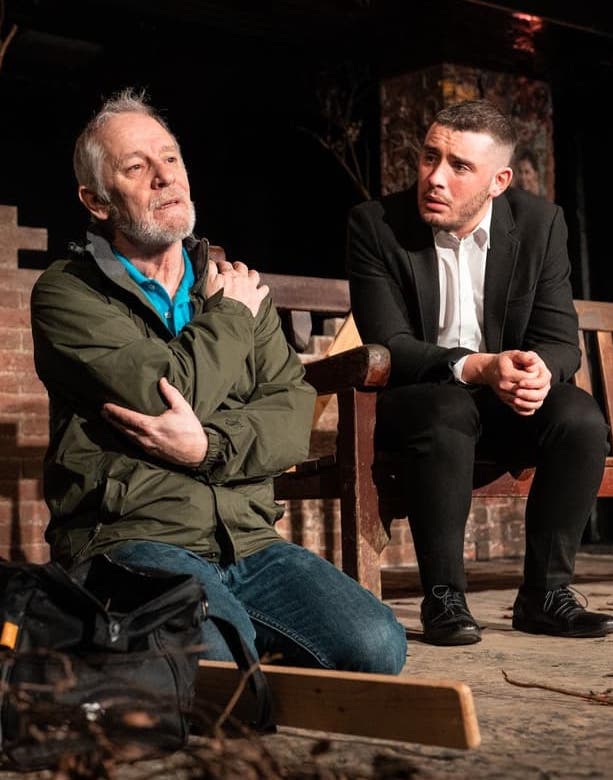
We’re offered a glimpse into this terrifying scenario through a simple park-bench, chalk-and-cheese set-up: a meeting between an eager young man of twenty-five (Sean Connor) and a gruff older one (Billy Mack). They’ve been matched by a supposedly ‘world-beating’ app, but this is not a date – or at least, not a conventional one. They are two avowedly heterosexual, cis-gendered men, following a strict government mandate to ‘connect’ – because things aren’t sustainable as they are. Through this smallest of microcosms, Carr seeds just enough information into the men’s darkly comic dialogue to allow us to envisage the bigger picture, the tortured society in which they live, where schools are closed, most interactions happen online, and everything feels wrong.

The characters are beautifully realised, played with warmth and humour by Connor and Mack, even as they expose the men’s real pain. The generational divide is deftly managed, the initial chasm between them narrowing as they talk and share confidences, slowly realising that they’re more alike than not, that their shared fate should bind them rather than pull them apart.

Under Caitlin Skinner’s assured direction, the play’s political points are clearly made without ever feeling intrusive. I like the cheeky use of tableaux and blackouts to mark the passage of time at the beginning, and the set – by Gemma Patchett and Jonny Scott – is modest but strikingly effective. I’m especially drawn to the myriad images of women adorning the tumbledown walls, and find myself wondering if they are ‘missing’ posters or simply photos, there to remind the men of what they’ve lost. 

Because, of course, you never know until it’s gone…

4.4 stars

Susan Singfield