12/03/25
Bedlam Theatre, Edinburgh
It’s mind-blowing to think that Frank Wedekind’s Frühlings Erwachen was written in 1890, when Kaiser Wilhelm II ruled the Deutsches Reich, Queen Victoria was on the British throne and Robert Gascoyne-Cecil (nope, me neither) was our PM. In a world where women weren’t even allowed to show their ankles, it’s not surprising that it was sixteen years before someone dared to stage this controversial exposé of the dangers of repression, with its bold depictions of teenage sexuality – not to mention rape, suicide and abuse.
Steven Sater and Duncan Sheik’s musical adaptation premiered on Broadway in 2006, exactly one hundred years after Wedekind’s play finally opened at Berlin’s Deutsches Theater, under the direction of Max Reinhardt. Despite the addition of some banging rock songs and more than a few profanities, this modern version actually pulls more punches than the original, most notably by omitting the rape and softening the ending. Nonetheless, it still has the capacity to shock, and to remind us that we make sex dangerous by hiding it, by making it taboo.
Set in 19th century Germany, this is a story about a group of young people coming of age under the stifling weight of moral expectations. Wendla (Hattie Sumners) asks how babies are made. Scandalised, her mother (Sophie Davis, who plays all the adult women) first shouts and then equivocates, condemning her daughter to an ignorance which will have severe consequences. Meanwhile, Moritz (Shaun Hamilton) is struggling to keep up with his schoolwork, and fear of failure takes him to a devastating place. Melchior (Daniel Fischer) seems stronger than the others: thanks to a combination of intelligence and a liberal mother, he’s more knowledgeable than his friends, and therefore better equipped to cope with life. Still, the authoritarian regimes of school and church soon drag him under too; no one is safe in this society.
Theatre Paradok’s production succeeds in conveying those most fundamental of teenage emotions: exuberance and despair (I’m guessing the student cast don’t have to dig that deeply to remember how raw and overwhelming those feelings can be). Sheik’s eclectic soundtrack is beautifully interpreted by musical directors Nonny Jones and Ruairidh Nicholson, the choral numbers being particularly impressive. The live band – hidden in the wings – are terrific, and plaintive solos by Sumners, Gemima Iseka-Bekano (Ilse) and Hamilton evoke some strong responses.
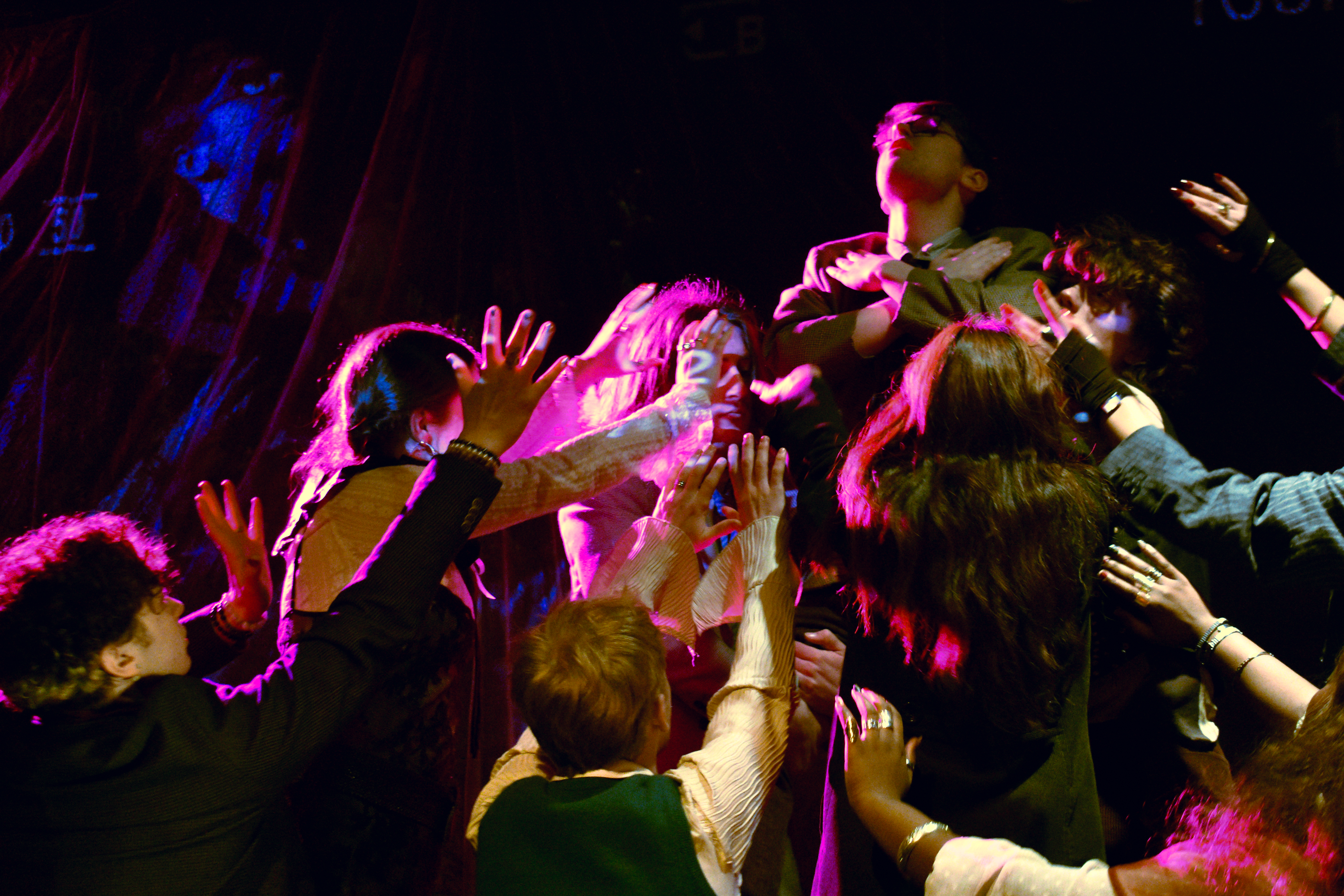
The show’s aesthetic is great. I love the androgyny of the costumes, with feminine dresses worn over masculine suits; the queer coding is fabulously done. The set is simple but very effective: items of underwear are stapled to a curtain framing a large gauze backdrop, onto which short animations and live videos are projected, creating an ethereal doubling effect and amplifying the characters’ emotions.
Directors Rue Richardson and Jane Morgan manage their large cast with aplomb. The play is dynamic and visually very appealing, from the arresting choreography (by Františka Vosátková, along with Richardson, Morgan and Andrea Adriana Prawono) to the boisterous shenanigans of the teenage boys. The gauze curtain makes metaphors literal: dead characters appear from ‘beyond the veil’, while ‘a veil is drawn’ over Wendla and Melchior’s lovemaking. However, Ernst (Michael Butler) and Hänschen (Max Middleton)’s homosexual relationship is placed boldly centre-stage – perhaps a subtle nod to the idea that some things shouldn’t be re-closeted.
I do have one criticism, and it’s the emergency exit door, stage left, which is open to the elements. Bedlam is a chilly venue at the best of times; tonight, with an outside temperature of 1°C, I could do without sitting in a freezing draught. And it’s not just the cold that’s a problem, there’s the noise of the city too: traffic and sirens and people passing by, all making a claim on my attention. I can see that the options are limited by the need to house the band, but – for the sake of one entrance and one exit – it’s surely not worth making the audience so uncomfortable.
Nevertheless, this production of Spring Awakening is a triumph: a lively, thought-provoking piece of theatre, as relevant now as it was more than a century ago.
4.2 stars
Susan Singfield


 Bouquets & Brickbats