Peterloo

Hard Truths

01/02/25

Cineworld, Edinburgh

It’s been quite some time since we had a new film from Mike Leigh. His last, 2018’s Peterloo, made for Amazon, was an attempt to transfer his inimitable style onto a bigger canvas and the results were somewhat mixed. With Hard Truths, he’s back on what feels like his home turf, in one of his intimate, unflinching examinations of the human condition.

Pansy (Marianne Jean Baptiste) is in a bad way. Plagued by awful nightmares, she’s not a great deal happier when awake and is prone to unleashing her acid tongue on anybody unlucky enough to cross her path. Her regular targets include her monosyllabic husband, Curtley (David Webber), and her disaffected son, Moses (Tuwaine Barrett), who has taken to reading children’s picture books and blocking out sound with his headphones, while she snarls and raves. And there are plenty of others who find themselves targets for a tongue-lashing: various shop workers, luckless members of the public… even the girl at the supermarket till is told to ‘do something about her face.’

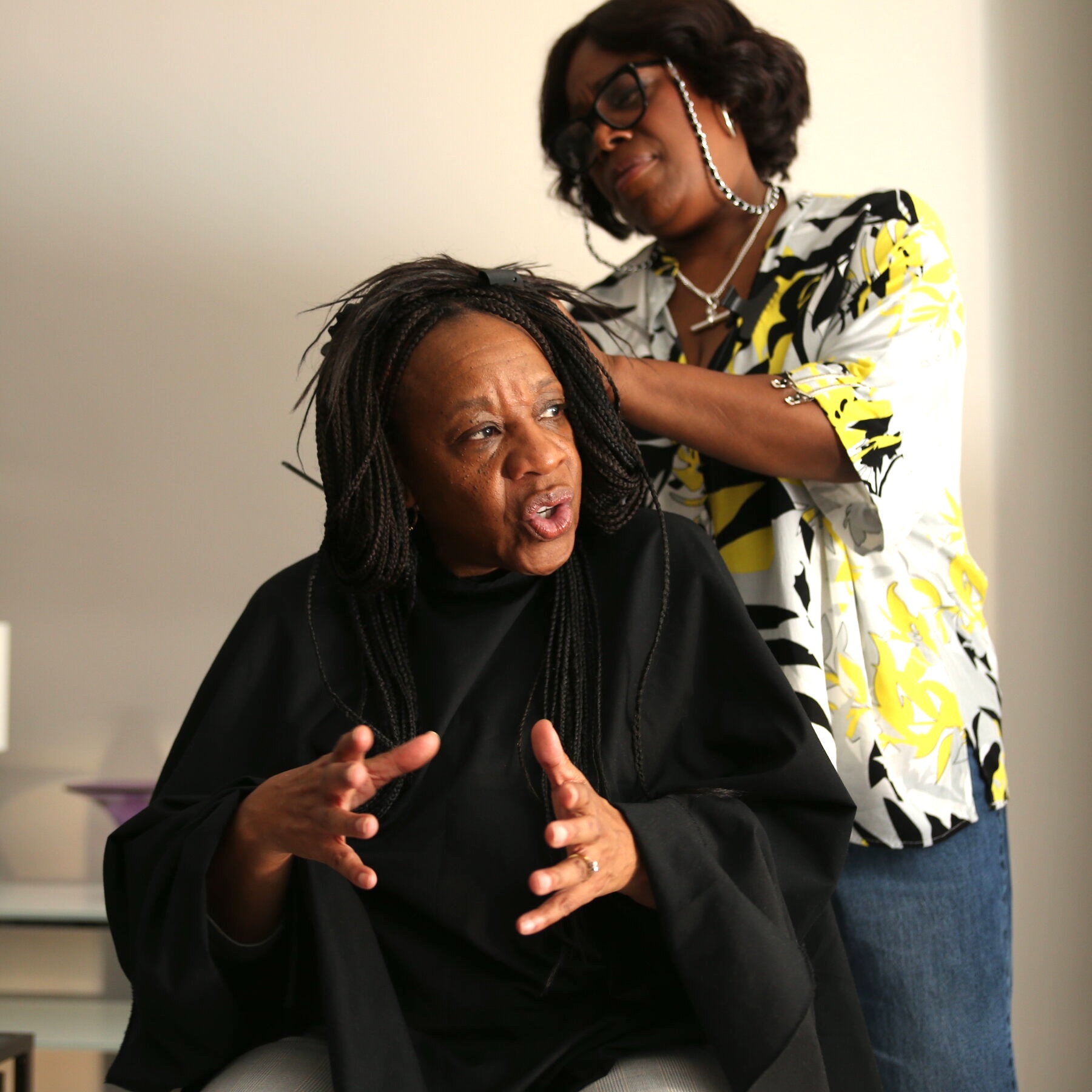
Pansy’s sister, Chantelle (Michele Austin), is her polar opposite. A hairdresser by trade, she has a warm, sunny disposition, always up for a giggle and a gossip, and she has raised her two daughters, Kayla (Ani Nelson) and Aleisha (Sophia Brown), to have the same happy-go-lucky approach to life, even when their own work situations are sometimes challenging.

As the anniversary of Pansy and Chantelle’s mother’s death approaches, a family get-together is planned but making things work with Pansy’s forbidding ‘ghost-at-the-feast’ presence is going to prove a tall order…

This feels like a classic Mike Leigh project and, as ever, his unique approach to filmmaking yields remarkable results. Both Jean Baptiste and Austin offer extraordinarily affecting performances in the lead roles, but the film is more than just a simple two-hander, with all the subsidiary characters beautifully delineated in a series of short set-pieces. Leigh handles a large cast with his customary skill: neither Webber and Barrett is given much in the way of dialogue, but their despair is written large in their desperate sidelong glances. And watch out for Samantha Spiro in a deliciously unpleasant cameo as Kayla’s employer, Nicole.

It’s fascinating to experience the film’s transformation, from the early scenes which are somehow caustically funny (and which have already spawned some internet memes) into a confrontation so utterly heartrending that I find my eyes involuntarily filling up with tears. Hard Truths won’t be for everyone. There’s a devastating melancholy at the heart of this film that seems to seep from the screen, and some of the later scenes make for harrowing viewing. But it’s proof if ever it were needed that Leigh is a unique filmmaker, who has always allowed his actors the creative freedom to explore their characters and in the process, yield extraordinary results.

4.4 stars

Philip Caveney

Peterloo

04/11/18

As somebody who lived and worked in Manchester for many years, the title of this film strikes a resonant chord with me. It refers to a particularly horrible massacre which occurred in the summer of 1819, when a huge crowd of peaceful pro-democracy campaigners marched to St Peter’s Field to hear a speech by acclaimed orator Henry Hunt, and were promptly set upon by the local yeomanry and a detachment of Hussars with sabres drawn. In the ensuing melee, 15 people were killed and more than 500 were seriously injured. The event was subsequently airbrushed from the pages of history and rarely spoken of. It’s not taught (much) in schools and many people – even those who live in the city where it occurred – have never heard of it.

One man who clearly thinks of this as a major injustice is Mike Leigh. Peterloo is his attempt to rectify the situation and it represents his most ambitious undertaking to date, portraying the slow build-up to the event and the massacre itself, whilst still employing his unique (at least in film) improvisational technique, where the actors inhabit their characters and devise their own dialogue. I’m sorry to say that I don’t think it works too well when applied to something of such immense scale. Sure, Leigh has visited the pages of history before, both in Topsy Turvey and in Mr Turner but, in both cases, he was working on a smaller canvas. Don’t get me wrong, I’m generally a huge fan of Leigh’s films, but what works brilliantly when applied to more intimate events founders somewhat here. Mind you, to be fair, the film does start well.

We meet Joseph (David Moorst), a young bugler at the Battle of Waterloo, clearly deeply and permanently traumatised by his experiences. The war over, he heads home on foot, to find his family struggling to survive in a country assailed by the corn laws, which prohibit the import of cheap grain. Family matriarch, Nellie (Maxine Peake), and her husband, weaver Joshua (Pierce Quigley), can barely afford to eat, so it’s hardly surprising when they find themselves increasingly drawn into the pro-democracy movement and looking forward to the great day at St Peter’s Field, when thousands of people in similar situations will come together to challenge the powers-that-be. The settings are convincingly done. Here is real squalor, real hardship, a million miles away from the chocolate box imagery so beloved of many period dramas – and early scenes of luckless individuals in court being sentenced to heinous punishments are powerful stuff.

But there are a lot of characters to take in – so many that, inevitably, acclaimed actors are demoted to tiny, walk-on roles. And there are speeches – a lot of speeches – so many that the film’s two hour running time starts to drag, especially in the long sequence depicting the mass gathering at St Peter’s Field. Henry Hunt (Rory Kinnear), heralded as a hero by the protesters, is depicted as a rather unpleasant, horribly self-serving prig who clearly thinks himself a cut above the working-class people whose plight he is supposed to be representing. The people would clearly have been better served by speaking for themselves.

If there’s a problem, it’s that virtually every establishment character we encounter is a smirking, pompous and downright unpleasant individual verging on caricature. This reaches its apotheosis in Tim McInnery’s turn as the Prince Regent, a bloated, giggling buffoon, not so much out of touch with the electorate as living on another planet. Of course the ruling classes’ behaviour was abominable, but this seems crude and over-simplistic.

And then of course, there’s the massacre itself, a lengthy sequence that really ought to bring us to tears of outrage – but the film’s 12A rating obliges Leigh to hold back from making it too visceral and the result, with sabres clearly hitting little more than fresh air just feels clumsy and unfocused. If ever a sequence cried out to be properly storyboarded, this is it.

This isn’t a total dud. Indeed, there’s plenty here that does work but, I think, too much that really doesn’t. I feel bad for not having enjoyed it more. I really wanted to like it, but ultimately, it feels like a missed opportunity. This is such an important subject, one that symbolises a turning point in British history and the democratic movement. I can’t help feeling that it deserves a better film than this.

3.5 stars

Philip Caveney