

29/03/25
Cineworld, Edinburgh
In 1964, I watched Stanley Kubrick’s dark satire, Dr Strangelove, in an RAF cinema somewhere in darkest Lincolnshire. I was thirteen years old, arguably a bit too young to fully appreciate its biting satire, but I remember being absolutely terrified by the apocalyptic ending, which left me feeling decidedly nervous about the world’s future.
Fast forward to the early 1980s, where I attend a stand-up gig at the Old Grey Mare pub in Didsbury, Greater Manchester. Friends have encouraged me to go along and catch a gifted young impressionist called Steve Coogan, who they predict ‘has a promising future ahead of him.’ It costs me fifty pence to get in and the funniest routine is the one where Coogan adopts the persona of a BBC reporter, commentating on a live tragedy unfolding in… er… Camberwick Green.
What I could never have predicted is that in 2025, Coogan would be starring in an adaptation of Kubrick’s film, adapted by Armando Iannucci from the original screenplay co-written by Kubrick and Terry Southern – and, perhaps more pertinently, that a story that played like an outrageous spoof in the 1960s feels suspiciously like a cautionary warning in the present day.
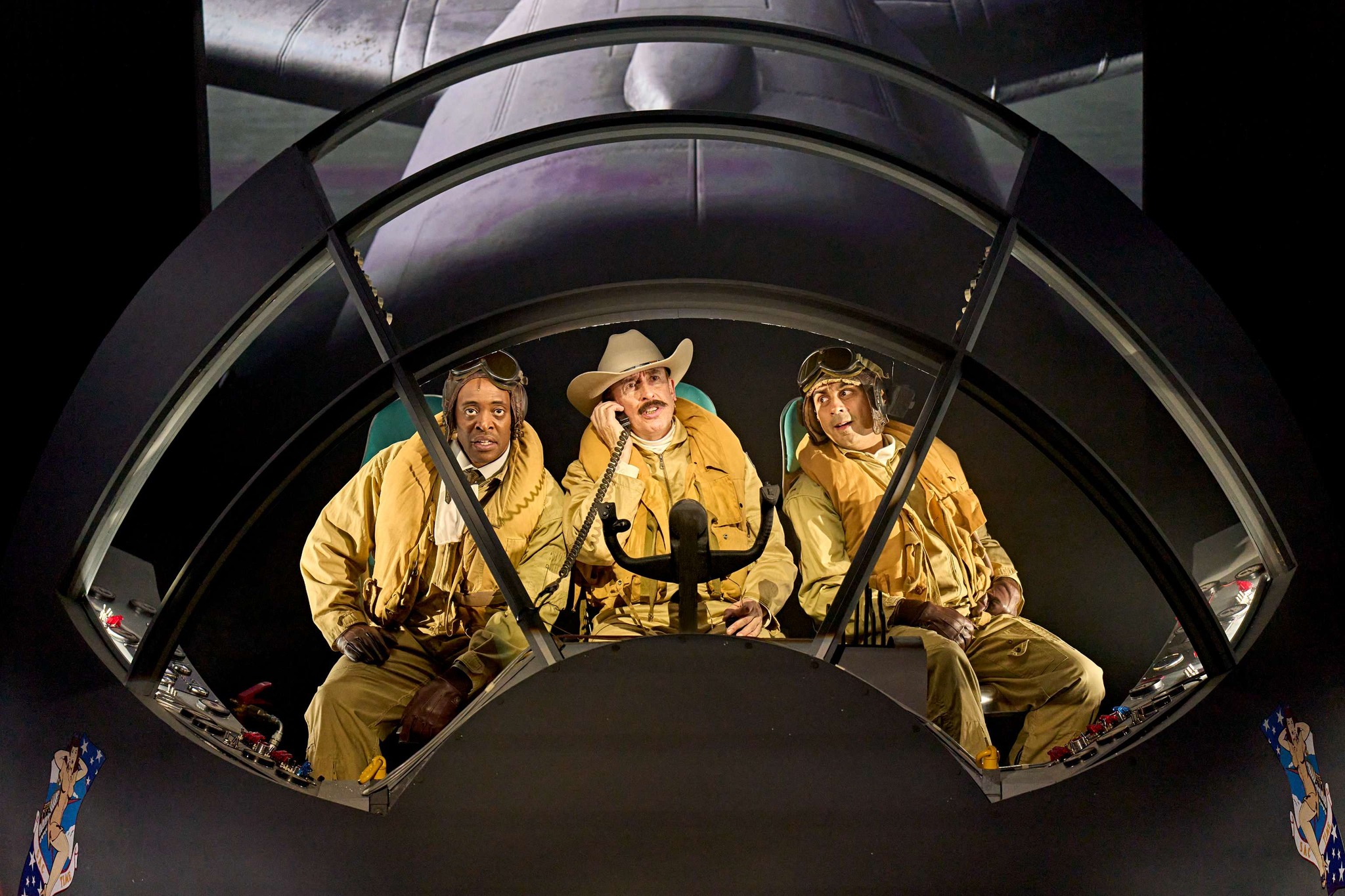
Brigadier General Jack D Ripper (John Hopkins) has a paranoid breakdown and orders a B52 bomber, piloted by Major TJ ‘King’ Kong (Coogan, in one of four roles) to drop a nuclear device on a target in the Soviet Union. President Merkin Muffley (also Coogan), after being briefed by General Buck Turgidson (Giles Terrera), finds himself presented with the tricky task of contacting the Russian President to warn him of the incoming attack. The Russian premier is understandably not too happy about the situation, especially when he learns that the aircraft is maintaining complete radio silence, and that the attack can therefore not be called off.
A whole series of disastrous events ensue…
This brilliantly-staged production is a weird hybrid – part play, part film – and at times it is astonishing in its sheer invention. Coogan is extraordinary. Like Peter Sellars before him, he also takes on the role of RAF officer Group Captain Lionel Mandrake and, of course, the titular Dr S, a man who can’t seem to stop himself from making involuntary Nazi salutes… (Now where have I seen that recently?) Some of the lightning-fast costume changes he’s obliged to undergo are so slickly done that I’m left gasping.
But it’s not just Coogan who excels here. Hopkins plays the cigar-chomping, alpha male, Jack D Ripper with panache, while Terrera milks plenty of laughs as the scheming, self-serving Turgidson. There’s a huge cast at work here and every one of them is drilled to perfection.
Hildegard Bechtler’s set design is accomplished, opening and closing to disclose a wild variety of settings, even managing to convincingly place the audience in the cockpit of a B52 bomber, flying over mountainous terrain. Iannucci handles the adaptation with a light touch, capturing the original film perfectly and only occasionally tweaking the script to accommodate more recent references.
You don’t have to have seen the original to appreciate this superb production, but it might prompt many to investigate it on streaming. Kubrick made many great films over his long career and was famously pernickety about his work. But I have no doubt that he would be absolutely delighted by what director Sean Foley and his team have done with what could be the filmmaker’s greatest achievement.
5 stars
Philip Caveney


 Bouquets & Brickbats