Paul Higgins

This is Memorial Device

05/04/24

Traverse Theatre, Edinburgh

A band does not become a cult all on its own – it takes devoted followers to propel it into those glorious realms, and music critic Ross Raymond (Paul Higgins) is one such follower. We’ve been summoned to a cluttered storage room in Airdrie, wherein he has assembled all the mementos of his youth, the time when he fell head over heels in love with the titular band, the greatest musicians you’ve never heard of. And he so desperately wants to spread the love, to show us exactly why they are legendary, it’s almost embarrassing.

This is Memorial Device, produced in association with The Lyceum Theatre and the Edinburgh International Book Festival, is based upon the acclaimed novel by David Keenan. Graham Eatough’s adaptation is essentially a monologue, though it’s augmented by filmed contributions from four other actors – Julie Wilson Nimmo, Mary Gapinski, Sanjeev Kohli and Gabriel Quigley – all of whom have their own respective ‘memories’ to share. And there are, of course, the four showroom dummies, who stand in for the members of the band, lovingly assembled by Raymond as the story unfolds.

He proudly shows us the various bits and pieces he has curated over the years – the scrapbooks, the vinyls, the cassettes and the T-shirts, the various scribblings and doodles in which he perceives some kind of hidden meaning. His fervour is evident, his wild-eyed enthusiasm utterly compelling as he darts back and forth across the stage, attempting to demonstrate the qualities that first drew him in to the band’s orbit, that first made him want to give them his allegiance.

Higgins submits an extraordinary performance and there’s enough detail here to convince us that this band actually existed. The music by Stephen Pastel and Gavin Thomson completes the illusion and the production hits a fevered peak as Raymond attempts to lead us in a chant hidden within the music that (sadly) only he can hear. If you’ve ever fallen for the charms of an obscure rock band, purchased all their music and followed them from gig to gig with their name proudly emblazoned on a T-shirt, then you’ll identify with what’s happening here.

A hit at this year’s Fringe, This is Memorial Device is back for a short run at The Traverse. If, like us, you missed it, here’s your chance to rectify the situation and become a believer.

4 stars

Philip Caveney

The Meaning of Zong

20/04/22

Lyceum Theatre, Edinburgh

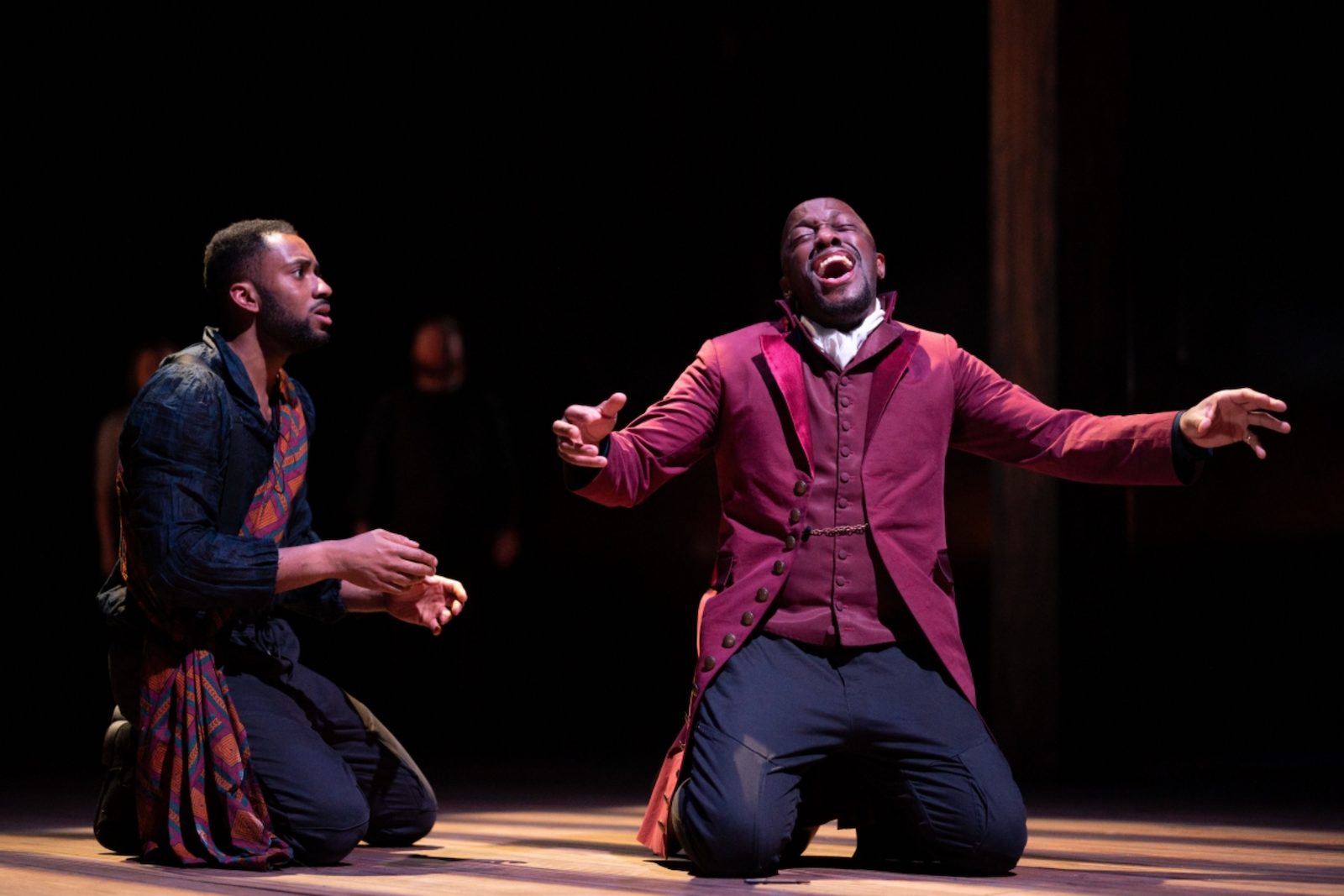
The Meaning of Zong opens in a contemporary UK bookshop, where Gloria, a young black woman (Kiera Lester), attempts to tell the white staff that they have misclassified a book about the Atlantic slave trade. They’re mystified. “It’s in African history,” they tell her. “But it’s British history,” she replies. They don’t understand, prevaricating with platitudes about ‘being allies,’ while vaguely insinuating that such decisions are taken by a distant boss. Gloria’s frustrated, but help is at hand, in the form of Olaudah Equiano (Giles Terera), a former slave, who steps out of the history book to tell Gloria (and us) his tale.

And the tale he tells is truly shocking: a shame-inducing account of an event so appalling it ought to be common knowledge. That it is not speaks volumes, illuminating the importance of that opening scene. If we don’t even acknowledge our history, how can we hope to learn from it?

In 1793, Oloudah tells Gloria, there was a massacre on board a British slave ship called The Zong. 132 slaves were thrown into the sea and left to drown, jettisoned because – so it was claimed – there was a shortage of drinking water, and so their killing was a “necessary” act. Not only did they commit murder, the ship’s owners also put in an insurance claim for the loss of their “property.” The insurers disputed the claim, of course (because some things are immutable), but not before Oloudah chanced upon the case, and joined forces with anti-slavery campaigner Granville Sharp (Paul Higgins) and shorthand secretary Annie Greenwood (Eliza Smith) to ensure the case was brought to public attention. The slave owners’ blatant dismissal of human beings as “cargo” caused outrage, and proved to be a significant step on the path towards abolition.

Although it’s an ensemble piece, this is very much Terera’s project: as well as playing Oloudah, he is both writer and co-director (along with Tom Morris). It’s a spectacular achievement, making bold social and political points, while still being playful and overtly theatrical. He pulls no punches and yet we’re on his side; he never lets us off the hook, but we feel galvanised rather than defensive.

We never witness the massacre. Instead, we are shown the legal struggle Oloudah and Granville mount to have the court’s ruling overturned. Instead, we are shown the strength of three female slaves (Lester, Bethan Mary-James and Alice Vilanculo), recounting the story of Anansi, the spider god, calling on the spirits to save them. And one of them – unnamed – is saved, clinging to a rope, reaching through the years to become Terera’s inspiration for this devastating reminder of our collective guilt.

Jean Chan’s set is a thing of beauty, reinforcing the notion that everything is connected, that we can’t escape our past just by shutting our ears and hiding things away. Thus Westminster Hall’s magnificent wooden ceiling is also the slave ship’s hull; the judge’s bench is also a Waterstones bookshelf. The furniture we sit on, the cutlery we use, the sugar we sprinkle in our tea: these things are all linked to slavery, Oloudah tells Gloria – and the truth will out.

Sidiki Dembele’s onstage drumming is both powerful and provocative, first bringing the audience together then silencing us with its force. It’s the perfect accompaniment to a story that demands to be heard.

The Meaning of Zong has already finished its run at the Bristol Old Vic, and only has a few more days here in Edinburgh before it moves on to Liverpool. It’s worth seeking out. We mustn’t let this story fade away. It belongs in the bookshop’s window, not relegated to a forgotten shelf.

4.7 stars

Susan Singfield