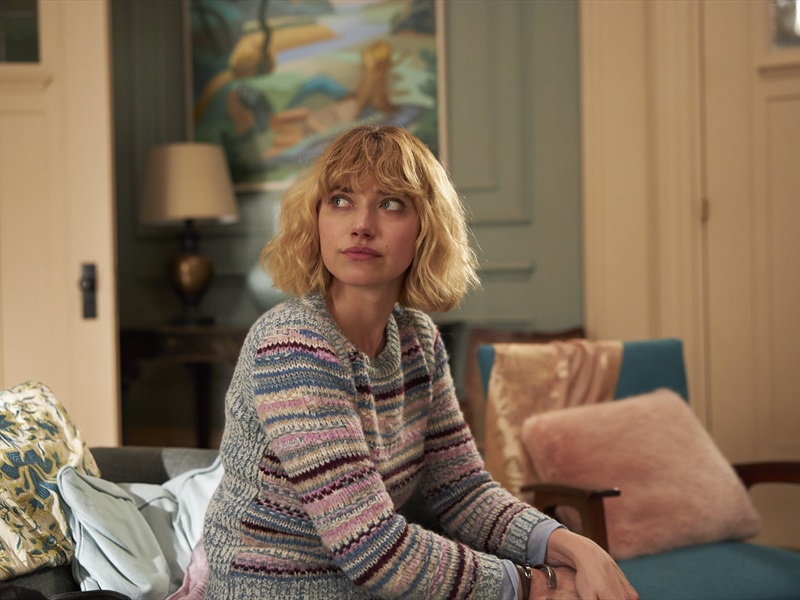
Olivia Williams

The Trouble with Jessica

06/04/24

Cameo Cinema, Edinburgh

The Trouble With Jessica is at the Cameo tonight, and so are director Matt Winn and lead actor Shirley Henderson, here for a Q&A. The place is bustling. Indeed, the only seats we can find are in the very front row, but that’s okay. We settle down in the comfy velvet chairs and stretch our legs out, making the most of the space.

TTWJ is essentially a comedy of manners, drawing on elements of farce. It goes to some dark places – including suicide, depression and rape – but always (trust me) with humour, eliciting belly laughs from tonight’s audience. Winn treads that precarious line well.

Sarah (Henderson) and Tom (Alan Tudyk) have invited their best friends over for what Sarah dramatically announces will be the last dinner party they’ll host in this house. Tom’s latest architectural project has flopped, and they need to sell their beloved home to save themselves from going under. But Beth (Olivia Williams) and Richard (Rufus Sewell) have brought along an extra guest, a mutual ‘friend’ called Jessica (Indira Varma), whose recent memoir has become a bestseller. Sarah is not pleased. She’s no fan of Jessica’s and, as soon as the titular character begins to speak, it’s easy to see why. She’s awful.

And then she kills herself in Sarah and Tom’s garden.

Sarah is furious. The house sale might be jeopardised! Her kids might have to go to state schools! They might have to live in a rubbish part of London! There’s nothing for it. They’ll have to move the body, pretend the suicide occurred elsewhere…

Through all the deliciously heightened nonsense that follows, the only thing I find hard to believe is that Sarah and Beth would keep up their friendship with Jessica. She doesn’t seem to have any redeeming features. She’s slept with two of Beth’s boyfriends and flirts incessantly with Tom. She’s rude and demanding and I don’t know anyone who’d put up with her.

That aside, I enjoy this film.

There is a charming cameo from Anne Reid as a nosey neighbour, and a wonderfully sinister series of scenes with Sylvester Groth as the potential house buyer. Jonathan Livingstone and David Schaal are very funny as PCs Terry and Paul, working-class foils to all the hoity-toity hogwash (although PC Paul recognises a decent clafoutis when he sees one).

It’s a stylish movie. The camera often lingers on the loveliness of the house, like an estate agent’s puff piece, reminding us of what’s at stake. Yes, Sarah and Tom are very privileged and it’s easy to mock their first world problems – but no one wants to lose what they have accrued; no one wants to fail, to have to step backwards. Of course they’d probably be fine if it all went tits up – but it’s no surprise they don’t want to put that theory to the test. It’s more relatable than its milieu might make it sound.

I like the title cards that act as introductions to the various ‘chapters’, each beginning The Trouble With… Tension mounts as the quartet struggle to come to terms with what they’re doing, as well as to manage the practicalities. Henderson in particular is riveting, her brittle capriciousness a delight to watch.

The Q&A is interesting too; it’s good to find out a little more about the process – especially Winn’s composition of the score – and it’s always a thrill to be in the same room as the people you’ve just been watching on the screen.

Once home, I find myself googling clafoutis recipes. Guess what we’re having for pudding tonight?

4 stars

Susan Singfield

The Father

11/06/21

Cineworld

It’s been over a month since the 2021 Oscars, where The Father won awards for best male actor and best adapted screenplay, but somehow it seems I’ve been eagerly awaiting its arrival for much longer than that. It’s finally here, available to view on the big screen, where its powerful narrative pulses from every frame.

Anthony Hopkins is, it seems, the oldest recipient of the best actor award and we know, don’t we, that sometimes such honours are handed out because it’s late in an actor’s career and there might not be another chance to reward him? But make no mistake, his performance in the lead role is a genuine tour de force. As ‘Anthony,’ a widowed man enduring the terrifying, mind-scrambling rigours of Alzheimer’s, he pulls out all the stops, taking his character through a range of moods and manifestations – from grandstanding showoff to sly insinuator – before delivering a final, desperate scene that is absolutely devastating.

Those seeking a rollicking, sidesplitting comedy should be warned: this is not the film for you.

Anthony – when we first encounter him – is living alone in his spacious London apartment, where he’s receiving regular visits from his compassionate daughter, Anne (Olivia Colman). Anthony has recently dismissed his paid carer, claiming that she’s stolen his watch, and he’s adamant that he will not, under any circumstances, move out of the place that he has always regarded as home. But as the story progresses, the touchstones of his life crumble one by one as the familiar things around him begin to change at a terrifying rate. The place doesn’t look the same… items have been moved, rearranged. Anthony’s favourite painting is missing… and why does somebody by the name of Paul (Mark Gatiss) parade around saying that this is actually his apartment? Who is Paul exactly? Anne’s ex-husband? If so, who’s the other Paul (Rufus Sewell), and why does he act like he owns the place? And what’s all this nonsense about Anne moving to Paris?

Perhaps the new home help, Laura (Imogen Poots), might be able to put things in order, but why does she remind Anthony so much of his other daughter, Lucy, the one he seems to have lost touch with? And most bewildering of all, why is it that sometimes, even Anne appears to be a different person than she used to be?

Florian Zeller’s astonishing film, adapted from his stage play, unfolds almost like a psychological horror story, as Anthony struggles to take in what’s happening to him. While I expected this to be bleak, I’m not fully prepared for the power with which it hits me. There’s doubtless extra impact because, for the last ten years of her life, my own mother was afflicted by Alzheimer’s and I recognise many of the beats here as being absolutely authentic. Perhaps that’s why the tears are rolling so copiously down my face.

Despite being confined mostly to one set, The Father never feels stage bound, because so much of what I can see onscreen is in a constant state of flux and because, at times, I feel every bit as unsettled as Anthony does. I’m never entirely sure where a scene is taking place, when it it is set and who is present in it – and that’s not meant as a criticism, but as an observation about the story’s unsettling grip on me. While there was aways a danger of The Father being completely dominated by Hopkin’s extraordinary performance, Colman is as excellent as always, managing to kindle the audience’s sympathy with a mere glance. And Olivia Williams is also compelling as the film’s most enigmatic character.

I walk out of the cinema, bleary-eyed from crying and, if I still have a few unanswered questions, well, that feels exactly right. This is an assured film that handles its difficult subject with rare skill.

So, worth the wait? Most definitely. But maybe remember to take some hankies?

5 Stars

Philip Caveney

Rushmore

12/01/18

Wes Anderson is one of contemporary cinema’s most original talents. Although his subjects are diffuse and far-ranging, his movies are always shot through with an idiosyncratic sensibility that marks him out as a true auteur. With his new release, Isle of Dogs, looming on the horizon, this is clearly a great time for a retrospective of his work and Edinburgh’s Cameo Cinema have seized the moment by devoting Monday evenings to showings of all his full length films in chronological order. It also gives me the welcome opportunity to see the one Anderson film that has thus far eluded me.

After the incendiary calling card of Bottle Rocket, 1998’s Rushmore is the film that cemented Anderson’s reputation as a force to be reckoned with but, for a whole variety of reasons, I have never managed to catch up with it until now. It’s the story of Max Fischer (Jason Schwartzman) a fifteen-year-old student at the titular preparatory school who has an obsessive genius for organising clubs and societies, even if this means that his actual school work consistently falls short of its potential. He also writes and directs hilariously over-ambitious school plays – his adaptation of Serpico needs to be seen to be believed.

Max chances upon what he feels is a kindred spirit in Herman Blume (Bill Murray), a dispirited businessman who, despite considerable wealth, has become disillusioned with his loveless marriage and the antics of his two oafish sons. He is quite happy to fund some of Max’s madcap enterprises. Max’s acquisitive eye also falls on a new teacher, Rosemary Cross (Olivia Williams), whom he starts to pursue in reckless fashion, even attempting, as a declaration of his love for her, to build a massive aquarium on the school sports field, without even bothering to seek permission. When Rosemary and Herman start an affair, Max is devastated – and takes out his anger in ways that will have disastrous consequences for his future…

Rushmore is an unqualified delight from start to finish and Schwartzman’s performance in the lead role is an extraordinary tour de force. Max is an inspired creation, a charming maverick who, despite a surfeit of confidence, still has an appealing vulnerability. Bill Murray puts in a sanguine and understated effort as the jaded businessman and, as the film progresses, I find myself wondering why we haven’t seen a lot more of Olivia Williams on the big screen, because she offers a beguiling presence as Rosemary.

For me this is up there with Anderson’s finest work (and that’s praise indeed). The completist side of me is very happy to have finally had the chance to tick this off my ‘to see’ agenda. Any other Anderson fans who fancy catching up (or reconnecting) with his work on the big screen should keep their eyes peeled for subsequent showings. Even his slighter efforts are never less than interesting.

4.6 stars

Philip Caveney