Neil Bettles

Driftwood

05/03/25

Traverse Theatre, Edinburgh

The opening moments of Driftwood are intense. To say this co-production by ThickSkin and Pentabus thrusts us straight into the action would be an understatement. One moment we’re in a brightly lit auditorium, muted chatter all around us, eyes drawn to the hypnotic rippling of the backdrop’s projected seascape. The next – without warning – there’s a blackout, paired with the thunderous roaring of crashing waves, and two boys, Mark and Tiny, in danger of drowning, are yelling each other’s names, desperately scrabbling to make it to shore.

That’s the past. And then, suddenly, we’re in the present. The boys are now men. Tiny (Jerome Yates) isn’t so tiny any more, and he hasn’t seen his older brother, Mark (James Westphal) in years. Not only is Tiny still in County Durham, he’s still in Seaton Carew, still living with their dad. He feels connected to the area – to its shoreline, its myths and to his family history. Anyway, he couldn’t leave if he wanted to. His dad needs a full-time carer and Tiny has filled that role for the past four years.

But now he finds himself on shifting sands. Dad is about to die. Mark – gay, estranged from his homophobic father – has come back from Manchester to say goodbye. The brothers love each other but they resent each other too. Tiny’s angry that he’s been left alone to cope, while Mark can’t quite forgive Tiny for sticking with the old man, nor for parroting his father’s homophobic slurs when he was young.

Tim Foley’s sprightly script keeps the story moving forward, even though most of the real drama happens offstage, the focus instead on the brothers’ relationship and their attempts to reconcile their differences. So we don’t get to meet Dad, nor to attend his funeral; we don’t see the arguments that led to Mark leaving; we’re told about but never shown the environmental protests dividing the town. It doesn’t matter. The piece feels very immersive nonetheless, thanks in no small part to Sarah Readman’s videos and Lee Affen’s rousing sound design. The ever-present image of the closed steelworks looming over the bay is affecting, reminding us throughout how bleak Tiny’s life is, his stubborn attachment to his home equal parts understandable and heartbreaking.

Yates and Westphal imbue both brothers with a likeable vulnerability: Mark’s obscured by a brittle carapace of self-protection; Tiny’s writ large in his wide-eyed naïvety. Co-directors Neil Bettles and Elle While strike an impressive balance between stillness and dynamism, Mark’s quiet rationalism contrasting effectively with Tiny’s chimerical obsessions. I especially like the funereal pace of the scene where the brothers dress for their father’s burial, the conceit conveying the emotions of the funeral without explicitly placing us there.

On tour until 31st March, Driftwood has – ahem – drifted on from Edinburgh now, but you can still catch it in Coventry, Ipswich, Leeds and Salford. It’s well worth an evening of your time.

4.2 stars

Susan Singfield

Peak Stuff

01/03/24

Traverse Theatre, Edinburgh

ThickSkin Theatre have a reputation for ambitious, cutting-edge theatre and I’m happy to say that Peak Stuff – a riveting new play by Billie Collins – does not disappoint. Indeed, this edgy slice of words and music manages to keep me on the edge of my seat throughout. 

I’m immediately pulled in by the ingenious set design, which has drummer Matthew Churcher poised in the midst of a hollow, which is itself surrounded by a series of flat panels onto which Jim Dawson and Izzy Pye’s video designs are projected. Churcher is, in effect, the beating heart of the story, his intricate, propulsive rhythms combining with the soaring, majestic music of Neil Bettles (who also directs) and interacting with the narratives of three disparate characters, all memorably played by Meg Lewis.

Alice is a disaffected teenager, who is both appalled and galvanised by the awful reality of life in the 21st century. The world is burning and nobody seems to care! She’s determined to make her voice of protest heard above the hubbub, but is unsure of exactly how to go about making it happen. Ben works in marketing and is a loner, currently living in his mother’s house, which he is steadily filling to bursting point with a whole series of pointless purchases. They include a massive collection of branded trainers, which he never even takes out of their boxes. Online influencer Charlie is gleefully devoting herself to her latest project: selling parts of her body online to the highest bidder, starting with the little finger of her left hand…

How the lives of this strange, unconnected trio unfold is the bedrock upon which Peak Stuff is built – and the greatest wonder of this multifaceted piece is that there are so many ways it could go wrong; the whole edifice could easily collapse in upon itself in a stream of disconnected words, music and lights. The fact that it never does is surely testament to how tightly drilled this creative unit is. Lewis moves effortlessly from character to character, with just the slightest of changes to her voice and posture; Churcher keeps supplying those metronomic rhythms as the excitement steadily builds – and the three narratives combine with the eye-popping video projections which take us from Albert Square, Manchester to the heart of a blazing building.

This is bold, experimental theatre at its finest and the tumultuous applause that greets the final chord is evidence that tonight’s audience has been just as thrilled as I am.

4.6 stars

Philip Caveney

How Not To Drown

29/03/23

Traverse Theatre, Edinburgh

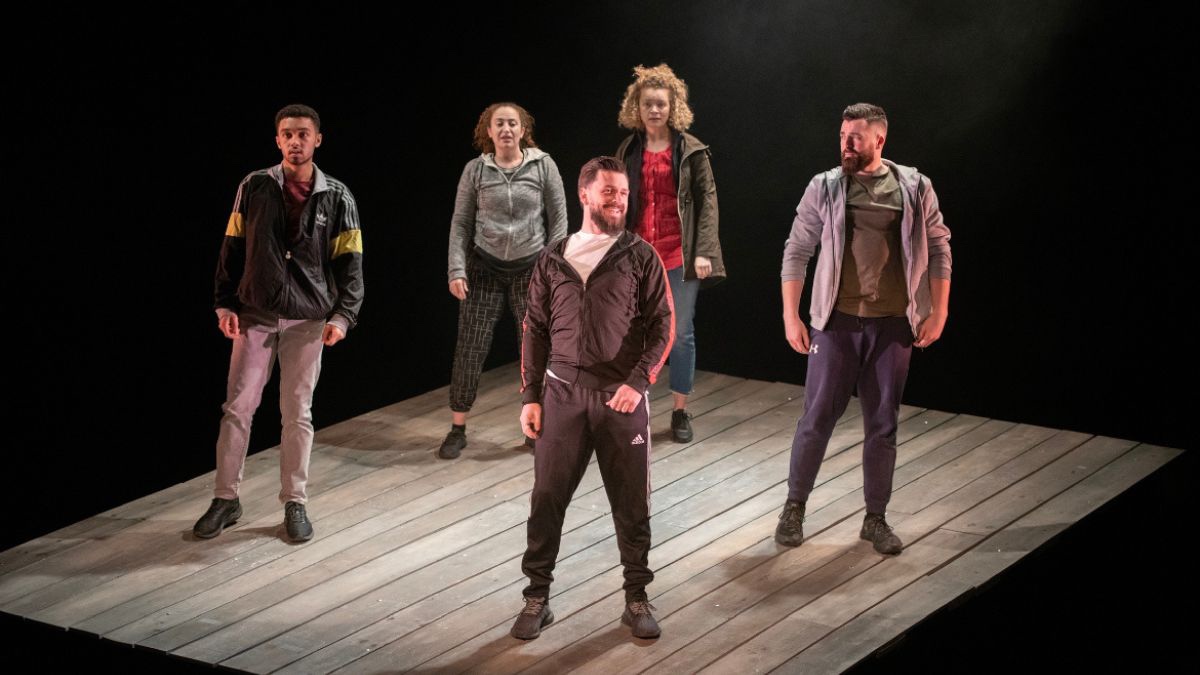
The first thing that captures my attention as I enter the auditorium is Becky Minto’s extraordinary set: a raised island of wooden planks, stark, powerful, simultaneously ramshackle and magisterial. There’s no other set dressing here, just two high towers of lighting on either side of the island, leaving lighting designer Zoe Spurr and composer/sound designer Alexandra Faye Braithwaite to layer on the atmosphere. Onto the dramatically sloping set climb the performers, five actors led by Dritan Kastrati, whose real life story is the inspiration for what we are about to watch (and who co-wrote the script with Nicola McCartney). But it’s clear from the outset that this will be an ensemble piece, as each of the actors in turn – Ajjaz Awad, Esme Bayley, Daniel Cahill and Sam Reuben – step forward to announce that they too are Dritan.

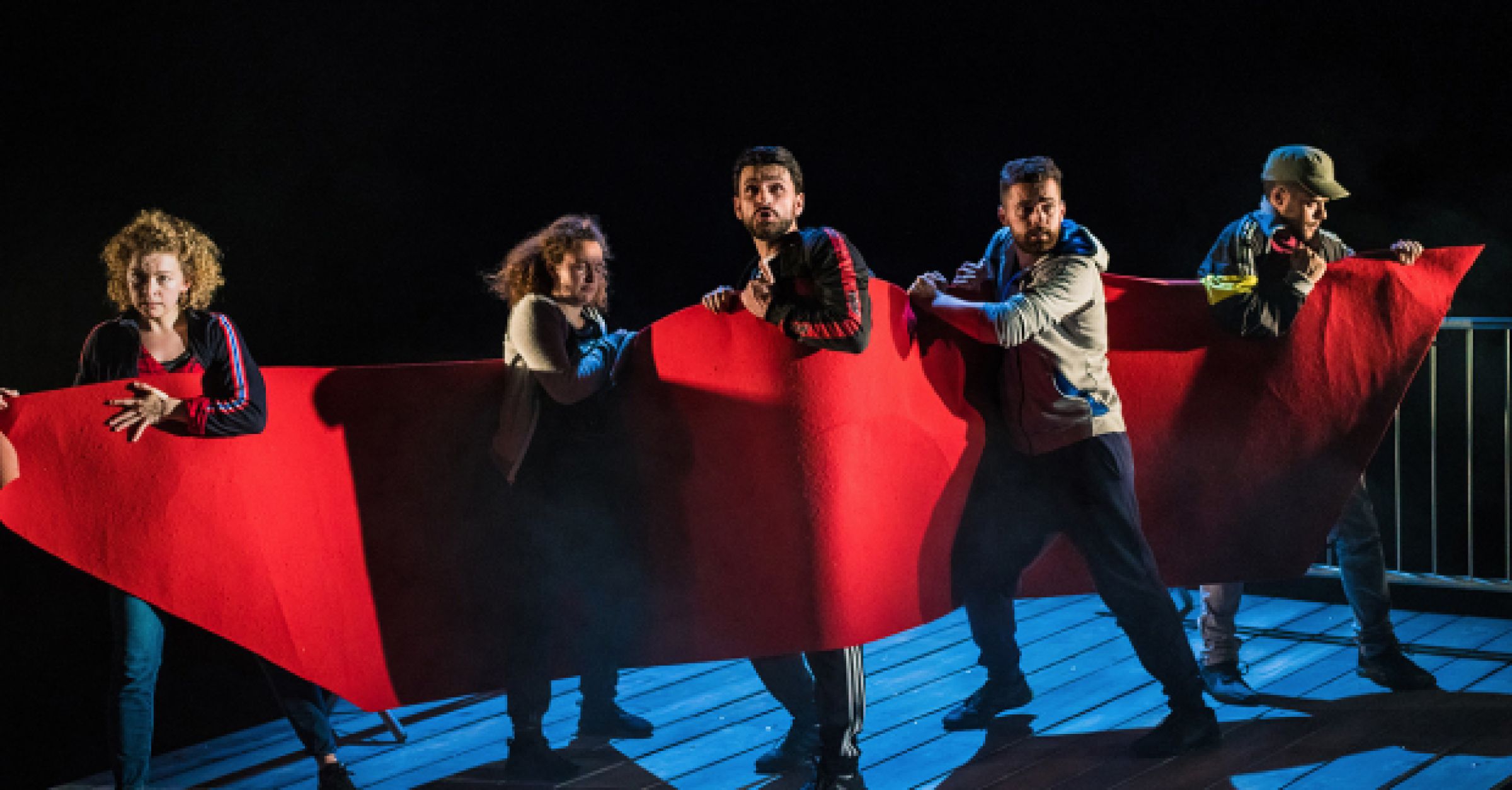
The drama unfolds, as the cast move back and forth on that precarious island, each actor in turn slipping into the role of Dritan, and skipping nimbly out again to portray a whole selection of other characters. There is never a moment’s confusion as to who is who. Director/ choreographer Neil Bettles has the cast drilled to perfection, as – with a modicum of props – they evoke a series of diverse locations and situations… and then, in a jaw-dropping coup de théâtre, the island begins to move.

Dritan’s story is one of abandonment and survival. At the age of eleven, he’s despatched by his well-meaning father from the family home in Albania, as war threatens to engulf the country. What follows is Dritan’s arduous attempt to get to his older brother somewhere in England, a difficult and sometimes dangerous journey. A sequence that portrays a perilous sea crossing feels horribly immersive, capturing the panic and uncertainty of the situation.

 Once in the UK, Dritan is confronted by the punishing series of hurdles faced by all young asylum seekers – a thankless procession of foster families, social workers and interpreters, each trying to give this boy whatever he asks for, but failing to provide him with the one thing he really needs: a family. We watch as his hopes and expectations crumble into dust.

How Not to Drown isn’t easy viewing, yet I wholeheartedly recommend it. It’s a powerful and affecting examination of the failure of bureaucracy, demonstrating all too clearly the problems that occur when it comes to caring for a child, cast adrift from everything he knows. Dritan Kastrati is only one of millions of people who have survived this awful situation, but his play brilliantly illuminates the experience like a beacon shining in a storm.

4.4 stars

Philip Caveney

The Unreturning

24/10/18

Traverse Theatre, Edinburgh

The Traverse Theatre is sold out tonight, testament to the fact that Frantic Assembly are arguably the UK’s leading exponent of physical theatre. The fact that their work is on many a drama exam syllabus may account for the scores of teens in the audience, or maybe it’s just that everyone already knows how good they are. Either way, this co-production with the Theatre Royal Plymouth is currently touring the country, and the word of mouth has clearly been good enough to pull in a crowd.

As we take our seats, a large metal shipping container appears to be floating centre stage on a pool of rippling water. The lights dim, the music begins to pulse and sliding doors in the container open and close introducing us to the four young actors who will be presenting Anna Morgan’s The Unreturning. Then the container starts to spin like a well-oiled merry-go-round and, from the very first moment right up to the powerful ending, I am totally mesmerised.

This is a story set in three different time periods. In 1918, young army officer George (Jared Garfield) returns from the trenches traumatised by the horrors he has endured and longing to be reunited with his wife, Rose. In 2018, squaddie Frankie (Joe Layton) comes back from a tour of Iraq in disgrace, after participating in an act of mindless violence after the death of one of his comrades. And in 2026, Nat (Jonnie Riordan), who has fled to Norway in order to avoid conscription in the UK, decides to head back to his homeland in the hope of reconnecting with his younger brother, Finn (Kieton Saunders-Browne), with whom he has recently lost contact. All three men are heading for the same place: their home town of Scarborough.

This is a tale about young men and the shattering effect that war can have on them. It is also about the importance of home and about what it represents to different people.  It is simultaneously a requiem for the past and a chilling warning for our potential future. Director Neil Bettles handles the piece with consummate skill as the four actors flit athletically from role to role, somehow finding time to refigure their costumes, so I am never in any doubt as to where I am or when I am. Morgan’s haunting prose is augmented by incredible physicality as the actors run, leap, clamber and whirl around the stage in a series of perfectly choreographed moves. Special praise must go to Andrzej Goulding’s deceptively simple set design, which allows the shipping container to be all manner of locations: a ruined house, a boat, a vehicle speeding along a motorway…

Look, I won’t beat about the bush here. This is, quite simply, a brilliant piece of theatre. If it comes to a venue near you, please don’t miss the opportunity to see it. It really is very accomplished, an absolute wonder to behold.

5 stars

Philip Caveney