
Mike Leigh

Lollipop

17/06/25

The Cameo, Edinburgh

Lollipop is writer-director Daisy-May Hudson’s debut feature film – and what a promising start this is. Sure, she’s treading in the footsteps of working-class champions such as Ken Loach and Mike Leigh, but – if this fiercely female and decidedly 2020s tale is anything to go by – Hudson is also forging her own path.

‘Lollipop’ is Molly (Posy Sterling)’s childhood nickname, but she’s come a long way since those innocent days. She’s just spent four months in prison – for an unspecified crime – and is looking forward to getting out and being reunited with her kids, Ava (Tegan-Mia Stanley Rhoads) and Leo (Luke Howitt). But things have gone awry while she’s been away: not only has she had to give up her flat, but her flaky mum, Sylvie (TerriAnn Cousins), who was supposed to be looking after the children, has handed them over to social services instead. “Don’t start,” she says, when Molly confronts her, aghast. “I can’t cope with you starting.”

Of course, once they’re in the system, the children can’t just be handed back. There are teams of people tasked with ensuring their welfare. How can they return Ava and Leo to Molly’s care when she’s homeless, pitching her tent illicitly in the park, washing in a public loo? But it’s Catch 22: Molly isn’t a priority for housing because she hasn’t got her kids with her. She’s going round in circles, and that’s not helping her already fragile mental health. However caring the individual professionals are – and they are decent, compassionate women, on the whole – the process seems designed to deny her any possibility of making good.

A chance encounter with an old school friend, Amina (Idil Ahmed), offers a glimmer of hope. Amina has her own problems: she’s separated from her husband, and living in a hostel with her daughter, Mya (Aliyah Abdi). But Amina is a natural optimist with an abundance of energy, spreading joy in the simplest of ways. She hosts a daily ‘party’, where she and Mya dance to their favourite tunes, while a disco ball transforms their dismal walls with colour and light. When Molly reaches breaking point, afraid she’s going to lose her kids forever, it’s Amina who breaks her fall…

It’s impossible not to draw comparisons with the second series of Jimmy McGovern’s acclaimed TV series, Time, which saw Jodie Whittaker’s Orla facing a similar situation, fighting against a failing and underfunded system that not only hurts people but also encourages recidivism. This doesn’t detract from Lollipop‘s power; sadly, it only serves to highlight the ordinariness of this extraordinary horror.

Sterling imbues the central role with so much heart that I defy anyone not to cry when they see Molly lose the plot at a resource centre, not to hold their breath while they wait for the court’s verdict. Newcomer Ahmed is also perfectly cast, lighting up the screen with her ebullience, although Amina also experiences great pain. Cousins infuriates as the selfish Sylvie, letting Molly down at every turn, but somehow still evoking our pity, and young Rhoads is heartbreakingly convincing as a little girl negotiating adult trauma before she’s even hit puberty.

Lollipop is a devastating but beautifully-realised film, as vital and engaging as Sean Baker’s The Florida Project (with which it shares some DNA). It’s the sort of potent story that ought to be the catalyst for change. Let’s hope.

4.5 stars

Susan Singfield

Hard Truths

01/02/25

Cineworld, Edinburgh

It’s been quite some time since we had a new film from Mike Leigh. His last, 2018’s Peterloo, made for Amazon, was an attempt to transfer his inimitable style onto a bigger canvas and the results were somewhat mixed. With Hard Truths, he’s back on what feels like his home turf, in one of his intimate, unflinching examinations of the human condition.

Pansy (Marianne Jean Baptiste) is in a bad way. Plagued by awful nightmares, she’s not a great deal happier when awake and is prone to unleashing her acid tongue on anybody unlucky enough to cross her path. Her regular targets include her monosyllabic husband, Curtley (David Webber), and her disaffected son, Moses (Tuwaine Barrett), who has taken to reading children’s picture books and blocking out sound with his headphones, while she snarls and raves. And there are plenty of others who find themselves targets for a tongue-lashing: various shop workers, luckless members of the public… even the girl at the supermarket till is told to ‘do something about her face.’

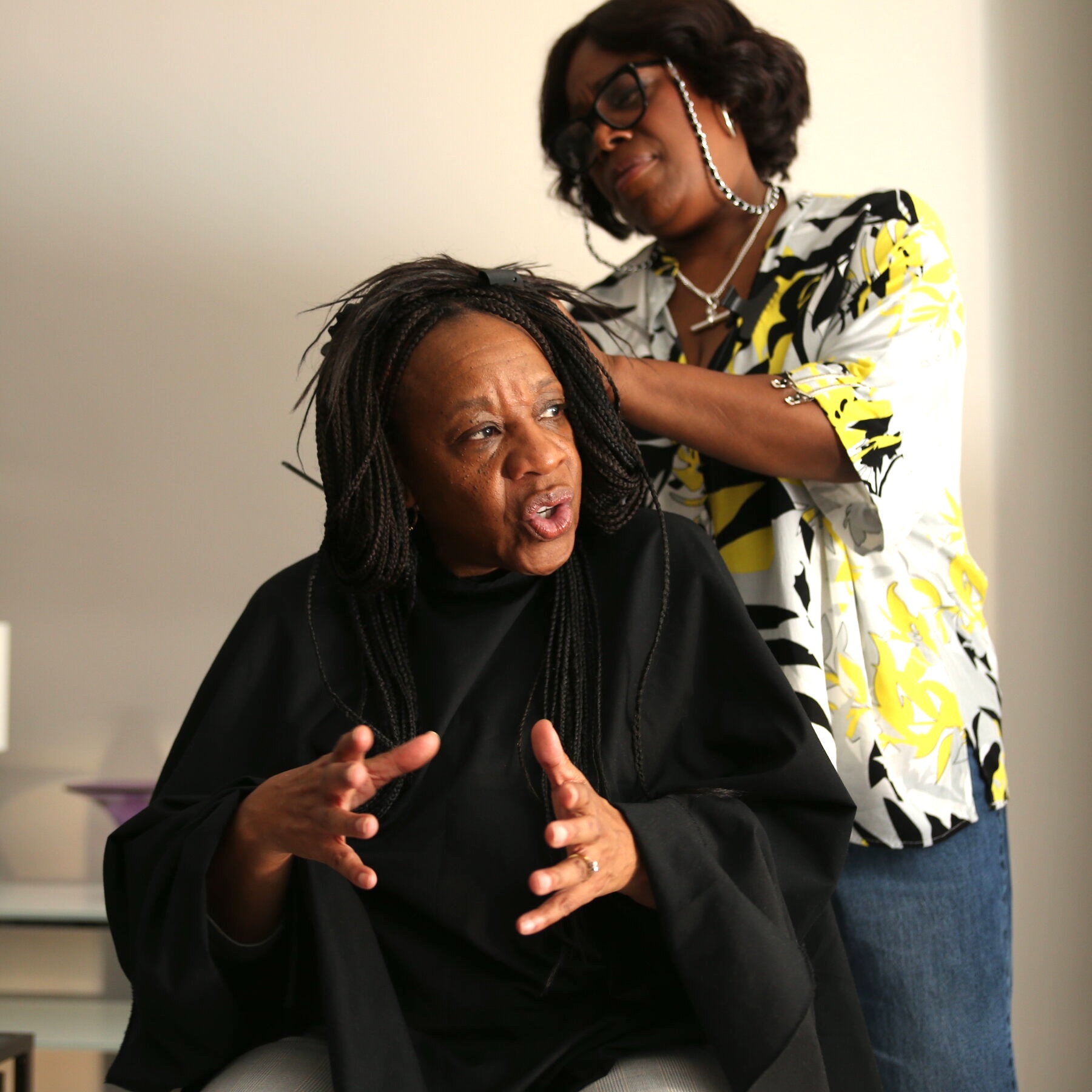
Pansy’s sister, Chantelle (Michele Austin), is her polar opposite. A hairdresser by trade, she has a warm, sunny disposition, always up for a giggle and a gossip, and she has raised her two daughters, Kayla (Ani Nelson) and Aleisha (Sophia Brown), to have the same happy-go-lucky approach to life, even when their own work situations are sometimes challenging.

As the anniversary of Pansy and Chantelle’s mother’s death approaches, a family get-together is planned but making things work with Pansy’s forbidding ‘ghost-at-the-feast’ presence is going to prove a tall order…

This feels like a classic Mike Leigh project and, as ever, his unique approach to filmmaking yields remarkable results. Both Jean Baptiste and Austin offer extraordinarily affecting performances in the lead roles, but the film is more than just a simple two-hander, with all the subsidiary characters beautifully delineated in a series of short set-pieces. Leigh handles a large cast with his customary skill: neither Webber and Barrett is given much in the way of dialogue, but their despair is written large in their desperate sidelong glances. And watch out for Samantha Spiro in a deliciously unpleasant cameo as Kayla’s employer, Nicole.

It’s fascinating to experience the film’s transformation, from the early scenes which are somehow caustically funny (and which have already spawned some internet memes) into a confrontation so utterly heartrending that I find my eyes involuntarily filling up with tears. Hard Truths won’t be for everyone. There’s a devastating melancholy at the heart of this film that seems to seep from the screen, and some of the later scenes make for harrowing viewing. But it’s proof if ever it were needed that Leigh is a unique filmmaker, who has always allowed his actors the creative freedom to explore their characters and in the process, yield extraordinary results.

4.4 stars

Philip Caveney

Abigail’s Party

16/04/19

King’s Theatre, Edinburgh

Mike Leigh’s 1970s drama is one of those pieces everyone just seems to know. I was only six when it was first screened in 1977, far too young to have seen it then, and yet it feels like something I have grown up with, ever-present, with Alison Steadman’s Beverly the towering icon at its heart.

For those few the play has eluded, or whose memories need a jog, Abigail’s Party is a dark comedy, an agonising depiction of social embarrassment. When painfully polite divorcee, Sue (Rose Keegan), needs somewhere to spend the evening while her wayward daughter, Abigail, has the titular party, Beverly (Jodie Prenger) seizes the opportunity to play host, inviting gauche new neighbours, Angela (Vicky Binns) and Tony (Calum Callaghan), to make up the numbers. Beverly’s overworked estate agent husband, Laurence (Daniel Casey), is reluctant – he has business calls to make and has to be up early in the morning – but Beverly prevails. It’s clear that Beverly always prevails. And nothing will stand in the way of her desire to show off her cocktail cabinet and leather three-piece-suite.

It’s a sturdy piece of work, and one that stands the test of time, with far more to offer than the kitsch 70s-pastiche set and costumes might suggest. But these are just a kind of shorthand, a means of settling the audience comfortably into a recognisable time and place, before discomfiting us with the hubris and frailty of the characters on stage.

The acid nature of the couples’ relationships and their collective lack of self-awareness drive the humour here; we, like Sue, are baffled outsiders, blinking at the awfulness of the people before us. Rose Keegan is adroit at conveying a sense of mounting horror, her pleasant manners becoming an ever-less effective method of keeping Beverly at bay.

Prenger, as Beverly, is of course the key to the whole play, and she’s a formidable performer, who has the chops for the part. I can’t help wishing there was less of Steadman here though; director Sarah Esdaile asserts that “Alison is inextricably linked with Beverly’s voice” – she helped create the role – and I know that’s true, but I would prefer to see a different incarnation of Beverly, a new interpretation of this monstrous creature. After all, there are Beverlys everywhere.

Vicky Binns does a cracking turn as the gawky Angela, gamely weathering her taciturn husband’s scorn, and desperate to impress. The saddest moment in the play for me is when she decries her parents’ dreadful marriage, seemingly unaware that her own is a carbon copy; the funniest is her dance. At first, I find her style a bit declamatory but, as the drama progresses, it works: Angela is performing for Beverly.

Calum Callaghan might not have showy stuff to do as Tony, but his dark mood effectively puts a dampener on the evening, quelling every moment of  light-heartedness or potential joy. And Daniel Casey’s Laurence is a fascinating study, almost likeable, but for his desperate snobbishness, and his vengeful urge to humiliate his wife.

An excoriating social satire, Abigail’s Party might press the nostalgia buttons, but it’s still very relevant today.

4 stars 

Susan Singfield


Peterloo

04/11/18

As somebody who lived and worked in Manchester for many years, the title of this film strikes a resonant chord with me. It refers to a particularly horrible massacre which occurred in the summer of 1819, when a huge crowd of peaceful pro-democracy campaigners marched to St Peter’s Field to hear a speech by acclaimed orator Henry Hunt, and were promptly set upon by the local yeomanry and a detachment of Hussars with sabres drawn. In the ensuing melee, 15 people were killed and more than 500 were seriously injured. The event was subsequently airbrushed from the pages of history and rarely spoken of. It’s not taught (much) in schools and many people – even those who live in the city where it occurred – have never heard of it.

One man who clearly thinks of this as a major injustice is Mike Leigh. Peterloo is his attempt to rectify the situation and it represents his most ambitious undertaking to date, portraying the slow build-up to the event and the massacre itself, whilst still employing his unique (at least in film) improvisational technique, where the actors inhabit their characters and devise their own dialogue. I’m sorry to say that I don’t think it works too well when applied to something of such immense scale. Sure, Leigh has visited the pages of history before, both in Topsy Turvey and in Mr Turner but, in both cases, he was working on a smaller canvas. Don’t get me wrong, I’m generally a huge fan of Leigh’s films, but what works brilliantly when applied to more intimate events founders somewhat here. Mind you, to be fair, the film does start well.

We meet Joseph (David Moorst), a young bugler at the Battle of Waterloo, clearly deeply and permanently traumatised by his experiences. The war over, he heads home on foot, to find his family struggling to survive in a country assailed by the corn laws, which prohibit the import of cheap grain. Family matriarch, Nellie (Maxine Peake), and her husband, weaver Joshua (Pierce Quigley), can barely afford to eat, so it’s hardly surprising when they find themselves increasingly drawn into the pro-democracy movement and looking forward to the great day at St Peter’s Field, when thousands of people in similar situations will come together to challenge the powers-that-be. The settings are convincingly done. Here is real squalor, real hardship, a million miles away from the chocolate box imagery so beloved of many period dramas – and early scenes of luckless individuals in court being sentenced to heinous punishments are powerful stuff.

But there are a lot of characters to take in – so many that, inevitably, acclaimed actors are demoted to tiny, walk-on roles. And there are speeches – a lot of speeches – so many that the film’s two hour running time starts to drag, especially in the long sequence depicting the mass gathering at St Peter’s Field. Henry Hunt (Rory Kinnear), heralded as a hero by the protesters, is depicted as a rather unpleasant, horribly self-serving prig who clearly thinks himself a cut above the working-class people whose plight he is supposed to be representing. The people would clearly have been better served by speaking for themselves.

If there’s a problem, it’s that virtually every establishment character we encounter is a smirking, pompous and downright unpleasant individual verging on caricature. This reaches its apotheosis in Tim McInnery’s turn as the Prince Regent, a bloated, giggling buffoon, not so much out of touch with the electorate as living on another planet. Of course the ruling classes’ behaviour was abominable, but this seems crude and over-simplistic.

And then of course, there’s the massacre itself, a lengthy sequence that really ought to bring us to tears of outrage – but the film’s 12A rating obliges Leigh to hold back from making it too visceral and the result, with sabres clearly hitting little more than fresh air just feels clumsy and unfocused. If ever a sequence cried out to be properly storyboarded, this is it.

This isn’t a total dud. Indeed, there’s plenty here that does work but, I think, too much that really doesn’t. I feel bad for not having enjoyed it more. I really wanted to like it, but ultimately, it feels like a missed opportunity. This is such an important subject, one that symbolises a turning point in British history and the democratic movement. I can’t help feeling that it deserves a better film than this.

3.5 stars

Philip Caveney

The Party

26/10/17

Shot in stark (and very unforgiving) black and white and confined pretty much to one set, The Party feels like the kind of thing that Mike Leigh has done so brilliantly in the past – indeed, if it resembles one of his works in particular, it certainly has echoes of Abigail’s Party about it. With a sprightly running time of one hour and eleven minutes, this film, written and directed by Sally Potter, canters amiably along but, though it can’t be accused of overstaying its welcome, it never entirely manages to blow you away.

Janet (Kristen Scott Thomas) is in the mood to celebrate. She’s just been appointed shadow health minister for the ‘opposition’ and has invited some close friends around for vol au vents and bubbly. They are: her snarky best friend, April (Patricia Clarkson), and her partner, the hippy-dippy faith healer, Gottfried (Bruno Ganz); feminist university lecturer, Martha (Cherry Jones) ,and her wife, Jinny (Emily Mortimer), who is currently expecting the patter of er… little triplets; and, definitely the odd one out at this gathering, handsome young property developer, Tom (Cillian Murphy), who explains that his wife, Marianne, will be ‘along later for dessert… or maybe just coffee.’ But it’s not destined to be a happy occasion, because Janet’s morose husband, Bill (Timothy Spall), has something he really needs to get off his chest…

Relentlessly middle class in its themes, the story is mostly about people being unfaithful to one another and, though the performances are generally pretty good, the protagonists cannot seem to help slipping into caricature. April can’t open her mouth without insulting somebody, Martha and Jinny say things in public that any rational person would surely save for later on, and Gottfried is so glib it hurts – but then maybe that’s entirely the point of him. Only Tom seems to have convincing reasons to act the way he does and, indeed, Murphy’s performance is the strongest one here – a man driven by jealousy to do something unspeakable.

Mind you, there’s a conclusion that I really don’t see coming and, all in all, this film makes a decent antidote to the steady diet of superhero movies we’re constantly being offered. I can’t help feeling though, that given the same set up and the same cast of characters, Leigh would have knocked this out of the park.

3.8 stars

Philip Caveney

Mr Turner

MV5BMjUzNTg0MzM3NF5BMl5BanBnXkFtZTgwNDg3NTY5MjE@._V1_SY317_CR0,0,214,317_AL_

7/11/14

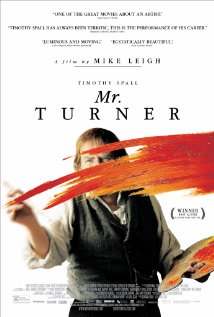
Mr Turner is that rarest of things, a resounding art house success. Judging by the ‘bums on seats ratio’ at my local Cineworld, Mike Leigh has succeeded beyond all reasonable expectation with this biopic of the great artist, Joseph Mallard Turner. It’s a difficult movie, one that obeys few of the rules you’d expect to find in a recent cinematic success – there are no car chases, superheroes or heads exploding in slow motion. But it’s also a richly rewarding experience and one that takes its own sweet time to convey its central message – that great artists exist outside of everyday conventions. For the first time since Topsy Turvy (his impressive biopic of Gilbert and Sullivan), Leigh has eschewed the contemporary ‘talking heads’ routine that is his trademark, to give us a historical piece where he’s employed the canny use of CGI to convey the intrinsic moods of some of the artist’s best-known work.

In the title role, Timothy Spall is simply quite extraordinary. He gives us a grunting, gurning turnip of a hero, a (probably autistic) painter who is hopeless at small talk and who treats the other people who drift into his world as little more than contemptible. We witness his deplorable relationship with Hannah Danby (Dorothy Atkinson), the niece of the woman who bore him two (unacknowledged) children but, nevertheless, a subject of brutal sexuality. We see his idolisation of his father, William (Paul Jesson) and his secretive relationship with Margate landlady Mrs Booth (Marion Bailey), where he finally found true happiness.

The film observes few of the accepted tropes of cinema. There’s no real story arc here, just a series of vignettes, illustrating Turner’s world, his relationships with those around him and his often stormy association with the Royal Academy. But throughout, there is stunning cinematography (by Dick Pope) that eerily recreates some of the man’s finest paintings; there’s dry humour -particularly in  the scenes with Ruskin (John McGuire), which serve to accentuate Turner’s lifelong hatred of critics, and there’s the stunning scene where Turner turns down the offer of £100,000 for his complete works from a rich benefactor, insisting that he wants to bequeath his paintings to ‘the nation.’

Mike Leigh is, quite simply, an anomaly. In an age where cinema is increasingly ruled by those who seek to champion the everyday, he is, quite simply, a national treasure, a man who ploughs his own furrow and does so on his own terms. Mr Turner will either leave you cold or cut you to the marrow. I’m happy to say that I belong to the latter category.

4.7 stars

Philip Caveney