
Meghan Tyler

Variant

28/03/23

Traverse Theatre, Edinburgh

The latest in this A Play, A Pie and A Pint season is Variant, written by Peter Arnott and directed by Kolbrún Björt Sigfusdöttir. It’s a distinctly Beckettian slice of absurdist theatre, a slippery two-hander that seems to question the very essence of identity. Who are we? Are we who we really think we are? And are the people we believe we are closest to, actually who they appear to be? Such heavy questions are just the tip of the iceberg in this taut and unsettling play.

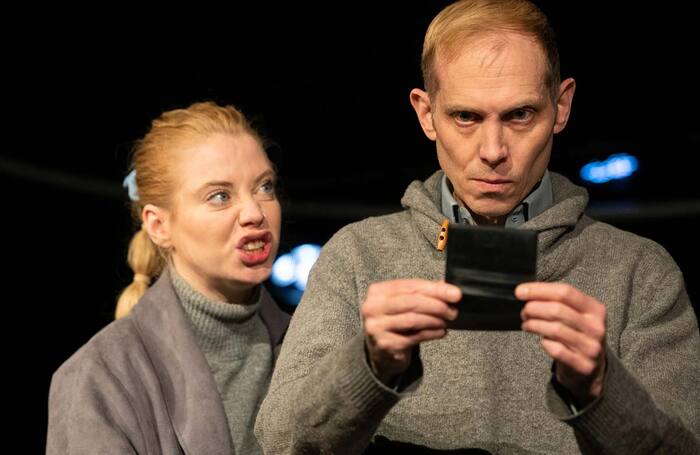
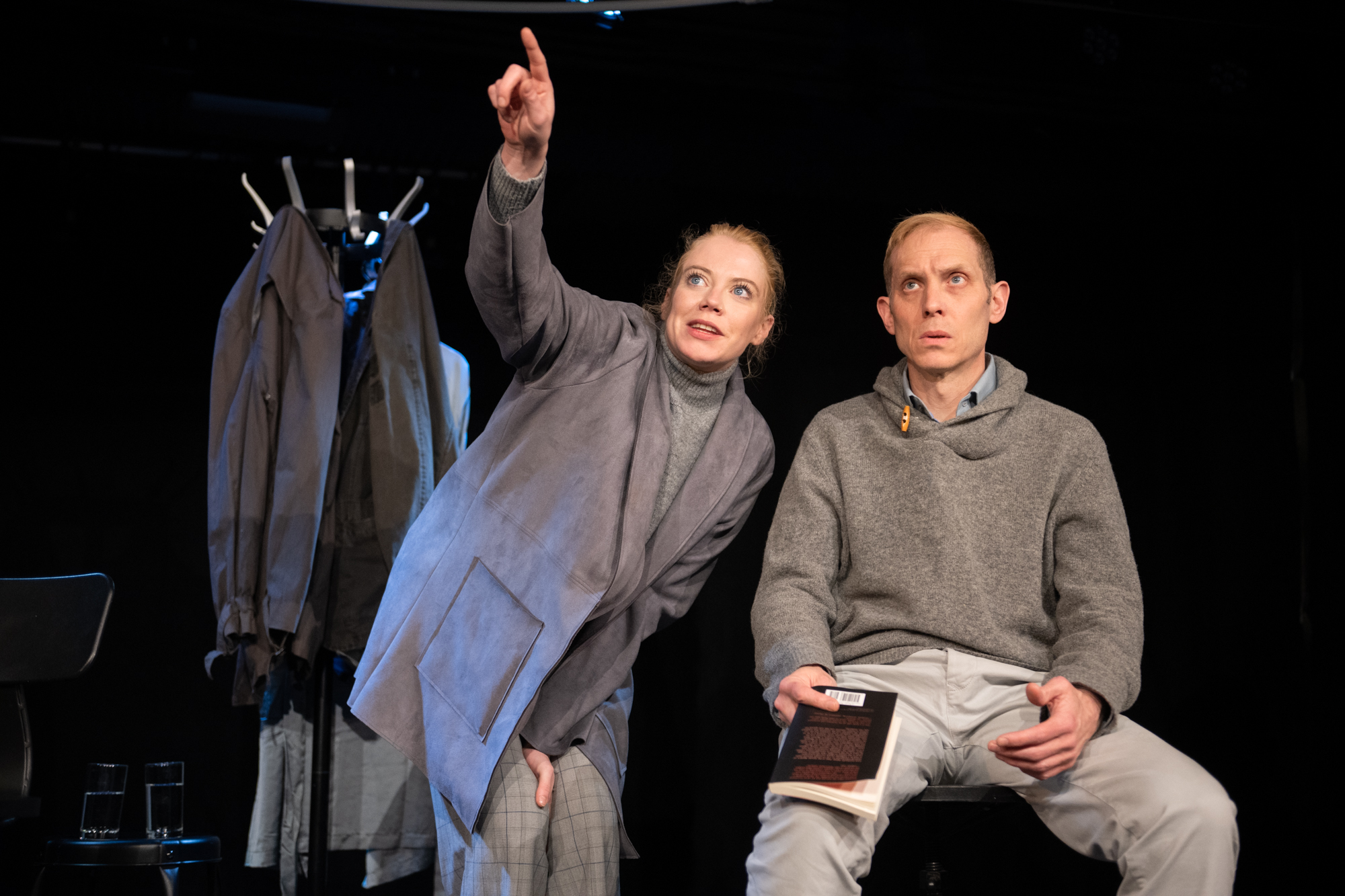
A woman (Meghan Tyler) and a man (Simon Donaldson) saunter into the circular performance space, dressed in muted tones that perfectly match the simple setting. The woman begins to write in a notebook, the man reads a novel, but the silence is almost immediately broken by the arrival of a fly, buzzing annoyingly around the man’s head, interrupting his reading. He kills it. And then he pauses to make a remark to the woman.

‘I see you’ve changed your hair.’

But she quickly questions what he means by this. Was there something wrong with her hair before? Does he approve of what she’s done to it? Or would he have preferred something else? What’s wrong with her hair?

At first the conversation seems innocuous, the bickering of a long-married couple – but as it progresses, it becomes increasingly complicated, loaded with allusions to other things. I find myself asking questions. Are the two people actually married? Because isn’t this beginning to feel distinctly like an interview? And why does the woman keep steering the conversation into darker waters? Why are the images she refers to so violent?

Arnott’s play is cleverly constructed, raising many questions but offering no answers, and – just as we’re beginning to think we have a handle on it – the piece resets itself, and pursues another line of thought, steering us in a different direction. All credit to Tyler and Donaldson, who inhabit their complicated roles with absolute authority. If I’m not always entirely convinced that the piece has as much substance as it has ambition, it’s still nonetheless an engaging, and wryly amusing play, weighing in at a taut forty-five minutes, during which it switches back and forth like a cerebral rollercoaster. 

Did I like the play? Well, let me ask you something. What do you mean by the word ‘like’? Are you asking if it entertained me? Or puzzled me? Or even baffled me? Do you think I should review it? But then, what is a review? And perhaps more to the point, who’s writing this one? Oh, hang on a minute. I think it must be me. Whoever I am.

3.8 stars

Philip Caveney

Pride & Prejudice* (*Sort Of)

24/01/20

Lyceum Theatre, Edinburgh

I’m enjoying the current flush of period drama adaptations on both stage and screen: Greta Gerwig’s Little Women, Armando Iannucci’s The Personal History of David Copperfield, Zinnie Harris’s The Duchess (Of Malfi). The staid and starchy interpretations I remember from my youth are long gone. Now there’s verve, vigour and a sense of fun, an assertion of the protagonists’ youth and the authors’ humour, a sharp incision that takes us to the beating heart of classic texts.

And Jane Austen is especially funny, isn’t she? (I come to this version as, if not quite a Janeite, then at least a fan of her writing.) It’s easy to lose sight of how bitingly satirical she was because her sarcasm is couched in antiquated politenesses, her characters’ bound by alien social mores. Here, writer Isobel McArthur strips away these obstacles to modern understanding, offering us a cast of refreshingly familiar wine-quaffing, lustful young women, whose potty-mouths are endearing and hilarious. Hurrah! These are people we can recognise and revel with, whose broken hearts and thwarted ambitions we can really care about.

It’s Pride & Prejudice through and through; we don’t really need the ‘sort of’ to qualify anything; the changes here are only superficial. The story is intact: the five Bennett girls and their parents are hostages to a dodgy will that determines only a man can inherit their father’s home and (modest) fortune. If he dies, the women will be destitute. No wonder Mrs Bennett is desperate to see her daughters married: their very livelihoods depend on it. No wonder either that a rich man is preferred; if he has a good income, he can take care of all of them. A shame, then, that they live in Meryton, where eligible bachelors are few and far between, and that firebrand Lizzie (Meghan Tyler) is so choosy about who she’ll shack up with. Until she meets the enigmatic Darcy (Isobel McArthur), and their love-hate relationship begins…

Directed by Paul Brotherston, Pride & Prejudice* (*Sort Of) is a glorious, riotous romp of a play, a bawdy, feminist iteration of the tale. The deployment of a karaoke machine is inspired, a perfect reimagining of the piano and singing performances required of young ladies in Austen’s time. The six-strong cast are all magnificent, but the standout moments belong to Hannah Jarrett-Scott, who switches effortlessly between a Tim-Nice-But-Dim-style Bingley and a tragic, lovelorn Charlotte Lucas. McArthur’s repressed, inarticulate Darcy is also a sheer delight, and props too to Mr Bennett, performed by a backward-facing armchair and an ever-present newspaper.

The only false note for me is the servant girl conceit. At the play’s opening, we’re introduced to the domestic help, reminded of their presence in the novels, told of how they are ignored. From thereon in, what we’re witnessing is supposed to be their play-acting, their impersonations of their employers, their interpretation of the landed gentry’s world. But we don’t learn anything about them, nor about their opinions, their deprivations, their own hopes and dreams. We just get Austen’s story; the working class is still ignored.

Still, it doesn’t detract too much. This is a sprightly, engaging, laugh-out-loud piece of theatre, richly deserving of tonight’s standing ovation.

4.6 stars

Susan Singfield