Marvel Studios

Thunderbolts*

02/05/25

Cineworld, Edinburgh

I’ve been decrying Marvel’s deplorable lack of ambition for so long that, when the studio finally comes up with something that’s genuinely different from what’s gone before, I feel mean when I say that it’s still not quite enough. But more of that later.

Thunderbolts* – and no, that isn’t a typing error, there really is an asterisk in the title, though I honestly haven’t the faintest idea why – is a superhero movie with a difference. The team of players we are presented with are all misfits in one way or another. I guess you could argue that DC’s Suicide Squad offers a similar premise, but it’s more cleverly handled here. Chief among our pound-shop players is Yelena Belova (Florence Pugh), the sister of the now-deceased Black Widow. Once a larger-than-life adrenalin-junkie, Yelena spends all her time miserably doing the bidding of Valentina Allegra de Fontaine (Julia Louis-Dreyfus), a crooked politician with her eye on world-domination. (Hmm. I wonder where they got that idea?)

Yelena has lost touch with her father, Alexei (David Harbour), who now plies a trade as a chauffeur, and she longs for something that will make her feel like she’s actually doing some good. Sent out on yet another thankless mission – to destroy one of de Fontaine’s secret laboratories – Yelena discovers that two others have also been handed the same task. They are shape-shifter Ava Starr (Hannah John-Kaman), and John Walker (Wyatt Russell), a kind of below-parr Captain America knock-off. After a thankless skirmish, the three of them decide to join forces rather than continue to oppose each other and, before leaving, they rescue a seemingly ordinary guy called ‘Bob,’ (Lewis Pullman), who they find wandering about the place looking vaguely confused.

Once back in the real world, the ‘team’ quickly adds congressman Bucky Barnes (Sebastian Stan, last seen by B&B as the odious Donald T in The Apprentice) and, of course, Yelena’s dad, who has been itching for an excuse to ditch the new job and get back into his old Red Guardian outfit. It’s Alexei who comes up with the titular name for the assembly but it isn’t long before they are being pitched by the opportunistic de Fontaine as ‘The New Avengers.’

Thus far, Thunderbolts* feels rather ordinary: too many characters struggling for screen time and going through the same over-familiar tropes – but Bob, it turns out, is the film’s secret weapon in more ways than one, especially once he discovers his own hidden powers. He metamorphoses into a kind of alternate Superman, a dark, brooding figure whose actions are motivated by depression and paranoia and who is much more interested in destroying the world than saving it. He’s also not above rubbing out cute little children who get in his way – a move unthinkable in most superhero films.

While director Jake Schreier takes too long to reveal this trump card, once it’s out there, the proceedings pick up immediately and actually start to feel – dare I say it? – genuinely interesting, which is not a quality I’ve seen in a Marvel film for quite some time. And if nothing else, here’s proof that Florence Pugh is now a major box-office star, always capable of finding new depths in any persona she chooses to take on. Her Yelena is much more than a 2D comic brought to life.

For those who care about such things, there are two post-credit sequences. The first is brief and actually makes me laugh out loud. The second is more complex and offers a glimpse of upcoming Marvel release, The Fantastic Four, but you’ll need to stay in your seats until the bitter end if you want to catch it. It remains to be seen if that seemingly-doomed quartet can be rescued from the doldrums, but for now, Thunderbolts* is way better than expected.

3.6 stars

Philip Caveney
Spider-Man: Across the Spider-Verse

04/06/23

Cineworld, Edinburgh

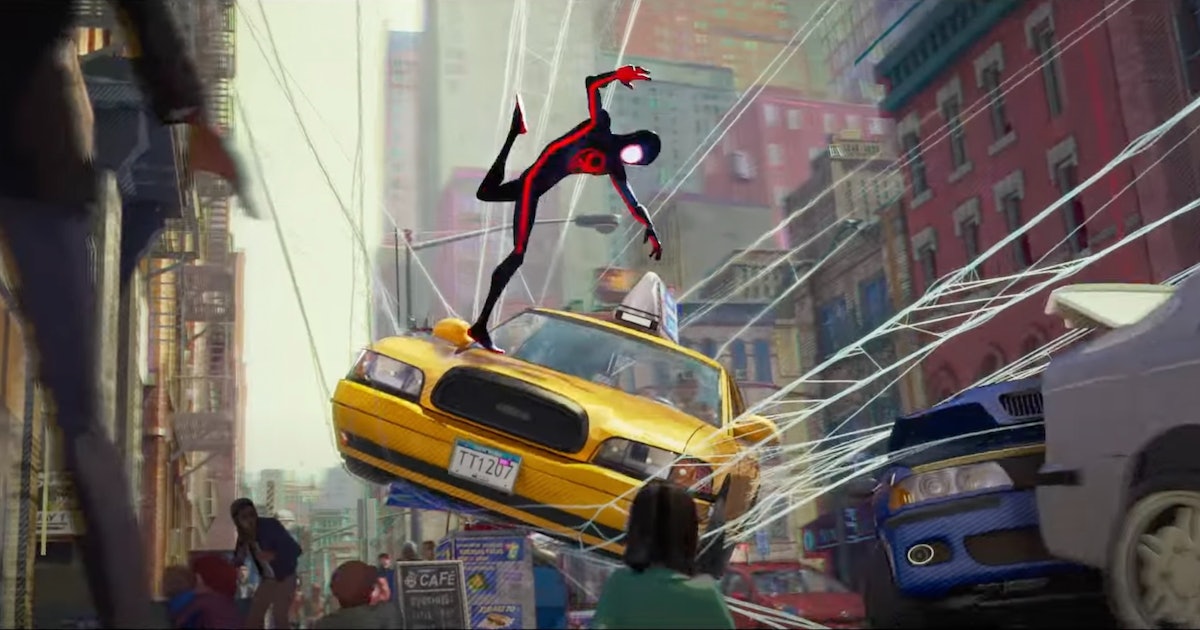
In 2018, Spider-Man: Into the Spider-Verse caught a lot of people napping. At that time, the Marvel Universe pretty much dominated the public movie-going imagination and here was something completely unexpected: Lord and Miller’s animated extravaganza – which had the temerity to take on the big guys. It was, quite literally, like nothing we’d seen before.

A lot has happened over the intervening years. Marvel are not quite the force they once were, with recent offerings (though still profitable) failing to reach the dizzy heights they’ve previously climbed to. And the weight of expectation for Across the Spider-Verse is palpable. Can this Sony Studios sequel really hope to put lightning into the bottle a second time?

Well, yes, as it turns out, it can. The credit sequence alone offers more imaginative filmmaking than we’re used to seeing in the average Marvel feature.

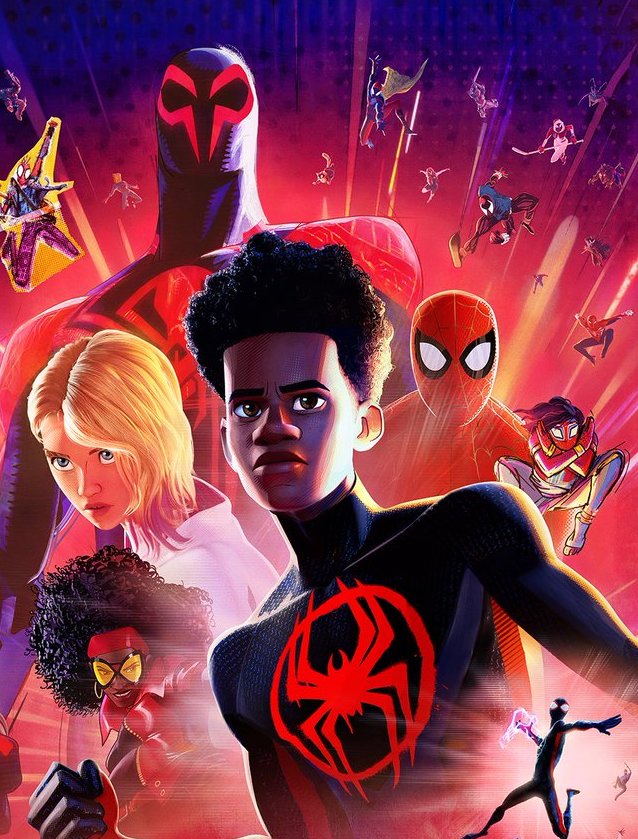
Sixteen months after the events of Into, Gwen Stacy (Hailee Steinfield) is having a hard time getting on with her life on Earth-65. After accidentally killing Peter Parker (Jake Johnson), she’s understandably depressed – and she can’t help but miss her old pal Miles Morales (Shameik Moore), who is inconveniently stranded in a completely different dimension. On Earth 1610, he’s still negotiating everyday life with his cop father, Jefferson (Brian Tyree Henry), and his nurse mother, Rio (Luna Lauren Vélez), whilst continuing his secret adventures as our friendly neighbourhood Spider-Man.

But when Gwen is visited by another couple of Spider-People, Miguel O’Hara (Oscar Isaac) and Jessica Drew (Issa Rae), they give her a handy bracelet that allows her to slip easily between dimensions. Time to give Miles a quick visit? Well, why not? Doing so couldn’t possible mess up the old twisty-turny-timey-wimey configurations… could it?

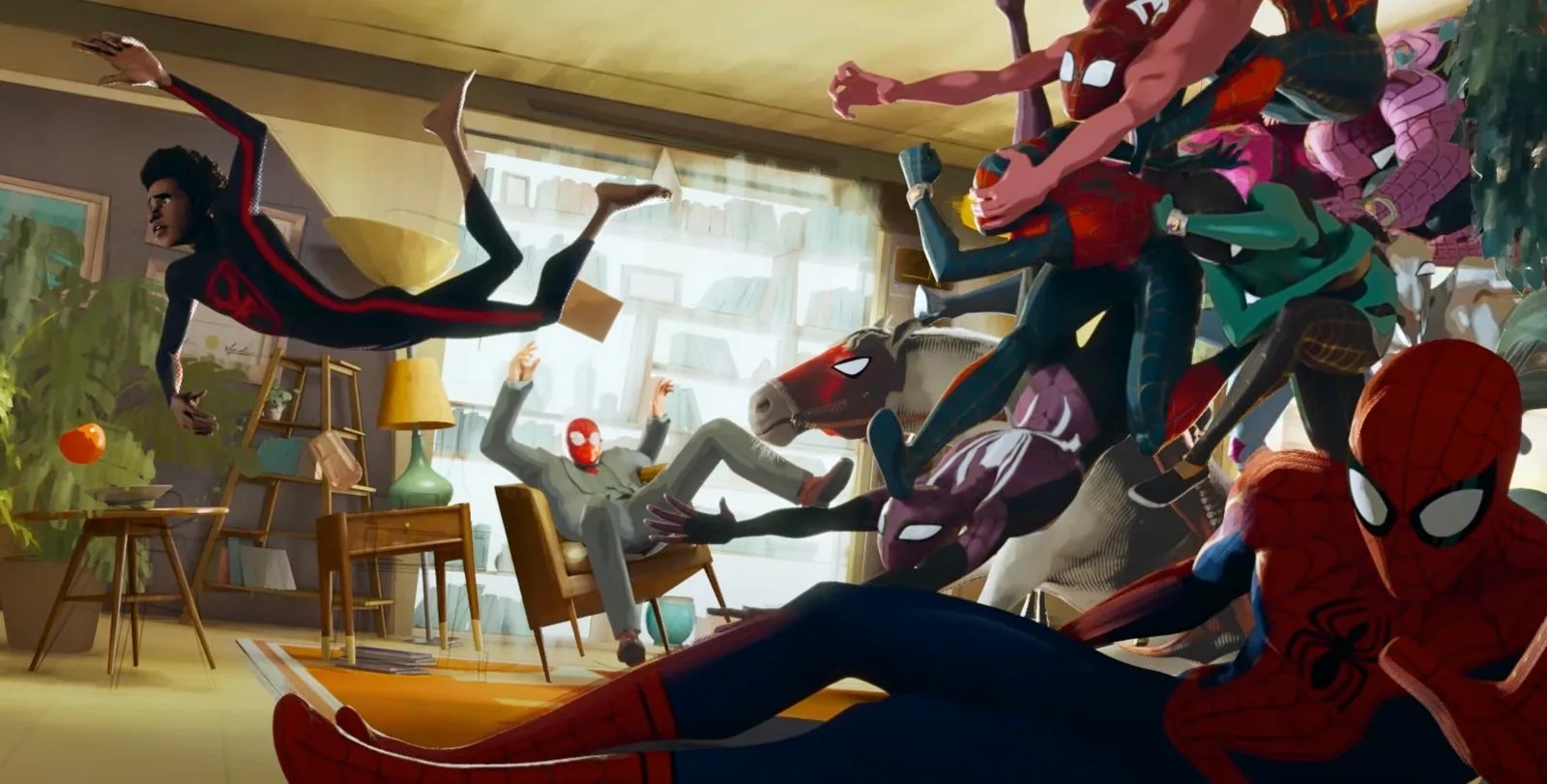
It would be pointless to try and convey more of the plot here because it’s complicated and mind-bending in the best possible sense. It’s to Lord and Miller’s credit (they wrote the script with Dave Callahan) that at no point do I feel bewildered by what’s happening onscreen. The true triumph, however, is the ever-changing beauty of the many different art techniques used to illustrate the story: from realist to impressionist; from pastel shades to psychedelia. Across the Spider-Verse is a mesmerising, eye-popping spectacle that feels like being plunged headlong into a fabulous maelstrom of sonic fury.

And it’s also more than that. The sprightly script keeps throwing snarky one-liners at me, the story counterpoints teenage angst with the minefield of parental responsibility and, with the arrival of The Spot (Jason Schwartzman), I’m offered a super-villain like none I’ve ever seen before. Best of all, I’ve rarely seen a film that feels more inclusive than this – that gleefully throws in a pregnant, afro-wearing, motorbike-riding Spider-Woman, just because it can.

My only real criticism? In a film with a running time of two hours and twenty minutes, surely the story arc could have reached some kind of standalone conclusion? When the ‘To Be Continued’ message hits the screen, I let out an audible groan. I can only hope I won’t have to wait another five years for part three, because I’d be happy to sit down and watch it right now. But hey, if my one negative comment is that I am left wanting more, that’s a good thing, surely?

Miss this one and weep. And folks, I know I say this a lot but please, please don’t wait for streaming. If ever a film was designed to be seen on the biggest screen possible, this is the one.

5 stars

Philip Caveney

Doctor Strange in the Multiverse of Madness

06/05/22

Cineworld, Edinburgh

Another Marvel, another Multiverse – and am I the only one who’s growing a little weary of this device? It worked wonders in the Spider-Man franchise, but can it do the same for my other old go-to comic favourite, Doctor Strange? Well possibly, but I have to admit the main thing that draws me to this is the presence of Sam Raimi in the director’s chair.

Raimi has released some great movies over the years: The Evil Dead and its super-charged sequels, as well as A Simple Plan and Drag Me to Hell – but it’s a while since he’s had a chance to strut his cinematic stuff. While he’s always been a director who dances to his own tune, can he successfully apply those considerable talents to Marvel’s famously constricting template?

The answer is, ‘sort of.’

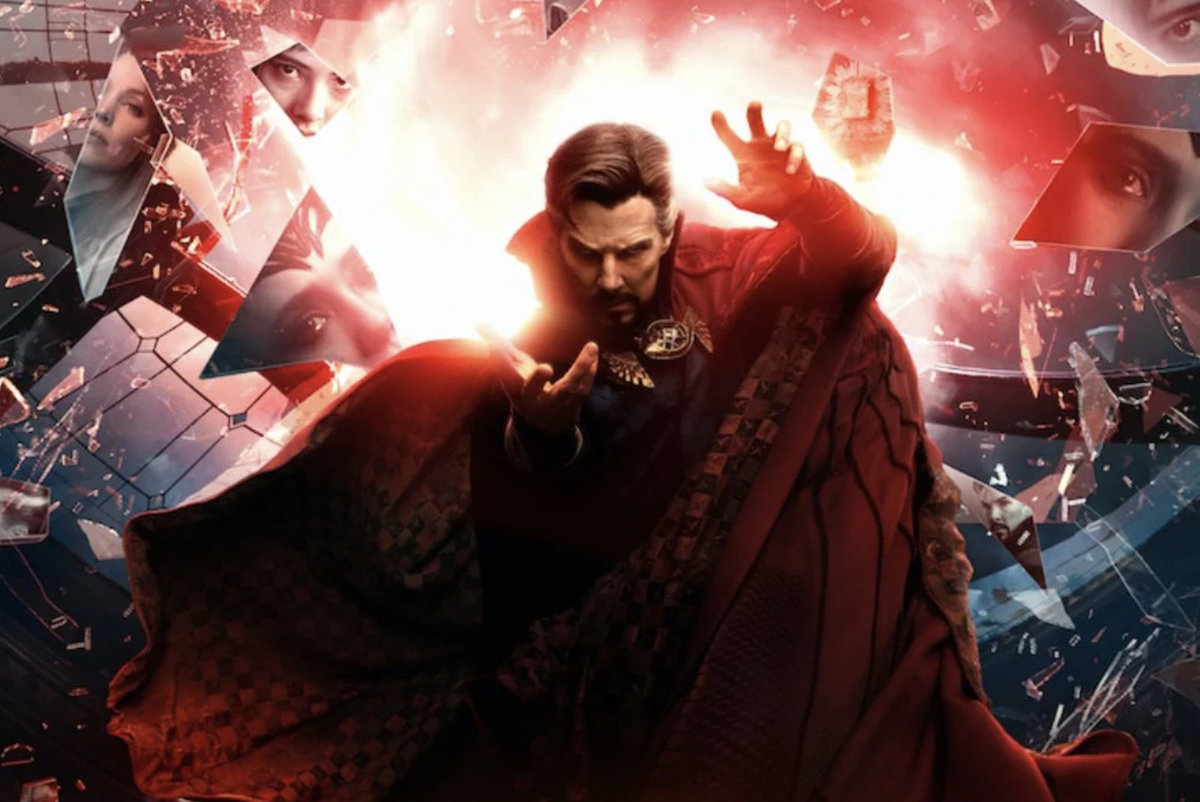
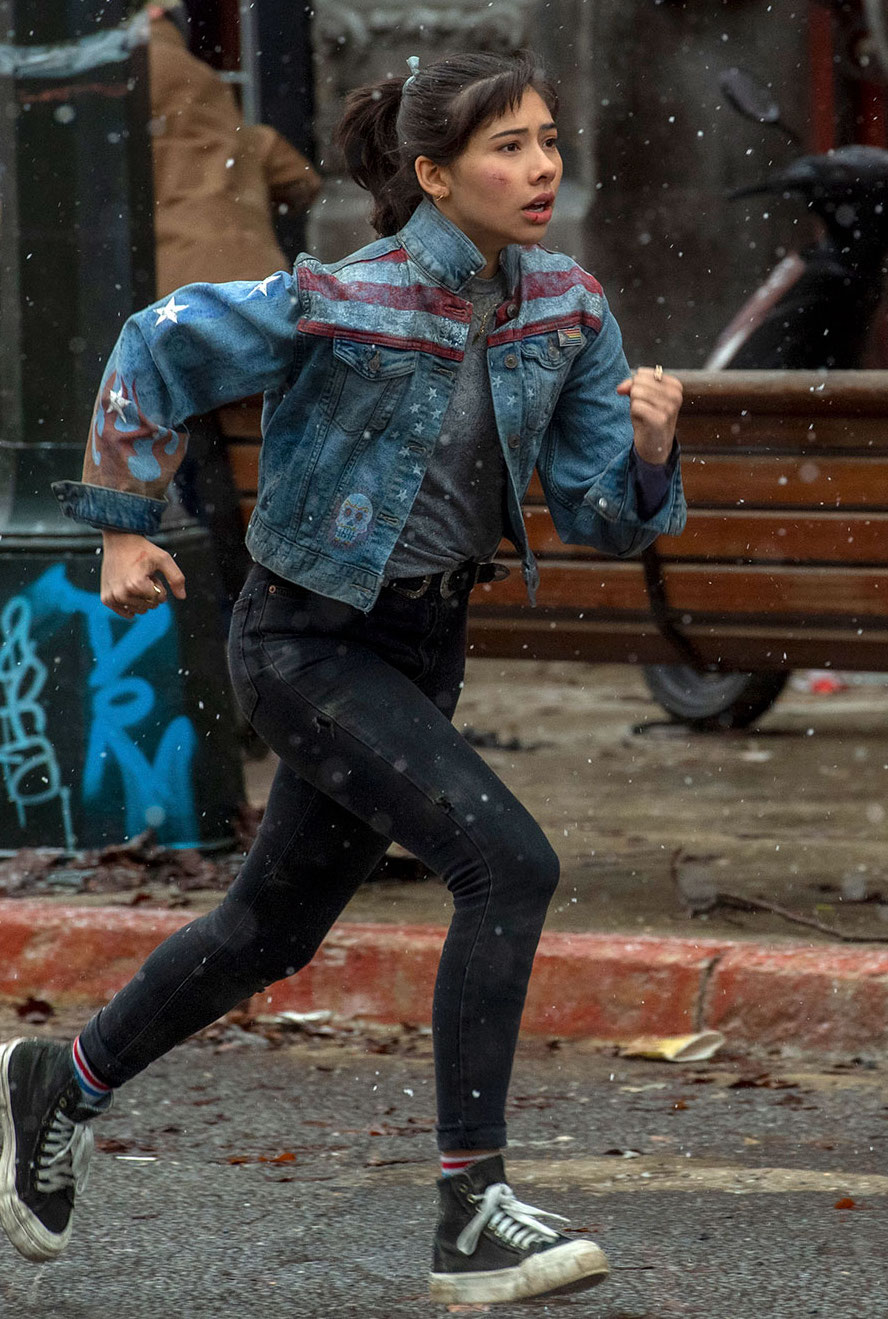
DSITMOM starts, appropriately enough with a dream sequence, where Stephen Strange (Benedict Cumberbatch) witnesses a twisted, evil version of himself attacking a teenage girl. But is it a dream? When, shortly afterwards, Strange encounters the girl in real life, she turns out to be America Chavez (Xochitl Gomez), who has the ability to travel across the multiverse with ease, though (rather conveniently) she doesn’t know how she does it. Or, for that matter, why. Nor can she explain why she’s being pursued by a giant one-eyed octopus. But hey, these things can happen, right?

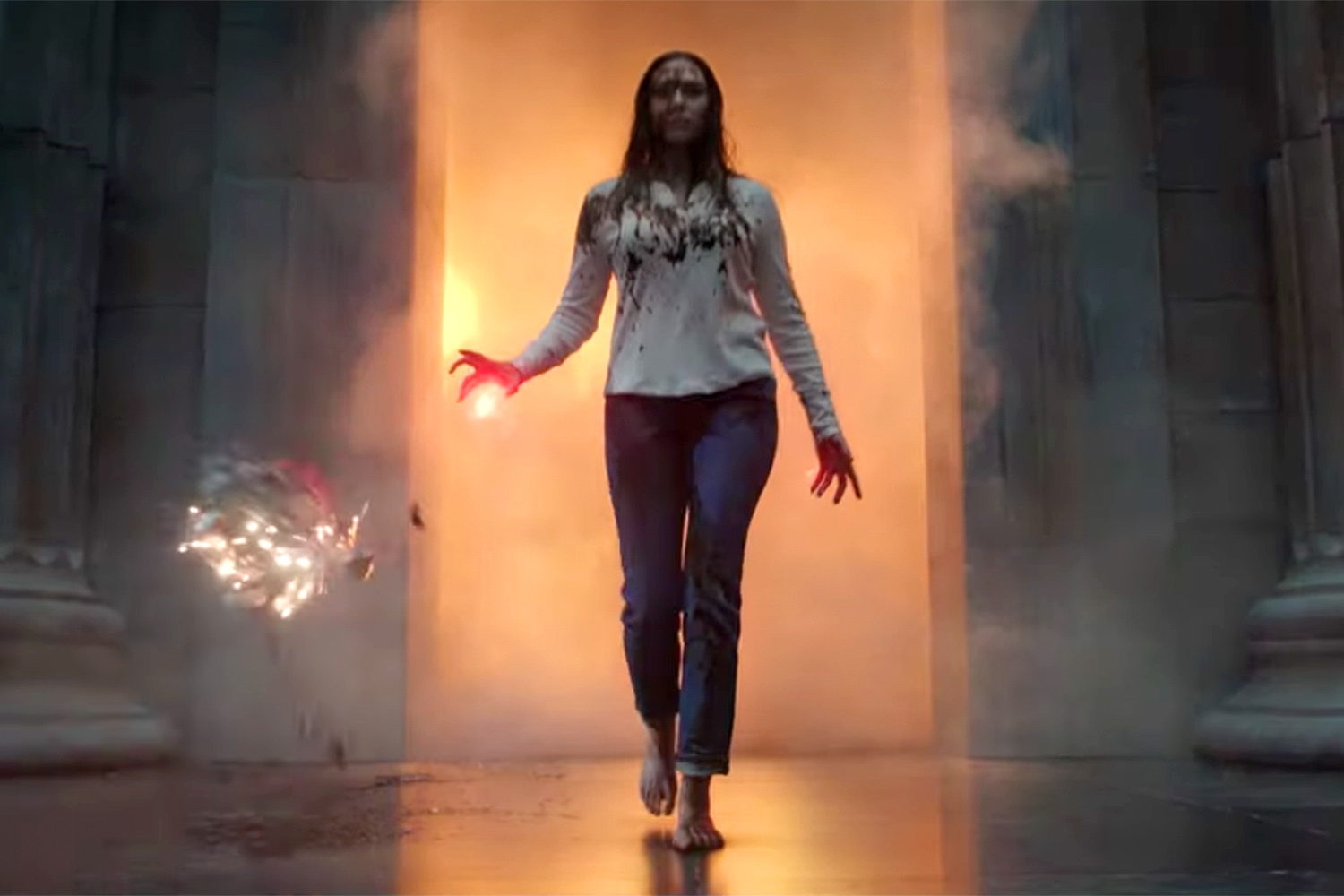
Sensing that she’s in danger (no shit, Sherlock), Strange seeks help from Wanda Maximoff (Elizabeth Olsen), only to discover that she’s not going to be any help at all. Demented by the recent death of her partner and terrified she might lose the two children she loves so much (the ones who don’t actually exist), Wanda decides to steal America’s power for her own wicked ends, an action that will cause the girl’s death. (Incidentally, for someone who’s supposed to be a genius, Strange seems to be very adept at putting his foot in things. He’s the one who messed everything up in No Way Home – and now this.)

I’m not going to relate any more of the plot because, frankly, it’s as mad as a box of frogs (I suppose the title should have warned me), but the more important question is, can this nonsense hold together as a movie, and the answer is ‘just about.’ DSITMOM is essentially a series of frantic action set-pieces, loosely strung together. Though they are occasionally eye-popping and sometimes make me feel that I’ve inadvertently dropped a tab of acid, they never really gel into a convincing story arc.

Different versions of popular Marvel characters keep popping out of the woodwork and in many cases are actually killed, but because we know they’re not the real McCoy, there’s no real sense of threat here. Cumberbatch gets to portray several different Stephens, which was probably more fun for him than it proves to be for an audience. The parts that work best for me are the Sam Raimi moments, the few scenes where he’s allowed to employ the tropes of low budget horror – and of course there’s the inevitable cameo from Bruce Campbell, which is always welcome. But too often Raimi’s singular vision is swamped in the sturm und drang of state-of-the-art special effects.

Elsewhere, actors of the the calibre of Benedict Wong, Chiwetel Ejiofor and Patrick Stewart are called upon to utter some truly naff dialogue, courtesy of screenwriter Michael Waldron.

The usual post-credits sequence suggests that Strange will be even stranger in the next instalment, if and when it happens. The enthusiastic applause from the mainly teenage audience at the end of this screening suggests that I may well be in the minority here.

Doctor Strange (and possibly Mr Raimi) will be back. Watch this space.

3.4 stars

Philip Caveney