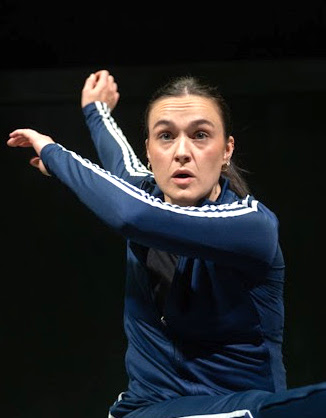


Lizzie Powell

Same Team – A Street Soccer Story

12/12/23

Traverse Theatre, Edinburgh

Street Soccer Scotland is a charity using football for positive social change, and Street 45 is its women’s programme. It makes perfect sense. Team sports promote both physical activity and social connection; they provide a sense of purpose and help build self-esteem. People experiencing poverty, homelessness or addiction; those in the care or criminal justice systems; those with mental illness or other support needs: all too often, they’re marginalised, excluded. Street Soccer Scotland aims to create a sense of hope and opportunity for them.

Same Team – A Street Soccer Story serves a similar purpose: to remove the stigma associated with certain life experiences, to celebrate the women at the centre of the tale – and to raise awareness of this most deserving charity. It’s also a cracking good play.

As we take our seats, five women drift onto the stage dressed in sports gear, stashing their belongings in lockers and beginning to warm-up. “Are you here for the try-outs?” they ask us. Several audience members get up and join in the running drills. (Spoiler: they don’t make the squad.)

Jo (Chloe-Ann Tylor) is chosen as captain. Of course. She’s the star player, and this is Scotland’s chance to win the Homeless World Cup. “There are five rules,” she tells her team. “Players always come first. We look to the future. We never leave anyone behind. We place others before ourselves. We keep our promises.”

The rules are not always easy to follow. The women’s lives are complicated. Single parent Sammy (Kim Allan) is facing eviction – again. Her teenage sons are hard work, and she’s not looking forward to moving back in with her disapproving mother. Middle-class Lorraine (Louise Ludgate) has been unceremoniously dumped by her husband after twenty years. She’s staying on a neighbour’s couch and fretting about her perilous finances.

Things are even harder for teenager ‘The B’ (Hannah Jarrett-Scott), who has only just come out of prison. She’s brittle and defensive, unable to secure a job. Meanwhile, her ex-classmate Noor (Hiftu Quasem) is still at school. She lives with her grandfather – her Nana – and he’s got dementia. A chance meeting between the pair proves fortuitous, as The B tells Noor about the Change Centre. “There’s loads going on, like fitba… You were always a good player. There’s trials on for my old team. You should come along.”

And Jo. Well. Jo’s got problems of her own.

But for a few hours each week, the women leave their troubles at the edge of the pitch and focus on the game. Their commitment to the team and to each other gives them something important to feel proud of. Slowly, they let their guards down, opening up to one another and forging friendships. Their shared sense of purpose binds them together.

Written by Robbie Gordon and Jack Nurse in collaboration with the women from the Dundee Change Centre, Same Team is a heartwarming and affecting piece of drama. The narrative is clear-eyed and unsentimental, affording the characters the dignity and respect they deserve. Director Bryony Shanahan maintains the kinetic pace appropriate to the theme, with softer, sadder moments punctuated by riotous cheering or flashes of anger. The movement feels real – even though we never see a ball or an opposing team. The light and sound (by Lizzie Powell and Susan Bear respectively) are integral to the atmosphere, especially once we arrive at the World Cup in Milan. I particularly like the way the different countries’ flags appear in the floodlights.

Perhaps I don’t quite buy finicky Lorraine’s inclusion in the team; perhaps some of The B’s jokes don’t need explaining by the other characters, but this is compelling and important theatre, with five impressive performances from the ensemble cast. Jarrett-Scott is a gifted comic actor, always able to undercut even the most heart-breaking scenes at exactly the right moment. Tylor brings the emotional heft, her Jo a smouldering fuse just waiting to explode.

Same Team – A Street Soccer Story is playing at the Traverse until the 23rd December, and – although it’s not a festive tale – it embodies the spirit of the season. Grab yourself a seat in the stands and get ready to cheer.

Oh, and make sure you know the words to Flower of Scotland.

4 stars

Susan Singfield

Dial M For Murder

24/02/20

King’s Theatre, Edinburgh

For a playwright who purportedly ‘hated writing,’ Frederick Knott has certainly had a lasting impact. True, he didn’t write a lot but his 1951 stage thriller, Dial M For Murder, is still packing in the punters almost seventy years after its creation, and is a classic of its kind.

Predictably, the King’s Theatre is full tonight; this one is almost guaranteed to be a crowd-pleaser. But it’s subtly done: Anthony Banks’ direction avoids the arch high-campery that’s all-too pervasive in period crime dramas these days. Sure, he embraces (and even highlights) the nonsensical aspects of the plot, but not at the expense of credible characters.

Still, there’s no getting away from it: this is a schlocky tale of murder and intrigue. Beautiful heriress, Margot (Sally Bretton), has been having an affair with dashing young writer, Max (Michael Salami), and has worked hard to keep her tennis-player husband, Tony (Tom Chambers), in the dark. She has no intention of leaving her marriage, and thinks she can keep everyone happy. But Tony is onto her, and has a yearning for revenge… His plan is cunning and convoluted; can he contrive the outcome he desires?

The four-strong cast (Christopher Harper, dual-roling as Captain Lesgate and Inspector Hubbard, completes the quad) deliver slick, believable performances, even managing to sustain my interest in the overly-expositional opening half hour. After that, things become more action-packed, and we’re less reliant on hearing the detailed back story.

I really like the bold lighting and sound design (by Lizzie Powell and Ben and Max Ringham respectively), which works especially well in the scene transitions. The passing of time following the fateful incident at the core of the play is beautifully evoked, and the use of The Beatles’  Tomorrow Never Knows is perfect here.

So yes, Dial M For Murder is a well-worn piece, and it won’t win any innovation prizes in 2020. But it’s a classic for a reason, and this production does it proud.

4 stars

Susan Singfield