Leonardo DiCaprio

One Battle After Another

04/10/25

Cineworld, Edinburgh

We’re uncharacteristically late to this one, mostly because in its week of release we are in a camper-van in the wilds of Scotland and no cinema in that vicinity is showing it. Not complaining, you understand, people need to have holidays, but this is a film by Paul Thomas Anderson, whom I’ve held in special esteem ever since watching Boogie Nights way back in 1997. And all those ‘best film of the year’ reports make me impatient to get back to civilisation.

Mind you, I’d be the first to admit that, in recent years, PTA has (at least for me) gone off the boil a bit. Unlike many of his followers, I didn’t really care for 2017’s Phantom Thread and his last offering, 2021’s Licorice Pizza, though a warm and appealing slice of nostalgia, wasn’t the finest work from the director of There Will be Blood and (in my humble opinion) his masterpiece, Magnolia.

One Battle After Another, as the name suggests, is an action film, perhaps the last genre I’d have expected this most enigmatic of film-makers to explore but, happily, he puts his own unique spin on it, producing a sprawling, multi-faceted tale set over the best part of two decades. It’s larger than life, peopled by a series of eccentrically-named caricatures and yet, once it settles into its stride, it manages to exert a powerful grip.

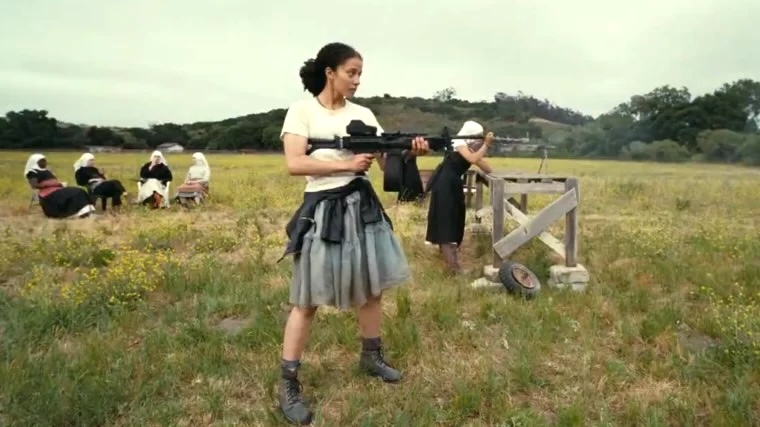
We first join the action as Pat Calhoun (Leonardo DiCaprio) and Perfidia Beverly Hills (Teyana Taylor), along with other members of their far-left terrorist group, French 75, launch an armed attack on a detention centre in California and free all of the captives. During the action, Perfidia encounters the unit’s commanding officer, Steven Lockjaw (Sean Penn), and – in a move intended to humiliate him – makes him masturbate at gunpoint. However, this only causes him to fixate on her, something that will have inevitable consequences further down the line.

Pat and Perfidia become partners, but their haphazard attempts to parent their baby daughter, Willa, seem doomed to failure – especially when Perfidia is captured and forced into witness protection, and Pat is left to deal with the situation alone.

Sixteen years later, Willa (Chase Infiniti) has grown to be an independent teenager, preferring to follow the guidance of her karate instructor, Sergio (an underused Benicio Del Toro), than her drug-addled old man. Pat hasn’t been involved in any terrorist activity in years, preferring to experiment with every drug he can lay his hands on but when, out of the blue, a coded telephone call reaches him, announcing that Lockjaw (now a Colonel) is coming after Willa, he’s forced to get up off the sofa and go to her aid…

From this point, the film pretty much delivers on the promise of the title – it’s a frenetic, explosive and breathless chase filtered through cinematographer Michael Bauman’s VistaVision lenses, and backed by Jonny Greenwood’s eccentric score. Written by Anderson and loosely based on Thomas Pynchon’s novel, Vineland, the director has reputedly been working on this project for something like 20 years so it’s remarkable that it feels as timely as it does.

DiCaprio is wonderfully endearing as the hapless Pat, desperately trying to remember passwords that he hasn’t used for far too long, while Penn, as the heinous, macho Lockjaw, is the personification of a living GI Joe action figure, a man committed to preserving his outward appearance, while inside he’s a festering, ambitious wreck. But strangely, it’s newcomer Infiniti who really impresses here as the quietly determined Willa, who, when pushed, snaps back with the stubborn tenacity she’s inherited from her mother.

One Battle After Another is a searing condemnation of contemporary America, a world where freedom has to be fought for with extreme violence, where the most cold-blooded assassins hide behind the personas of smiling, corn-fed patriots. PTA finds original ways to explore the most well-worn conventions. Even the old fall-back of the car chase is given a mesmerising makeover, as vehicles glide silently through a shimmering waterfall of desert roads like some kind of LSD-induced hallucination.

Despite a hefty running time of two hours and 41 minutes, the film flashes by in what feels like half that time and it’s clear pretty much from the outset that Paul Thomas Anderson is back on form. Whatever comes next, I’m already looking forward to it.

4.8 stars

Philip Caveney

Killers of the Flower Moon

22/10/23

Cineworld, Edinburgh

A quick glance at IMDB informs me that I first watched a Martin Scorcese movie way back in 1976 – Taxi Driver – and that I have seen pretty much every film he’s directed since. So naturally I am eager to see Killers of the Flower Moon, though somewhat apprehensive at its prodigious running time of three hours and twenty-six minutes. 

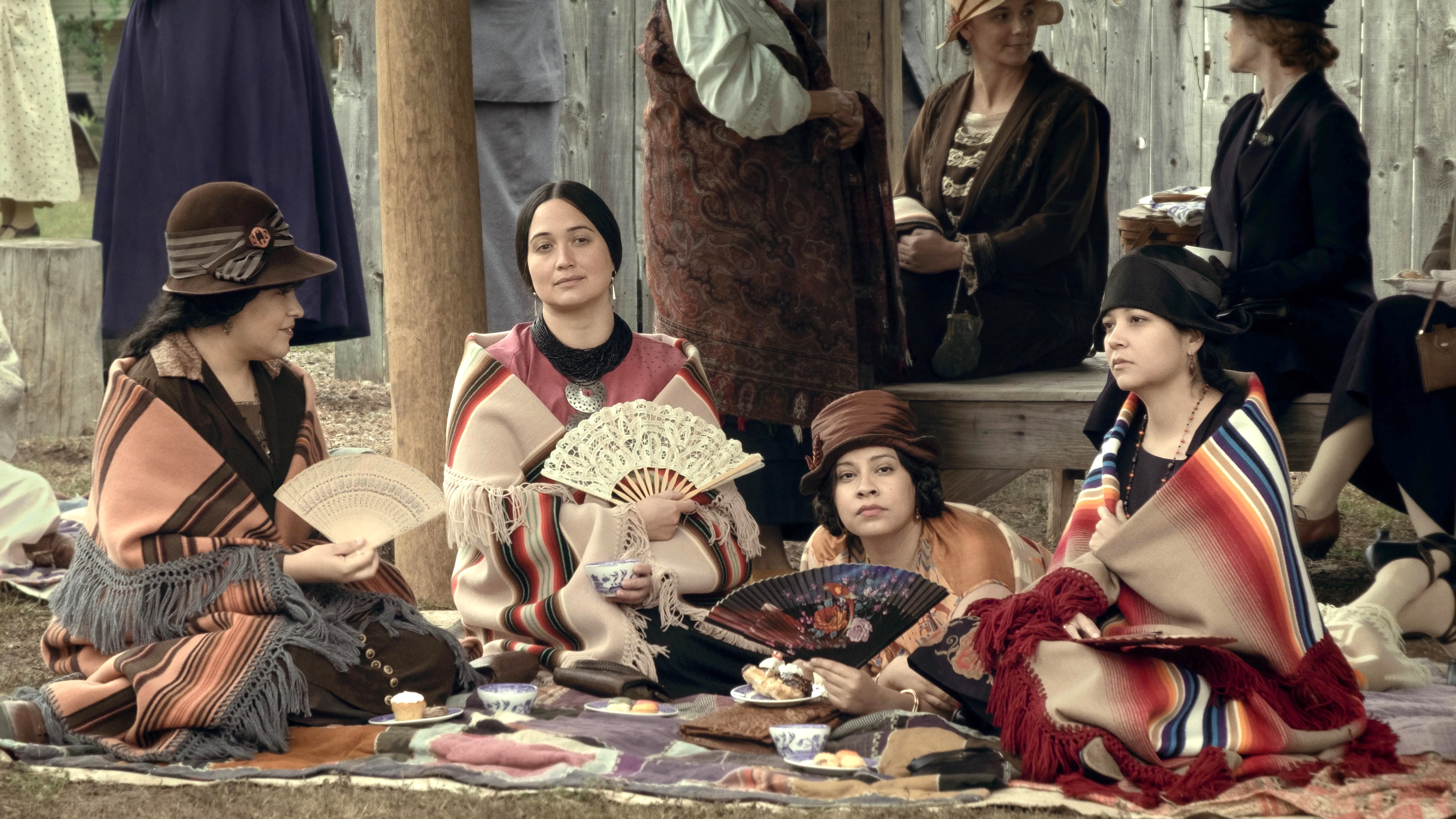
Set in the early 1920s, it tells the story of the Osage tribe, native Americans who, after being shunted unceremoniously from their Kansas homeland to a reservation in the wilds of Oklahoma, subsequently discover that the land they have been allocated contains vast quantities of crude oil – and that they are now the richest people per capita in the USA.

Of course, this being America, it’s complicated. For one thing, the Osage can’t just be allowed to own their own money. The very idea! In most cases, they must have a white guarantor to enable them to have access to it. And naturally, there are plenty of unscrupulous people in the vicinity, who are eager to put their hands on that wealth – even if it means arranging for the regular liquidation of certain members of the tribe. Suspicious deaths among the Osage are all too common, and such crimes are rarely even investigated.

Chief among the white opportunists is rancher ‘King’ William Hale (Robert De Niro), who purports to be the tribe’s greatest friend and has even learned to speak their language, but who secretly wheels and deals to ensure that large amounts of Osage money keeps flowing in his general direction. When his nephew, First World War veteran Ernest (Leonardo DiCaprio), arrives looking to make a new start, Hale ensures that he crosses the path of Osage woman, Mollie (Lily Gladstone), telling Ernest that this will be an opportunity for both of them to make a killing…

There’s no doubt that this true story, based on the book by David Gran, makes for compelling viewing – and the film’s two-hundred-million dollar budget ensures that Scorcese’s evocation of the era is beautifully realised. Many of the great director’s touches are in evidence here: the matter-of-fact quality of the murders; the chilling depictions of everyday cruelty and avarice; and, as ever, there’s Scorcese’s uncanny ability to choose the perfect music to accompany any given scene.

There are also three extraordinary performances to savour. Di Caprio as the sullen, selfish and frankly not-very-bright Ernest may be a career-best display of acting. He plays the role as a kind of arrested adolescent with a constantly glum expression, as though he’s being admonished for something he’s done (or maybe hasn’t done). Old hand De Niro is horribly oleaginous as Hale, a man so utterly devious, it’s a wonder he can manage to walk in a straight line. And Gladstone is terrific as Mollie, managing to convey so much with a withering look, a shrug, a silence. Her calm presence is somehow this turbulent story’s anchor.

The film’s first and concluding thirds, the set-up and pay-off – when FBI man Tom White (Jesse Plemons) arrives to initiate a long-awaited investigation –  easily hold my attention, but that middle section feels decidedly baggy and and the constant stream of viewers nipping out for a judicious toilet break is really distracting. It prompts the inevitable question: does the film need to be so long? In my opinion, no. Trimmed back by an hour, this could have been even more satisfying. I can’t help but think wistfully back to the likes of Lawrence of Arabia and Doctor Zhivago, epic films that always included an intermission around the halfway mark for this very reason.

That said, I love Killer’s ironic coda, which presents an account of what we have just seen as a soapy ‘true crime’ vintage radio recording, and which also features a cameo from Mr Scorcese himself. But the film fails to mention the fact (which I read about elsewhere) that the heinous conditions that the Osage tribe suffers in this film persist to this day. They are still being stiffed by the oil companies, who have brazenly commandeered the ‘black gold’ that continues to bubble up from beneath their reservation. And their demands for justice remain unheard.

Land of the free? Don’t make me laugh.

4.2 stars

Philip Caveney

Once Upon a Time in Hollywood

15/09/19

We’re deep into our annual scramble at the Edinburgh Fringe, but there’s a problem. Once Upon a Time in Hollywood has opened and I need to see it. Not, I should hasten to add, because I’m a fan of Quentin Tarantino. Quite the opposite. Indeed, I’d go so far as to say that – in my opinion – he’s the most overrated film director in history. But, The Cameo is screening the film in 35 mm, using a projector that was made some time in the 1940s and that’s something that the geek in me needs to see. So, a two-hour-and-forty-one minute slot is located in our schedule, and here I sit as the lights dim and the screen kicks into life.

The first thing to say is that the film looks incredible. Light projected through celluloid will always be superior to a digital print. That’s a fact. And I will also add that the film’s musical score is also pretty fantastic, featuring a plethora of sparkling 60s pop classics. But I’m afraid that’s the last good thing I have to say about Once Upon a Time in Hollywood.

The plot: actor Rick Dalton (Leonardo DiCaprio) was once a big name in Hollywood, due to regular starring roles in Western TV shows, but now his star is beginning to wane. He lives in a big house on Cielo Drive and is driven around by his gofer, Cliff Booth (Brad Pitt), who lives in a lowly caravan a short distance away. Booth too is on his uppers. Once a respected stuntman, he is now reduced to fetching and carrying for Rick. Oh, and the rumour is that back in the day, he murdered his wife. Next door lives the director du jour, Roman Polanski (Rafal Zawierucha), fresh off the hit film Rosemary’s Baby, and his pregnant wife, Sharon Tate (Margot Robbie). And meanwhile, up at Spahn’s Ranch, the Manson family are gearing up for some very dark deeds…

Look, the truth is, I really should like this film. The era fascinates me and so does the central story around which this is based. But what I see onscreen is an interminable trudge through a series of over-extended background stories, with Tarantino spending far too long on telling them and being far too pleased with his evocations of 60s cinema and television. Margot Robbie barely gets any lines of dialogue (which sadly enforces Tarantino’s reputation as a misogynist), the great Bruce Lee is depicted as an absolute dick, and a whole troupe of respected actors – Bruce Dern, Dakota Fanning, Timothy Olyphant, Kurt Russell, Al Pacino – are brought onscreen to perform five minutes of pointless ‘acting,’ before being summarily dismissed.

And then there’s that fairytale ending, applauded by many film critics as ‘audacious,’ but which to me seems merely dumb and kind of borderline offensive. Tarantino has previous form here as anyone who saw Inglourious Basterds will know.

Look, the man has many fans and this film has already been widely praised by other critics, so maybe I just need to accept that his style of filmmaking is not for me. But nobody is ever going to convince me that he is a director in control of his own process. Two hours and forty one minutes? Really?

But that 35mm print. Now that is class.

2.5 stars

Philip Caveney