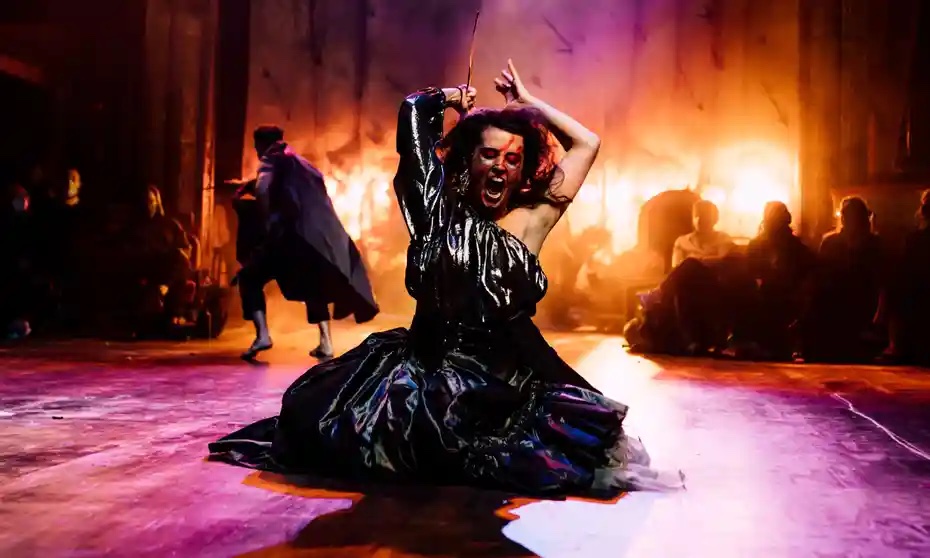


Laura Lovemore

Detained

22/10/24

Traverse Theatre, Edinburgh

In a week when the Home Office has found the time to issue the fictional Paddington Bear with an official passport, it’s sobering to be faced with a stark reminder of the realities of the UK immigration system and the human lives caught up in it.

Playwright Michelle Chantelle Hopewell’s professional debut has a strong premise, exploring the uneven power dynamic between two friends, where a single impulsive moment of spite has a profound and devastating impact.

South African asylum seeker Yemi (Titana Muthui) is incarcerated in a detention centre, and she’s appalled to learn that she’s there because of her best friend, Bea (Laura Lovemore). The women work in the same restaurant, and Bea, catching her boyfriend in the arms of another waitress, has called the authorities to report her for being there illegally. She doesn’t know that Yemi’s visa has run out, that her ‘sister’ will get caught in the crossfire.

We’re witness to a series of visits spanning two years, as Yemi languishes in ‘jail’, refusing to open up about her traumatic past, even to the lawyer who might be able to assist her. Through her conversations with Bea, we learn how horribly dehumanising the process is, and how a simple oversight – such as not filling in a form on time – can change a person’s life. Bea is impacted too, learning to live with the guilt of what she’s done, trying – and failing – to compensate by campaigning for Yemi’s release.

Both Muthui and Lovemore are compelling in their roles, with Muthui in particular exuding a desperate dignity. Even though I want to shout at Yemi to tell the lawyer what he needs to know, I can’t help but be impressed by her quiet determination not to be forced to share her nightmares to appease others. Muthui makes this awful choice entirely credible.

Caitlin Skinner’s direction ensures that this wordy drama remains dynamic, and Heather Grace Currie’s simple set design manages to include both the barbed wire holding Yemi back and the blue skies still offering her a glimmer of hope.

Even for A Play, A Pie and A Pint, Detained is short, and doesn’t perhaps make the most of its potential, with a lot of ideas left unexplored. I’m also not convinced by the single section addressed to the audience by Yemi, which feels stylistically (but not tonally) different from the rest. I think for this to work, she would need to be revealing something we haven’t previously seen from her – a greater anger, maybe, or a deeper exploration of her situation.

A piece that asks more questions than it answers, Detained is certainly a play for our times. Let’s hope that fewer pretend bears and more actual people are afforded access to asylum over the coming years.

3 stars

Susan Singfield

James IV: Queen of the Fight

05/10/22

Festival Theatre, Edinburgh

For the fourth part of her epic series about Scottish history, Rona Munro chooses to focus her gaze upon a little known episode in the reign of James IV – the influence of two ‘Moorish’ women on the Scottish court and the events that lead to the writing of Ane Blak Moor, a derogatory (and openly racist) poem written by the Makar, William Dunbar (Keith Fleming).

In 1504, Lady Anne (Laura Lovemore) and her servant, Ellen (Danielle Jam), arrive at the Scottish court. Anne is to be lady-in-waiting to James’s young English bride, Margaret (Sarita Gabony), so Ellen is left to form her own alliances. She soon finds a role within the royal household – as an entertainer – and eventually finds herself the confidante/lover of King James (Daniel Cahill). She plays the titular ‘Queen of the Fight’ – a kind of MC – in the symbolic tournaments he leads. But Margaret’s jealousy of the woman she perceives as an interloper will have significant consequences for James and his followers – and shows how, even though the King apparently champions diversity, when push comes to shove, racism rears its ugly head.

The real strength of this production is the way that Munro finds contemporary echoes in these historical characters, who talk and act like the kind of people you might encounter in modern-day Edinburgh. This is particularly apparent in Dunbar, who is obliged to cut his cloth according to the changing mood, in order to eke a meagre living from his writing. His grumpy observations about his precarious existence put me in mind of a typical freelancer, forever having to apply himself to the fickle moods of the court. Clearly some things never change. (No, no, never been there myself…)

This is a handsomely mounted production, from Jon Bauser’s elaborate set designs to the sumptuous costumes by Karen Short. (I love the way the play begins with the characters in contemporary clothes, before they are dressed in their period finery.) There are some wonderfully boisterous fight scenes too, the participants swinging broadswords at each other with wince-inducing gusto.

There’s so much to enjoy here – I’m especially amused by Gabony’s petulant, seventeen-year-old bride, too moody to even get out of bed – and there are Dame Phemy’s delightfully caustic remarks (Blythe Duff); she has worked in the court longer than anyone and has everybody (including the King) dancing to her tune.

Queen of the Fight is proof, if ever it were needed, that historical fiction doesn’t have to be dull and strait-laced. Here is a production that positively thrums and pulses with energy and one that genuinely earns an exuberant and heartfelt ovation.

4.6 stars

Philip Caveney

Life is a Dream

02/11/21

Lyceum Theatre, Edinburgh

There’s something decidedly dreamlike about our return to the Lyceum.

It’s been so very long since we’ve entered these hallowed portals and, now that we’re here, we hardly recognise the place. It’s had a major makeover for this play, with a new floor built up over the stalls. The result is a more intimate performance space; this production is presented in the round, with some members of the audience sitting right next to the actors. I’m reminded, more than anything, of the Royal Exchange in Manchester, our old ‘go to’ venue for new and innovative theatre, and this reinvention seems like an astute move on the part of the Lyceum. And if director Wils Wilson doesn’t maximise the reconfigured space’s potential quite as well as, say, Sarah Frankcom might, that’s only to be expected; after all, the Exchange’s artistic directors have had a lot of practice at this!

Life is a Dream is one of those weird seventeenth century fairy tales, written by Pedro Calderon and first staged in Madrid in 1630. This translation, by Jo Clifford (who, coincidentally, is sitting in the row in front of us), is strong on acerbic humour and gender confusion and, while it probably wouldn’t do to think too closely about the bizarre machinations of the plot, the actors’ confidence seems to grows steadily throughout the performance, exerting a powerful grip on the audience.

This is the story of captive prince, Segismundo (Lorn MacDonald), imprisoned in a tower by his own mother, Queen Basilio (Alison Peebles), who once dreamed that her son would turn out to be a tyrant, so decided to be proactive and imprison him just in case. But Segismundo is released by his old tutor, Clotaldo (John McCaulay), and pretty soon, the prince has the opportunity to show that he can be kind and considerate, but, driven half mad by his long imprisonment chooses to do exactly the opposite – until he is told that life is all a dream, and so he should do his best to behave well and stop the nightmares. Then there’s angry, jilted Rosaura (Anna Russell Martin) and her companion, Clarin (Laura Lovemore), the latter of whom keeps breaking the fourth wall to make sarcastic comments about what we’re watching…

Actually, there’s little point in going over the plot in detail, because it’s quite frankly bonkers, but what comes across so powerfully here is the magical feel of the production and the excitement of seeing something new, fresh and innovative. McDonald is terrific as the near feral Segismundo, scampering around the stage, snorting and quivering like a hunted animal, seemingly unable to make a quick decision. Peebles brings a sense of quiet authority to her role as the much misguided Queen of Poland and Russell Martin has a delightful knack for uttering sarcastic asides.

More than anything else, it’s great to back at the Lyceum and this sparky piece makes for a delightful return.

We’re already excited to see what comes next.

4 stars

Philip Caveney