King’s Theatre

The Mousetrap

unknown

17/10/16

King’s Theatre, Edinburgh

It’s hard to believe that I’ve been on this planet for sixty-four years and I’ve never seen a stage production of Agatha Christies’s The Mousetrap beforeIronically, the play has been around for exactly the same length of time as I have. It was first performed  in 1952 and has been running in the West End ever since. This touring production, directed by Ian Watt-Smith, is at the King’s Theatre until the 22nd of October.

It’s a single-room drama and the events take place in an extraordinarily naturalistic set, which looks as though it was tailor-made to fit the stage of the King’s (although, of course, it wasn’t, and will shortly move on).  The detail is meticulous – even the smattering of snow on the characters’ coats melts as they warm up by the fire. We are in Monkswell Manor, an old country pile, where Mollie Ralston (Ann Anderson) and her husband Giles (Nick Barclay) are attempting to set up a guest house. As the play opens, a terrible snowstorm is in progress and we learn very quickly that there has been a brutal murder nearby. As the first clutch of guests begin to arrive, it is apparent that each of them can be considered a suspect – especially the histrionic ‘Christopher Wren’ (a deliciously revved-up performance by Oliver Gully), whose ill-considered utterances make him look more suspicious by the moment, and the mysterious Mr Paravicini (Gregory Cox), who wears makeup to appear older than he really is – why? The first half closes with the murder of one of the guests and, in the second act, it is up to Sergeant Trotter, who has arrived on skis in the middle of the storm, to attempt to unravel which of the Manor’s inhabitants is guilty of murder most foul.

This is unashamedly old-fashioned in its style and ambitions (how could it not be?) and fans of Agatha Christie will revel in the avalanche of red herrings unleashed here. At times, it’s like being caught up in a game of Cluedo, with characters conveniently slipping away to a variety of locations throughout the house, just as something important happens. Of course, the play is famous for it’s ‘twist’ ending and it’s impossible not to play armchair detective as you try to unravel the possibilities of who might be hiding something. The play’s revelation (which audiences are always entreated not to reveal) must have seemed pretty incredible back in the day, but those well-versed in detective stories may find themselves guessing the eventual outcome early in the proceedings.

It doesn’t matter. This is an enjoyable slice of classic theatre and it’s easy to see why it has remained in the public gaze for so long. Why not drop in and see if you can work it out for yourself?

4 stars

Philip Caveney


Gangsta Granny

05/10/16

King’s Theatre, Edinburgh

The Birmingham Stage Company’s children’s shows are well-known throughout the UK (as well as further afield), and this touring adaptation of David Walliams’ best-seller lets us see why they are so popular. This is theatre with its target audience firmly in its sights, every detail carefully judged to ensure it hits its mark.

It tells the tale of Ben (Ashley Cousins), whose ballroom-obsessed parents (played tonight by Benedict Martin and understudy Louise Bailey) force him to spend every Friday night with his boring Granny (Gilly Tompkins). But, as Ben soon discovers, there’s more to Granny than cabbage soup: her secret alter-ego is an infamous jewel thief – and anything but dull. It’s a charming story with a simple message: don’t underestimate people just because they’re old. “I wasn’t born a little old lady,” as Granny says to Ben.

The production is big and bold, the supporting characters a series of Roald Dahl-style grotesques. The children in the audience love these comic exaggerations: Mr Parker, the nosy neighbour (Benedict Martin again), seems a particular favourite, eliciting squeals of delighted laughter with his heightened mannerisms.

There are some stand-out moments and ideas. The mobility scooter is used to good comic effect, and the unflinching approach to mortality is very refreshing in a production of this ilk. The characters are all well-drawn and clearly delineated throughout. I love the way that sound effects are employed, not just in the inevitable (and very funny) fart jokes, but also to facilitate our acceptance that there is, for example, a car on stage. It’s a neat, efficient means of conveying ideas, and the performers physicalise it well.

In fact, if there’s a criticism, it’s that there could be more of this. The set seems overly complex, with too many distracting scene changes that often seem unnecessary. A simpler, more pared-down approach would mean less stage traffic and less ‘busy-ness’ (the constant setting up/taking down of the kitchen table and chairs seems particularly pointless), and would make the story’s through-line clearer and more direct.

All in all, though, this is a lot of fun, and a huge success with its intended audience. The children near us were shiny-eyed and excited as they left the theatre, and that’s surely what this is all about.

4 stars

Susan Singfield

The King’s Speech

Unknown001562_regular

King’s Theatre, Edinburgh

23/05/15

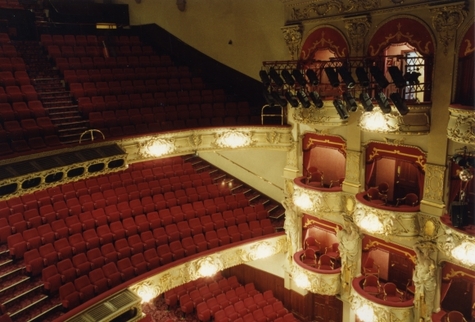
The King’s Theatre, Edinburgh, has a reputation for being beautiful. “If you like the Lyceum,” several friends have told us, “just wait until you see the King’s.” And, to be fair, the building is gorgeous: all perfectly preserved Art Deco woodwork, and a frankly overgenerous serving of boxes, with a staggering eighteen ornate (and empty) loges dominating the auditorium. So, yes, the theatre is lovely to look at.

Unfortunately, I didn’t love the play. The story was too familiar from the over-praised film (I enjoyed the film, I really did, but it felt more like a decent TV drama than the Oscar-winning heavyweight it was lauded as), and the subject too unsympathetic. It’s hard to empathise too much with such a vastly over-privileged man.

The performances were good: Jason Donovan made an appealingly irreverent Lionel; Claire Lams a wonderfully acerbic Queen. But the dialogue was plodding, and the direction lacked the lightness of touch that elevated the film. Set changes, for example, were more complex than necessary, interrupting the flow and slowing the pace. The simplicity of the wooden wall panels was negated by the constant shifting of superfluous props: the location was clear as soon as a door slid open; I didn’t need three desks, a bookshelf and a couple of armchairs to tell me where we were.

I liked the way the political machinations were writ large in this play, and how Lionel Logue’s refreshing lack of agenda was shown to contrast so heavily with the naked, ugly self-interest of the clergy, the government and the royal family itself. But, overall, this was not for me.

2.3 stars

Susan Singfield