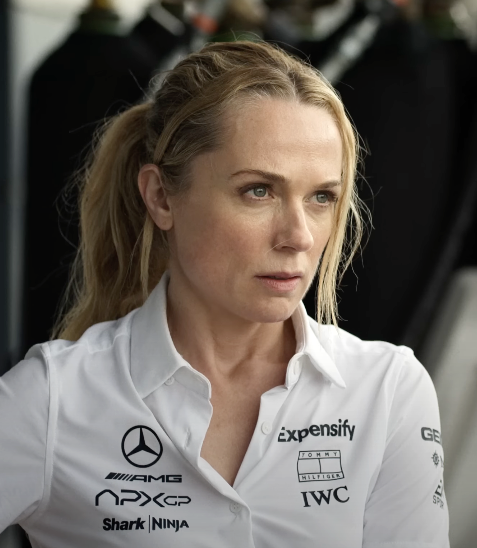
Kim Bodnia

F1: The Movie

25/06/25

Cineworld, Edinburgh

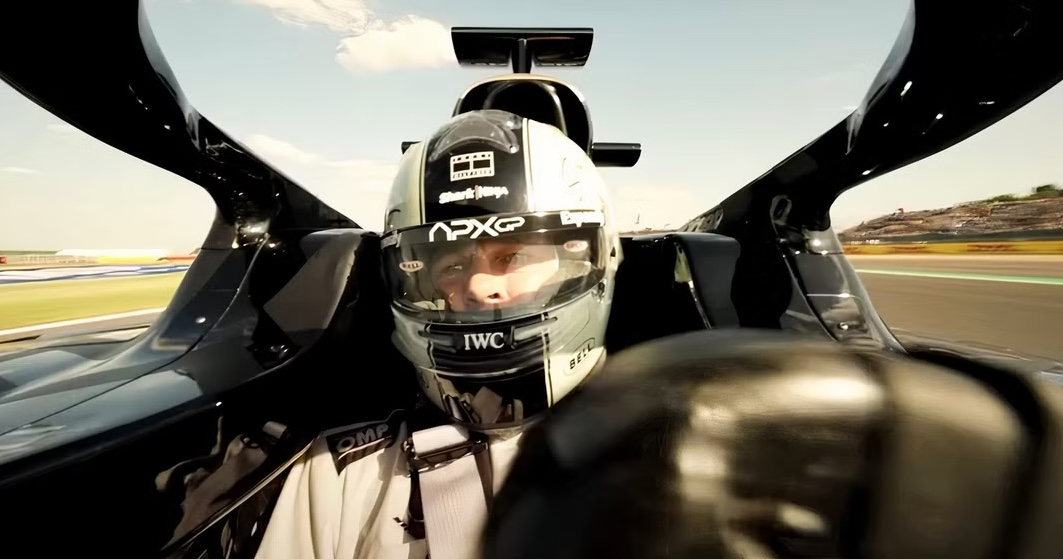
Capturing the appeal of Formula 1 in a feature film has eluded directors since the 1950s. This Apple production, helmed by Joseph Kosinski, has had a fairly troubled journey to its cinematic release and arrives boasting a rumoured production budget in the region of 300 million dollars – which Groucho Marx would doubtless have dubbed ‘one hell of a region.’ As somebody who cares not one jot for Formula 1, I had expected not to like this quite as much as I do. But Kosinski, pretty much as he did in Top Gun: Maverick, straps the viewer into the driving seat and stamps a virtual foot down hard on the accelerator. For the most part, it works.

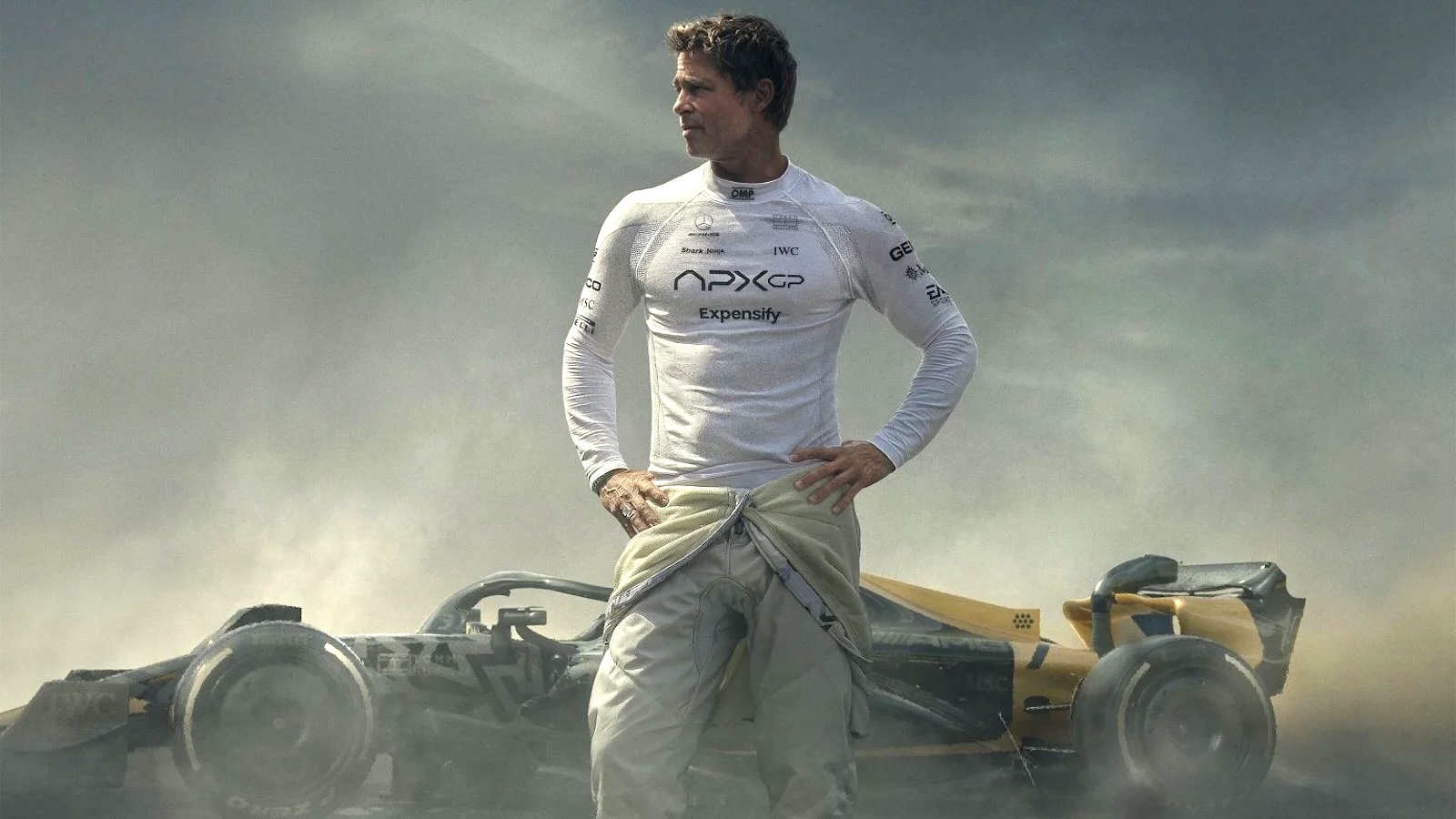
Sonny Hayes (Brad Pitt) is a former F1 driver, who, after a near-fatal crash back in his youth, has lowered his sights somewhat. When we first meet him, he’s gleefully driving a jalopy around a less sophisticated track but he’s clearly learned much over the years and is easily picking up some decent prizes. Out of the blue, he’s approached by his old racing partner, Ruben (Javier Bardem), who offers him second seat on the APXGP Formula 1 team, he now runs, which is currently going through a bad patch. Ruben thinks that Sonny’s vast experience may be just the thing to help his team up the scoreboard.

Sonny is initially reluctant to return to the fray, but eventually the offer of a first class plane ticket to London lures him to Silverstone. He’s immediately met with derision by the team’s young lead driver, Joshua (Damson Idris), and with reluctant interest by the team’s resident car designer, Kate (Kerry Condon). But it’s clear that over the ensuing season of high-stakes racing, Sonny’s relaxed and easygoing attitude is eventually going to win over all opposition…

With a running time of more than two and a half hours, F1: the Movie is probably going to find the bulk of its audience on streaming, but there’s no denying how handsome the film looks with cars thundering around the track to the raunchy backing of classic cuts from the likes of Led Zeppelin and Queen. One of the producers is Lewis Hamilton (who even I’ve heard of) and it’s clear that there are cameos scattered throughout proceedings from people I think I’m supposed to recognise. There’s also a little too much here for a rube like me about the various tricks of the trade that Sonny uses to clip seconds off each circuit. Characters debate the advantages of hard tyres versus soft tyres and various additional doo-hingies, leaving me none the wiser, but I’ve no doubt that fans of the sport will be nodding along in approval.

Pitt makes a great job of the lead role, giving us a character who’s driven by his inner demons but nonetheless remains eminently likeable. While his younger teammates are half killing themselves with their exercise regimes, he seems happy to throw a tennis ball around and head out for a leisurely jog. Condon is terrific as the straight-talking Kate, a perfect foil for Hayes’ cynical, hard-bitten one-liners. But I would like to see the excellent Kim Bodnia given more to do as the team’s principal, Kaspar, than just sit around, frowning furiously at a console.

Everything builds to a final showdown at the Yas Marina Circuit in Abu Dhabi, with the very future of the team hanging in the balance. Do they seriously think they’ve a chance of winning?

This makes for decent entertainment; indeed, one sequence, depicting a terrifying crash, actually has me gasping out loud. Aficionados will doubtless have different, more informed criticisms of the film, but for me, this is an enjoyable way to spend a couple of hours. Whether F1 will ever earn back that prodigious production budget remains to be seen.

3.8 stars

Philip Caveney

Young Woman and the Sea

03/06/24

Cineworld, Edinburgh

As true stories go, few are as inspiring as that of Trudy Ederle, who in 1926 was the first woman to swim the English Channel. If it sounds a bit so-so now, when so many people have managed it, consider how difficult it must have been in an era where there was little in the way of swim technology – and at a time when women were expected to stay quietly at home and look after the family.

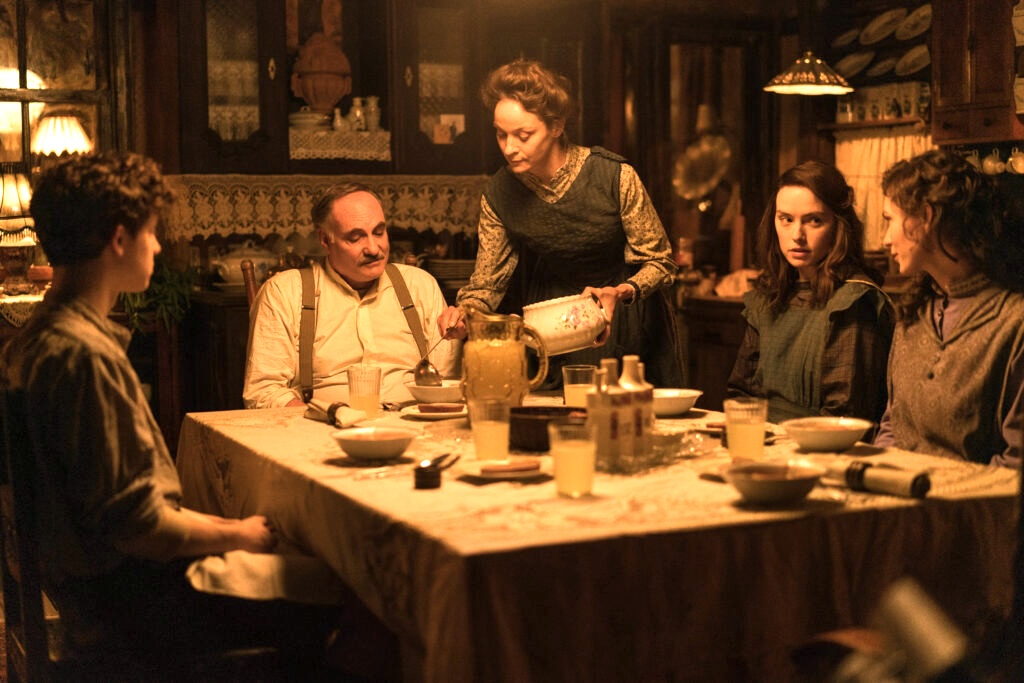
We’re first introduced to young Trudy (Olive Abercrombie) in 1914 when she’s suffering from a bout of measles that’s expected to kill her. Out in New York harbour, a fire on a passenger boat has killed a large number of people, most of them women, who burned to death because none of them had ever been taught to swim. When Trudy makes a miraculous recovery from her illness, her indefatigable mother, Gertrude (Jeanette Hain), decides that Trudy (now played by Daisy Ridley) and her sister, Margaret (Tilda Cobham-Hervey), shall have swimming lessons, even though the concept is virtually unheard of. The girls’ father, Henry (Kim Bodnia), a butcher by trade, doesn’t encourage the idea. He would rather see his daughters married with kids at the earliest opportunity and preferably to other German butchers. Whatever will these women want next? The vote?

Luckily, the girls fall under the influence of fearless swimming trainer Charlotte (Sian Clifford), who can see no logical reason why women shouldn’t be allowed to swim competitively and, sure enough, they take to the sport like… ahem… ducks to water. Trudy soon has her eyes on bigger prizes and even gets to take part in the 1924 Summer Olympics – but her determination stretches to different horizons and she’s very aware that, so far at least, no woman has ever swum across the English Channel…

This is a Disney film, but screenwriter Jeff Nathanson mostly manages to steer clear of the schmaltz, only occasionally flirting with it in the shallows. Of course, there has to be a villain in a film like this, and that duty falls to Christopher Eccleston (sporting a spectacularly dodgy Glaswegian accent) as Jabez Wolffe, the man picked to be Trudy’s trainer for her first attempt. A failed channel swimmer himself (22 attempts!), Wolffe is clearly the wrong man for the job and it’s hardly surprising that the enterprise is doomed to failure – but then Trudy falls in with Bill Burgess (Stephen Graham), the second man to make it across (in 1911!), who can see her potential and is prepared to pick up where Wolffe left off.

The rest, as they say, is history, but director Joachim Rønning does a spectacular job of creating almost unbearable suspense even though the ending is a matter of record. And Trudy’s epic swim, through bad weather, stinging jellyfish and – worst of all – almost total darkness, makes for an absorbing and compelling experience in the cinema.

How well this will fare in a summer where some excellent films are failing to find an audience is anybody’s guess, but as ever, it’s worth catching this one on the big screen before it drifts on by.

4.3 stars

Philip Caveney

The Bridge

imagesUnknown

05/01/16

Since the success of The Killing, Scandi Noir has become something of a TV growth industry – it seems the viewing public can’t get enough of lurid crimes in snowy landscapes – and out of all the series that followed the adventures of Sarah Lund, perhaps The Bridge is the most assured. It incorporates fiendishly twisty (and it has to be said, highly unlikely) plots with a hist of fascinating characters. Most intriguing of all, of course, is Sofia Helin’s remarkable turn as police inspector Saga Noren. I could probably fill a book with praise for Helin’s creation. Saga is somewhere on the autistic spectrum, (it’s never really pinned down) which means that her responses to social situations can be somewhat inappropriate and often, wildly funny, a device that cleverly undercuts the series’ visceral story lines, which would otherwise make relentlessly grim viewing.

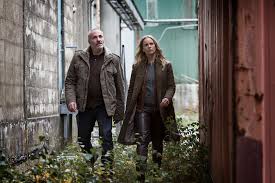
In Season One, the corpse of a woman is found lying on the Oresund Bridge – or rather, two corpses, since the top half belongs to one victim and the bottom half to another. (Yes, I know. It’s a trope of this series that no killing is ever straightforward). As the corpse has been deliberately placed at the halfway point between Denmark and Sweden, Saga is required to collaborate with Danish copper, Martin Rohde (Kim Bodnia), an affable married man with serious commitment problems (when we first meet him, he’s just undergone a painful vasectomy). The pairing of the two characters is a masterstroke, creating some ‘odd couple’ interplay that powers the first ten episodes to a suspenseful and heart breaking conclusion. Unlike their American counterparts, the Scandis never shy away from tragedy and Martin in particular is put through the emotional wringer.

In Season Two, Saga and Martin are reunited when a tanker heading towards the Oresund Bridge is found to be without a crew, apart from five drugged youths, who have no idea how they came to be there. The story cleverly links back to Season One and we’re on for another ten episodes of fascinating crime drama, as Saga and Martin try to unravel the ensuing mystery. Martin is called upon to confront the criminal mastermind who tortured him in Season One, Saga tries to establish a stable relationship with spectacularly awkward results and just to up the stakes, there’s a potential outbreak of a killer plague virus…

Season Three presented its fans with a potential problem. After a disagreement with the show’s creators, Bodnia walked, leaving author Hans Rosenfeldt to do a frantic last-minute rewrite. It’s absolutely to his credit that he not only manages to pull it off, but that the introduction of Saga’s new, pill-popping male partner, Henrik (Thure Lindhardt), gives the series a whole new lease of life. It soon becomes clear that Henrik is not the kind of character we have initially assumed he is and in fact, has his own, complicated and tragic back story. (There’s a moment where the rug is pulled out from under us with an unexpected revelation, that is quite frankly, brilliant). Meanwhile, we learn a lot more about Saga’s troubled family background. This new case kicks off with the murder of the owner of Copenhagen’s first gender-neutral pre school and leads to another incredibly complicated series of murders, which involve the recreation of contemporary paintings, using corpses as the raw material. Once again, it’s all rather ridiculous and yet the brilliance of the characters makes you accept what’s happening, no matter how bizarre the events. Against all the odds, the Bridge delivers a third slice of compelling television.

Will there be a fourth season? I certainly hope so. The Bridge is engaging stuff and there’s no indication that Hans Rosenfeldt is running out of ideas. If anything, he’s upping his game… so my advice is to tune in to Netflix and gorge yourself on one of the best crime dramas of recent years.

5 stars

Philip Caveney