25/02/22
Cineworld, Edinburgh
The story of Cyrano de Bergerac is a rather unlikely one; nonetheless, over the years it has fired the imaginations of film and theatre directors alike, sometimes with spectacular results. In 1990, it brought director Jean-Paul Rappeneau and his lead actor, Gerard Depardieu, much acclaim in a movie adaptation of Edmond Rostand’s source play. And, a few years earlier than that, Steve Martin had already turned it into the much-admired contemporary comedy, Roxanne.
In both films, of course, Cyrano was a character with a comically oversized nose – something that his adversaries mentioned at their peril.
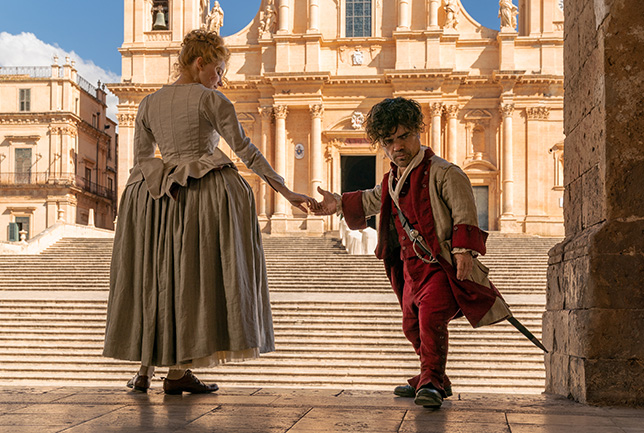
In Cyrano, director Joe Wright adopts a different approach. The hero of his story, though a brave and valiant soldier, is small of stature; and, as portrayed by Peter Dinklage, this simple premise turns out to be a masterstroke, the character’s inner turmoil told mainly through the cleverly nuanced expressions on his face. Everything else about the story stays pretty much the same – though I should probably add that this is a musical version, with songs by Aaron and Bryce Dessner.
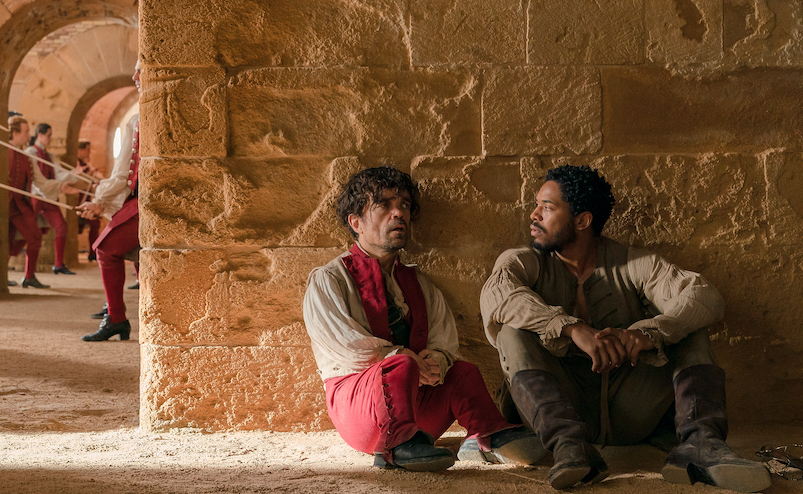
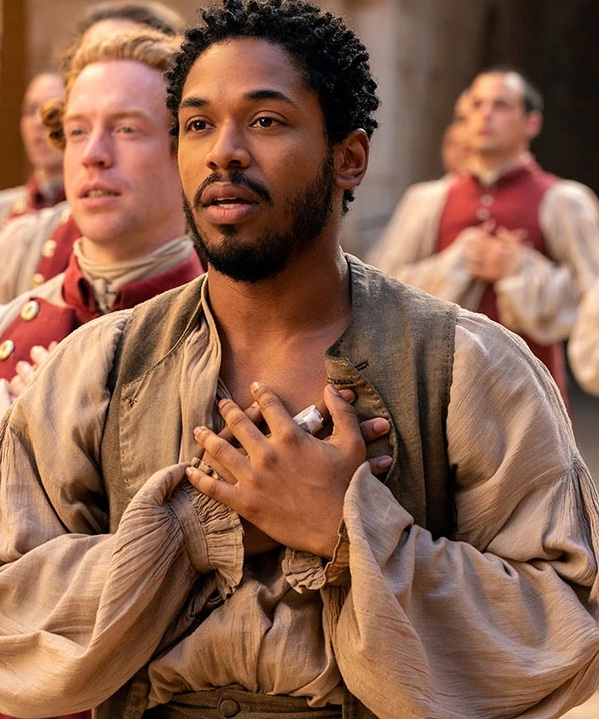
Cyrano is desperately in love with Roxanne (Hayley Bennett), a poor and (it must be said) somewhat shallow young woman, who is considered a great beauty in her home town. She is pursued by many men, among them the rich but odious De Guiche (Ben Mendelsohn). When Roxanne summons Cyrano to meet her in private, he dares to hope that she might have reciprocal feelings for him; instead she confesses that she has fallen in love with Christian de Neuvillette (Kelvin Harrison Jr), a handsome new recruit to Cyrano’s regiment. Could Cyrano keep an eye on Christian and protect him from any harm?
Cyrano is so enamoured of Roxanne that he reluctantly agrees to help – and, when it turns out that Christian isn’t very good with words, Cyrano becomes the man who writes the many love letters that ‘Christian’ regularly sends to Roxanne. As Cyrano unfurls the deluge of longing he has nurtured for so long, the task nearly unhinges him.
Filmed on location in Southern Italy, Cyrano makes few concessions to realism. Instead, Wright’s film plays out through a series of highly stylised backgrounds with garish costumes, masks and makeup used to create a vibrant world that seems to virtually pulse with colour. Soldiers practising with swords move gracefully into dance routines, while large stretches of the dialogue are spoken in rhyme. It’s only when the film reaches its later stretches (and the location switches to the snow-covered heights of Mount Etna) that the brutal reality of war seems to bleach all colour from the screen and the story descends headlong into tragedy.
The songs are distinctive, plaintive and affecting, particularly in the scene where three soldiers, about to go out to their deaths in battle, leave letters to their loved ones, singing the words as they hand the pages to a messenger. It would already have been the film’s most moving sequence, but thoughts of the current conflict in Ukraine seem to lend it extra poignancy, and my eyes fill as it unfolds. If you’re already familiar with the story of Cyrano de Bergerac, you’ll know that there’s also a coda to this tale that isn’t exactly the happy ending you might have wished for.
This is undoubtedly Dinklage’s film, revealing impressive new depths to his acting, but Bennett is good too and her final scenes with Dinklage will probably send you out into the night with tears running down your face. If I’m making it sound like something of an ordeal, it really isn’t. Wright is adept at making every scene look ravishing, as he did in his under-appreciated adaptation of Anna Karenina. It’s the very theatricality of the telling that makes this film so powerful – and, in its own way, unique
4 stars
Philip Caveney


 Bouquets & Brickbats