

01/11/23
Traverse Theatre, Edinburgh
The Grandmothers Grimm, written and directed by Emily Ingram, returns to Edinburgh for the final two nights of its latest tour. Premiered in 2017, this long-running play continues to resonate six years later, drawing in a sizeable crowd tonight at the Traverse.
Revisionist fairy tales are nothing new: like pantomimes, these stories survive because they’re endlessly adaptable. But this production, by Some Kind of Theatre, is more about intellectual property: who invented the stories, who owns them – and who gets the credit.
It’s no surprise to learn that the past was sexist (the present is pretty sexist too). But it is perhaps news that the Grimm brothers’ project – collecting traditional folk tales for a compendium – actually deprived a lot of working-class female storytellers of their living, like a nineteenth-century Spotify. After all, who’s going to pay to listen to an old woman tell them a story if they have ready access to a printed copy of the text? Jacob (Justin Skelton) and Wilhelm (Gerry Kielty) might argue that they never claimed authorship of the tales, readily acknowledging their process, but it was their names on the cover – and their profits in the bank.
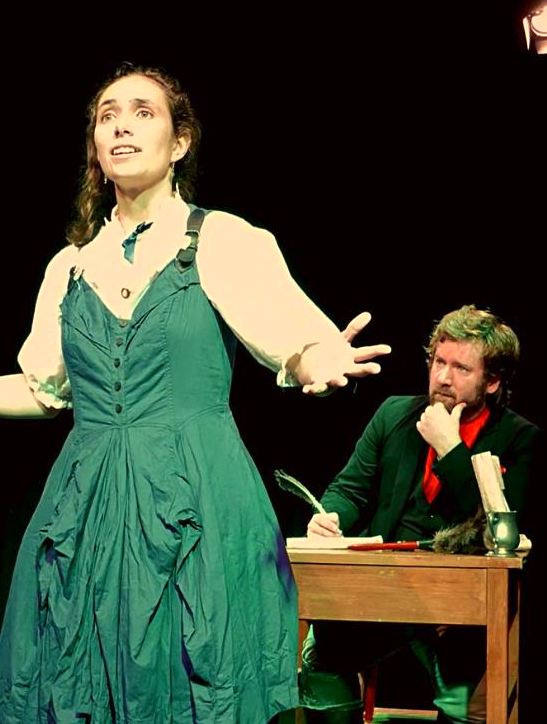
Marie Müller (Ingram) opens the play, alone, weaving her narrative with practised ease. This, we understand, is how the stories were traditionally told: a paying audience listening, rapt, as an elderly, peasant woman draws us in. When Jacob and Wilhelm burst onto the stage, accompanied by the middle-class Marie Hassenpflug (Sophie Harris), it’s clear that Old Marie doesn’t stand a chance. She’s displaced, allowed to speak only for as long as it takes for the brothers to transcribe her words.
Hassenpflug doesn’t fare much better. She’s educated so the Grimms are superficially more respectful towards her. Nonetheless, they purloin her stories with a blatant disregard for her authorship; it doesn’t occur to them to credit her (a bit like those celebrity children’s authors, who don’t credit their ghost writers…). Harris imbues Hassenpflug with a fierce dignity, which makes for a stark contrast to the brothers’ pettiness.
Kietly’s Wilhelm is focused on sales. He thinks the stories need to be sanitised so that parents will buy them for their children. Skelton’s Jacob hates this idea: he doesn’t want to create the kind of sappy stories he associates with Charles Perrault. He favours a warts and all approach, arguing that the darkness is what makes the tales. I’d agree with him if it weren’t for the fact that his version of ‘authenticity’ denies the existence of the real originators.
The staging could hardly be more simple: the performance area is almost empty, save for a desk and a couple of books; the only additional props are some feathers, cups and apples. This is no-frills, low-budget, black-box theatre – and none the worse for it. Skelton provides the comic relief, galloping round the stage as a donkey prince, as the quartet bring the various tales to life. It’s deftly done, so that we hear the original versions and then see them warped and changed. The pace never falters.
If The Grandmothers Grimm feels like a natural fit for the Edinburgh Fringe, then it’s nice to be transported back to August on this cold November night.
4 stars
Susan Singfield
 Bouquets & Brickbats