Juliette Binoche

La Passion de Dodin Bouffant (The Taste of Things)

17/02/24

Cineworld, Edinburgh

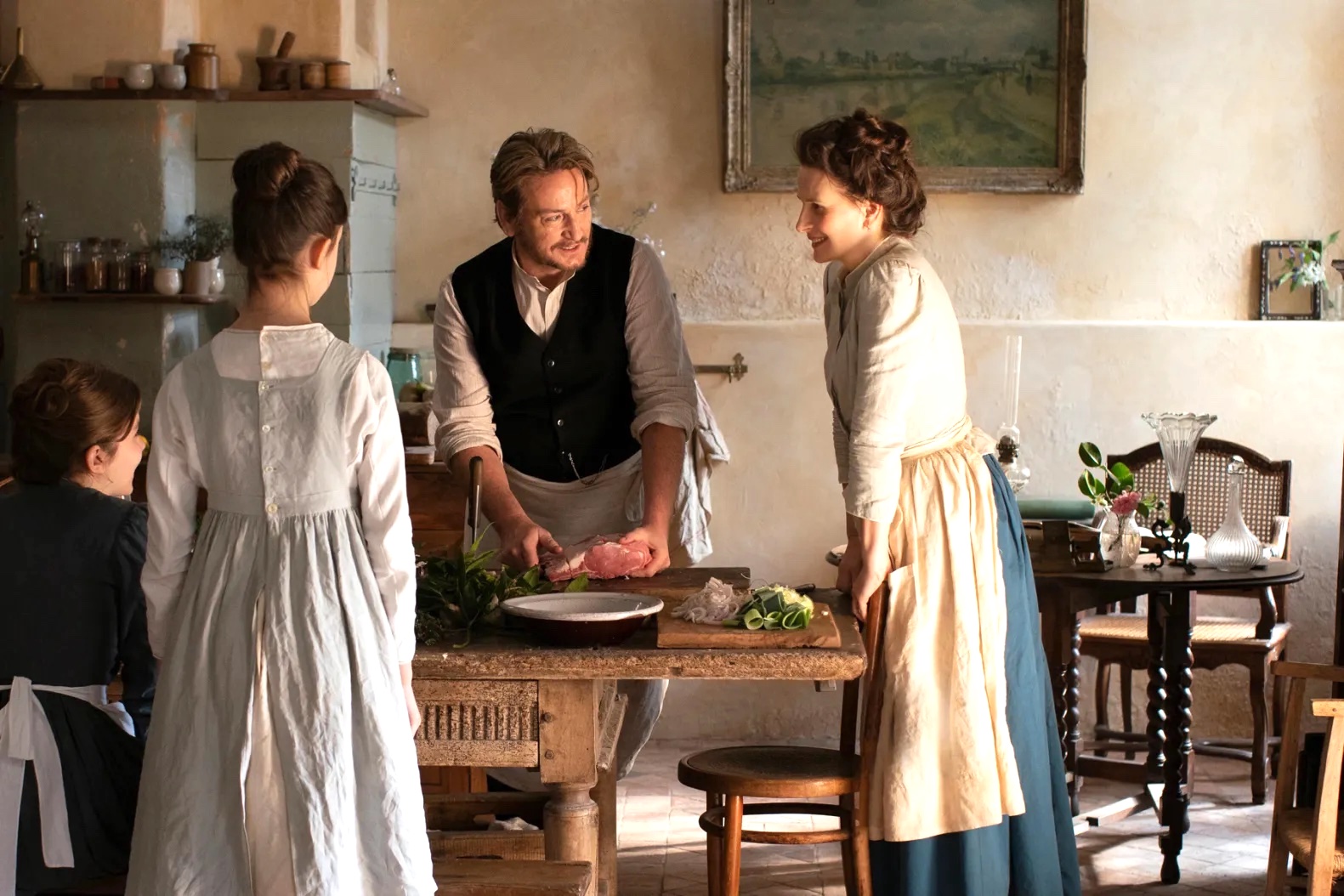
Apéritif: Set in France in 1885, La Passion de Dodin Bouffant or The Taste of Things is very much a foodie film.

Amuse-bouche: The pace is languid, the plot – such as it is – simmering slowly, allowing the audience to absorb the complex flavours of the central characters.

Entrée: French-Vietnamese film-maker Anh Hung Tran has already won the coveted Best Director award at Cannes, and this unusual film is now an Oscar-contender too.

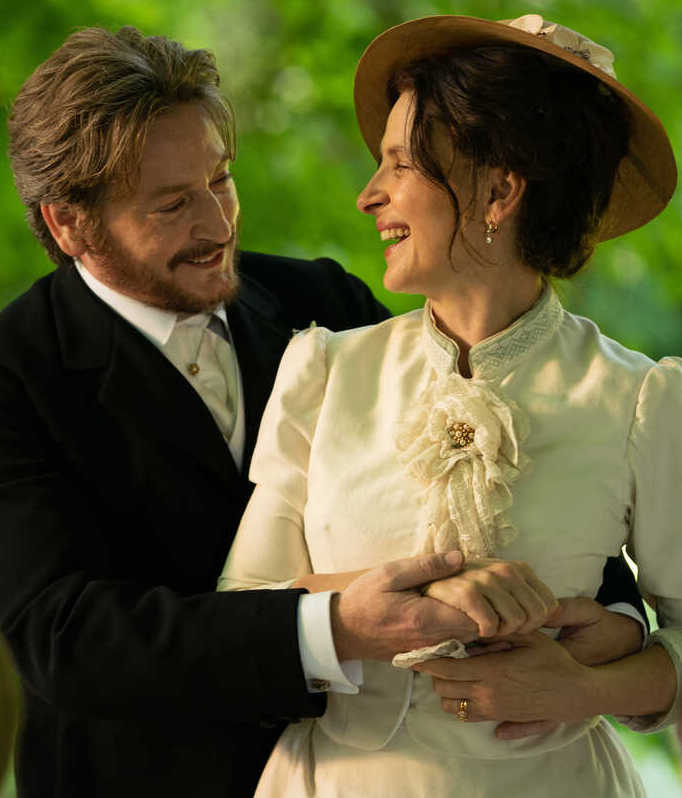
Plat principal: Benoît Magimel plays the eponymous Dodin Bouffant, a famed gourmet; his real-life ex, Juliette Binoche, is his trusted cook, Eugénie. She lives in his château, which diners come to visit from all over the world. Over two leisurely hours, we imbibe a sense of how their twenty-year relationship has matured, like the fine wines Dodin keeps in his cellar. Food binds them together: they are lovers, yes, but first and foremost they are cooks.

Salade: Kitchen assistant Violette (Galatéa Bellugi) brings her teenage niece to work one day. Pauline (Bonnie Chagneau-Ravoire) might be green, but Eugénie recognises fresh talent when she sees it, and she soon persuades Dodin to let her take the girl on as her apprentice. Pauline’s appearance signals change. Will Eugénie finally agree to marry Dodin?

Fromage: It might seem a little cheesy to use food as a metaphor for love, but when it’s as sumptuously done as this, it’s perfectly justified. The connections feel real as well as symbolic, the care taken over each component of every dish surely an indication of deep affection.

Dessert: I defy anyone to watch this film without salivating. Cinematographer Jonathan Ricquebourg’s camera lingers lovingly over basted meats and exquisite sauces; we see glass-clear consommés and glistening poached pears. When she tastes Eugénie’s Baked Alaska, Pauline weeps. I almost do the same, even though it’s just an image on a screen.

Café: A gentle story with notes of romance and an aftertaste of melancholy, The Taste of Things is a lovely film. Just not one to watch when you’re hungry.

4 stars

Susan Singfield

The Truth

12/05/20

Curzon Home Cinema

Hirokazu Koreeda’s first film outside his native Japan is an elegant French affair, a story about the tensions between mothers and daughters, fiction and truth, acting and living. Fabienne (Catherine Deneuve) is a celebrated actress, whose memoir – entitled La Vérité – has just been published. There’s an initial print run of a hundred thousand, she boasts to her daughter, Lumir (Juliette Binoche). ‘Fifty thousand,’ her assistant corrects her, and Lumir rolls her eyes. Such self-aggrandising exaggeration is clearly typical of her mother, and establishes Fabienne’s complicated relationship with ‘truth.’

Lumir lives in New York, where she is a screen-writer. She has a husband, Hank (Ethan Hawke), a TV actor, newly sober after a stint in rehab, and a young daughter, Charlotte (Clémentine Grenier); this is their first visit to Paris for many years. Clearly Lumir and Fabienne have issues to work through.

The storytelling is as elegant as Fabienne’s home furnishings. She has all the trappings of success, including a house that ‘looks like a castle.’ She’s imperious and vain, but complex too: this is no pantomime villain. Just a woman, caught in the gap between the fantasies she performs and the emotional realities she avoids.

The film-within-a-film device is neatly employed, the parallels between Fabienne’s current project, Memories of My Mother (based on a short story by Ken Liu), and the dynamics of her real-life family are subtly – but clearly – defined. In the story, a mother is frozen in time; her daughter ages while she stays the same. Fabienne plays the daughters’s oldest incarnation. But Fabienne and Lumir are frozen too; they’ve never moved past the resentments forged in Lumir’s youth, never resolved their feelings around a cataclysmic event, the death of ‘Sarah,’ Fabienne’s friend (and rival), and Lumir’s confidante. But, as Lumir confronts Fabienne about the distortions in her memoir, we see the glimmerings of a thaw…

Deneuve completely dominates this film, and that’s as it should be: it’s clearly her story. Fabienne is a huge character; everyone is diminished in her presence. Binoche and Hawke make excellent foils, their exasperation and admiration beautifully conveyed.

Koreeda is clearly one to watch; this is an utterly compelling piece of cinema, where not much happens but everything matters.

4 stars

Susan Singfield


High Life

13/05/19

The first English language production by French auteur Claire Denis, High Life uses the conventions of a science fiction film to tell its rather bleak story, though there is little in the way of the kind of visual splendour you might expect to find in this genre. Here is a nuts and bolts future where space ships look like packing crates and space suits resemble things you might pick up in Gap. Monte (Robert Pattison) is a former Death Row inmate who, when we first meet him, is alone on a space ship with a baby. We then learn, through a series of flashbacks, how the two of them came to be there.

Monte, it turns out, was part of a team of prisoners, sent on a journey to a black hole deep in space in order to harness its energy. This crew of misfits is presided over by Doctor Dibs (Juliette Binoche), who – presumably spurred on by the knowledge that the mission is going to take longer than the average human life span – has become obsessed with the idea of starting new life aboard the ship. But instead of letting the crew just pursue things in the usual way of procreation, she keeps everyone heavily sedated. The male crew members have to submit a daily sperm sample to her, which she, in turn,  administers to the females.

Hardly surprising then, that deep resentment begins to simmer, and it’s only a matter of time before things kick off.

Denis has quite a reputation and it might be this, more than anything else, that has initiated the slew of glowing reviews this film has already garnered – but for the life of me, I can’t share this enthusiasm for it. It soon becomes apparent that, while the film’s setting might be futuristic, its sexual politics remain deeply entrenched in the stone age. And this prompts some worrying questions.

Why does Binoche’s character wander around the spaceship in a nurses’s outfit that is clearly several sizes too small for her? And why, in the extended sequence when she pleasures herself in the ship’s ‘fuckbox,’ does it look as though it has been choreographed to please some unseen male gaze, even though it’s been co-authored by Denis herself? There’s also a particularly nasty rape scene, later in the film, which culminates in the bloody death of the perpetrator, but which adds precisely nothing of value to the story. Presented as it is, it just feels salacious.

These are not the only problems I have with High Life. I learn very little about Monte and even less about his crew mates, which makes it hard for me to care about them when they end up as so much flotsam. I think that Monte has some feelings for Boyse (Mia Goth) but can’t be entirely sure – and what exactly is the story behind Monte’s childhood crime, only partially revealed in flashback? Finally… that harnessing of the black hole’s power… how was that supposed to work exactly? It seems a bit cavalier to use the conventions of a genre without properly thinking it through.

If High Life was the product of a debut director, it would be panned and quickly forgotten. But I fear it’s become one of those ‘Emperor’s New Clothes’ movies, with few people prepared to step up to the plate and denounce it as the wrong-headed, misogynistic muddle that it surely is.

Unless I’m missing something? Answers on a  postcard, please…

2.8 stars

Philip Caveney