Joseph Quinn

The Fantastic Four: First Steps

24/07/25

Cineworld, Edinburgh

The world of superhero movies has become an unpredictable place. DC’s recent Superman film was dismissed as a sprawling mess by the majority of critics (me included), but proved to be a palpable hit with the public – which makes me somewhat nervous to announce that, for my money, Marvel’s latest offering is the studio’s best effort since Guardians of the Galaxy. Which probably earns it a one way ticket to ignominy.

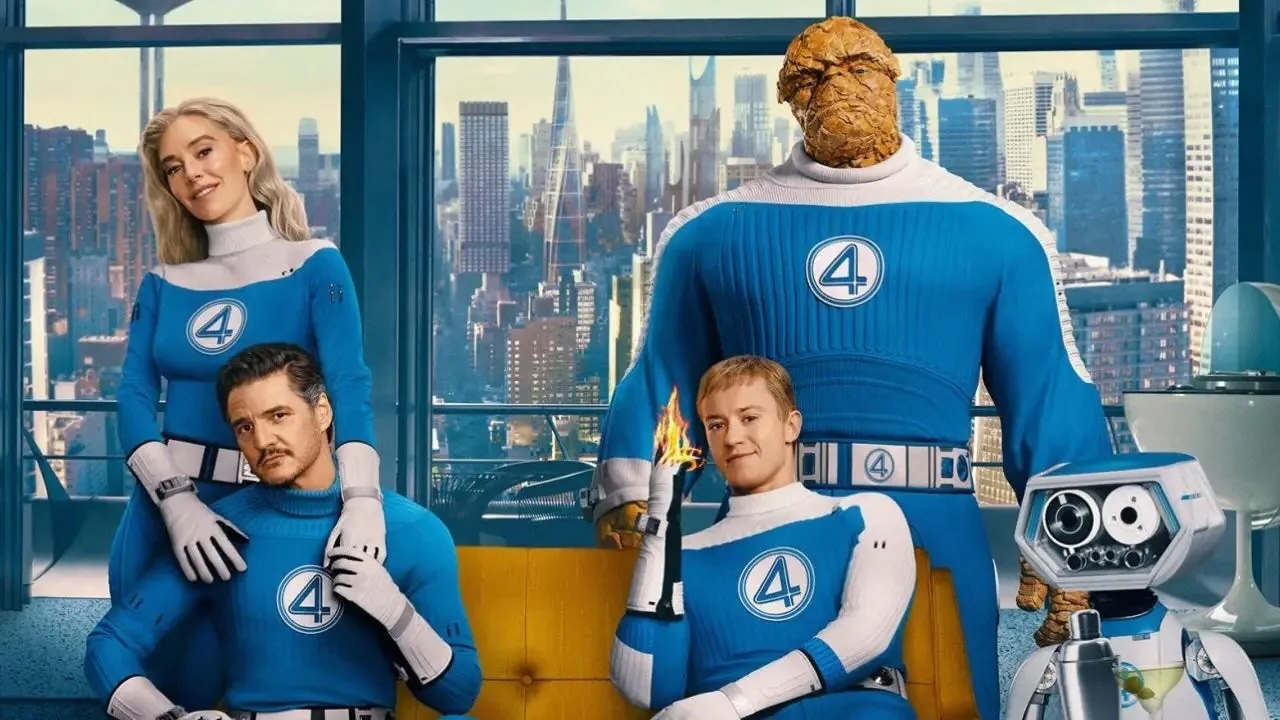
Stan Lee and Jack Kirby’s first superhero team, The Fantastic Four, have had a pretty rocky ride on the big screen. Previous attempts to capture their antics have been met with howls of derision from Marvel fans and a distinct lack of bums on seats at the box office. First Steps might suggest an origins movie, but this film begins four years after the space flight that dramatically changed the lives of its four crew members. That mission is only alluded to in a brief television interview, introduced by Ted Gilbert (Mark Gatiss). Now, Reed Richards (Pedro Pascal), Sue Storm (Vanessa Kirby), Johnny Storm (Joseph Quinn) and Ben Grimm (Ebon Moss-Bachrach) have been widely accepted as the Earth’s protectors. But, in a shot of realism rarely seen in this genre, married couple Reed and Sue are about to have their first child and are going to have to learn to go about their super-business with a baby on board.

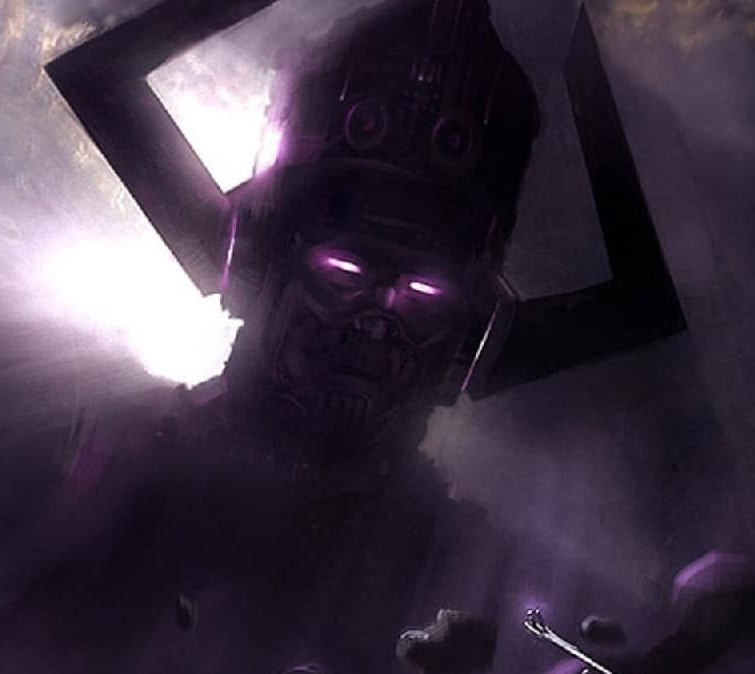
New York City receives an unexpected visit from Shalla-Bal (Julia Garner as the ex-girlfriend of The Silver Surfer, Stan Lee’s oddest hero), who points out that Earth is soon to be… ahem… eaten by Galactus (Ralph Ineson). He’s a suitably gargantuan alien, who has already gobbled up several other luckless planets and has made sure to leave room for pudding. It’s up to the four superheroes to devise a plan to save the world and carry it out, whilst taking care of new arrival, baby Franklin.

So… no pressure.

While the storyline is as batty as we’ve come to expect from Marvel, what really works here is the film’s overall aesthetic, which locates the story in an alternate nineteen-sixties (the era in which the source comics were conceived and created). The ensuing world-building is delightful, with that kooky style applied to every last detail. This results in a futuristic world where, for instance, mobile phones don’t exist. Cinematographer Jess Hall ensures that everything is filmed in vivid, eye-popping hues, while director Matt Shakman keeps the action propulsive enough to ensure that audiences don’t have time to consider how silly the storyline is.

The characterisations of the four leads are nicely handled, particularly by Pascal, who makes his Reed Richards a nerdy number-cruncher, who loves nothing better than scribbling equations on a chalkboard. The dialogue achieves just the right mix of funny and heartfelt, even if it did take seven writers; and for once, there aren’t too many characters to get a handle on. While I generally complain when everything comes down to a climactic punch-up – and this film is no exception to the rule – this one doesn’t overstay its welcome and, in its final furlong, manages to crank up some genuine moments of suspense. Mission accomplished.

So yes, it’s been a while since I enjoyed a Marvel movie to this degree. We’ll see how it fares over the following weeks but, in my humble opinion, First Steps deserves to succeed. Make sure you stay in your seats for the mid-credit sequence announcing… well, you’ll have to go and see for yourselves.

4.2 stars

Philip Caveney

Warfare

19/04/25

Cineworld, Edinburgh

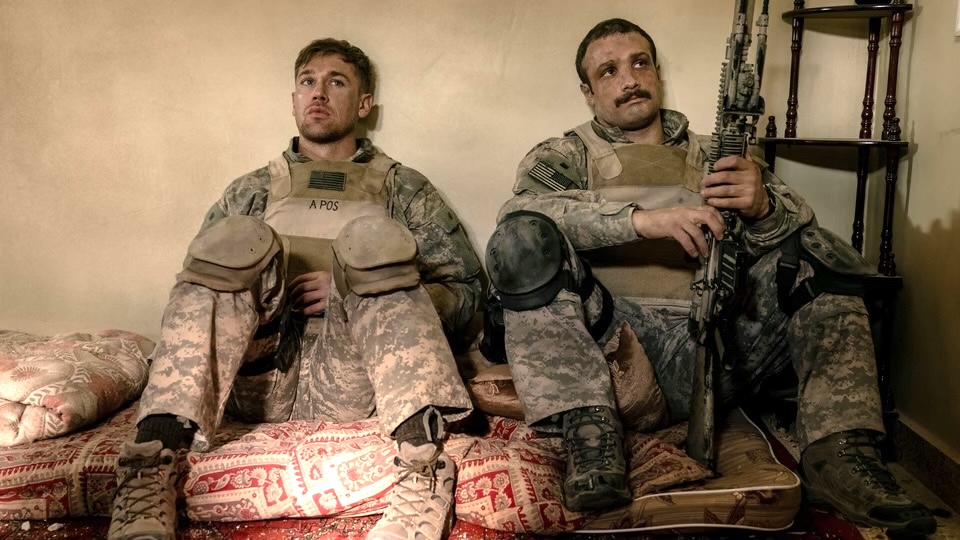
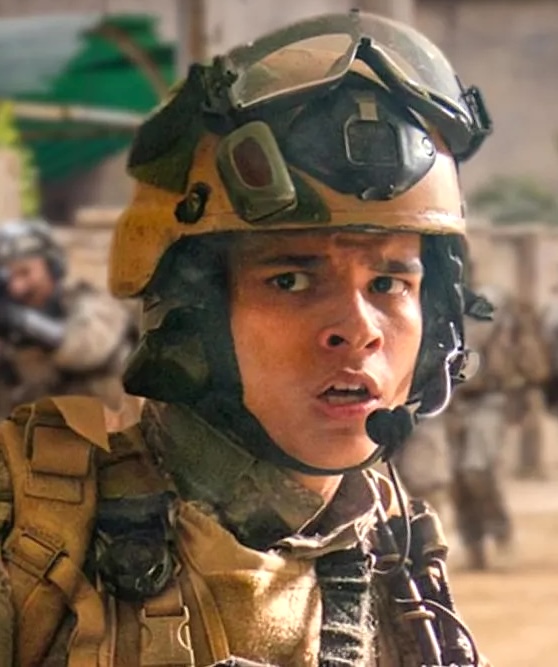
After the ferocity of Civil War, perhaps it was inevitable that Alex Garland’s next project would see him heading further into the world of military action – though it must be said that Warfare, co-written and co-directed with former marine Ray Mendoza (depicted in the film by D’Pharoah Woon-A-Tai), may qualify as the most realistic slice of it ever recreated on camera. Based on a real event, which took place in November 2006 in Ramadi, Iraq, it follows a platoon of Navy SEALS into action, as they occupy a house and await incoming Iraqi forces.

We first meet the platoon in their downtime as they watch an Eric Prydz workout video featuring some statuesque women and one man, bobbing about to the strains of Call On Me. The men laugh along and react to each other’s antics, letting off steam before heading into action. But the fun is short-lived. All too soon, they’re sneaking down darkened streets, singling out the house where they are going to hole up overnight while they wait for things to kick off. Two Iraqi families live there and are taken captive and secured in one room ,while the troops take up their positions, keeping watch for the insurgents they are told are gathering in this area.

As a new day dawns, I begin to recognise some of the actors. That’s Will Poulter as Erik and Joseph Quinn as new recruit, Sam. And there’s Cosmo Jarvis as the sniper, Elliott. But I can’t recall seeing a film where recognising the actors matters less, because this is a true ensemble piece, the characters’ identical uniforms making it difficult to tell them apart, just as it must be in reality. 

Warfare does exactly what it says in the title. It takes you from your safe seat in the cinema and plonks you down in the midst of the action – and it’s not somewhere you really want to be. There are none of the tropes that we so often associate with movies about war. There are no heroes here, no villains, no miraculous dodging of incoming bullets, no conveniently-timed lulls in the action.

At first what there is in abundance is waiting. The troops sit around, bored, longing for the action to start but only so it will eventually be over. And I share that awful anticipation with them. I flinch at every unexpected sound; I hold my breath whenever a radio crackles into life. And, when the action does come, it occurs with such unexpected shock that I find myself wincing at every explosion, every unexpected rattle of gunfire. 

The real-life event I spoke of is actually a tragedy. This is not the story of a platoon of soldiers who act with extraordinary valour and emerge with everything intact. It’s the story of a bunch of guys who have their asses handed to them in a string bag. It’s hard to watch and occasionally even harder to stomach, because there’s very realistic injury detail here and the troops who went through the experience have contributed all their memories to ensure that nothing is left out.

Warfare is truly game-changing. Does it qualify as entertainment? The truth is, I’m really not sure that it does, but it feels to me like an important film and a unique achievement, a construct that doesn’t try to tailor its narrative in an attempt to make it more palatable, preferring to depict warfare as it really is: bloody horrible. 

Those of a nervous disposition may want to give this one a wide berth – and anybody out there who harbours illusions about the nobility of war is about to have them well and truly shattered.

4.6 stars

Philip Caveney 

Gladiator 2

17/11/24

Cineworld, Edinburgh

Back in the year 2000, Gladiator was a significant game-changer. Ridley Scott’s sword and sandal epic, starring a lean, mean Russell Crowe, wowed audiences and critics alike. It was nominated for twelve Oscars and actually won five, including Best Picture and Best Actor for Crowe. Over the intervening years, Scott has often stated his intention of doing a sequel, if only he could find the right story. And finally, nearly twenty-five years later, I’m sitting in front of an IMAX screen, eager to see what he’s come up with.

I seriously doubt that Gladiator 2 will be picking up any awards (except perhaps for special  effects) because I suspect that galley has sailed. And to be honest, in most respects it plays more like a re-run of the original than an honest-to-goodness sequel. But don’t let that put you off.

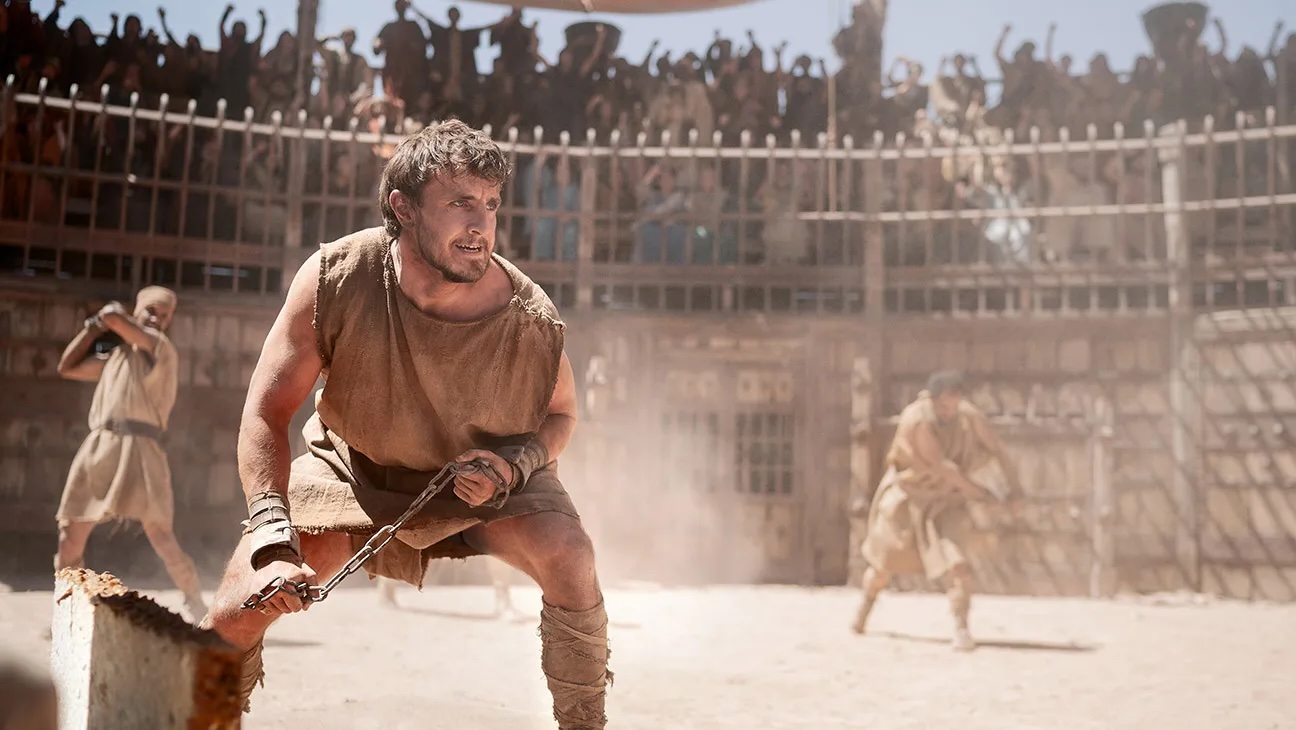
It’s some thirty years after the death of Maximus when we first meet Lucius (Paul Mescal), a soldier living and working in Numidia, alongside his wife, Arishat (Yuval Gonen.) But it isn’t long before a huge fleet of Roman warships, led by General Marcus Acasius  (Pedro Pascal), appears on the horizon. As ever the Romans are looking to extend their empire and this is just the next step in their bid for world domination. An epic battle ensues, replete with giant trebuchets and fusillades of arrows. In the carnage, Arishat is killed and Lucius taken prisoner and ferried back to Rome. On the long sea voyage he (understandably) nurtures a desire for revenge on Acasius. 

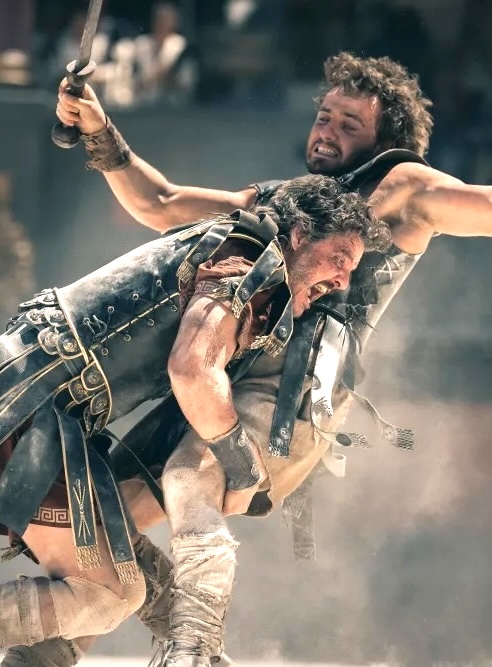
Rome is no longer the glorious empire it once was. Ruled by despotic brothers, Geta (Joseph Quinn) and Caracalla (Fred Hechinger), it’s become a place where corruption holds sway and where cunning players like gladiator-master, Macrinus (Denzel Washington), can rise to positions of influence. Does the latter have bigger ambitions than buying and selling gladiators? Well, naturally he does.

Macrinus quickly spots a quality in Lucius that he feels he can exploit and gets him into the arena at the earliest opportunity. Lucius, it turns out, has the ability to pulverise all who oppose him, even if he does pause every so often to quote Virgil. Could it be that he has some connection to the late Maximus? When we learn that Acasius’s wife is Lucilla (Connie Nielsen – the only major character to return from the original film), it soon becomes clear where this story is headed…

Gladiator 2 could justifiably be criticised for failing to explore new ideas, but this film’s DNA is all about its sheer sense of scale. Scott has always been a master of battle scenes, and lovers of spectacle can hardly complain about being short-changed in that department. Deep into his eighties now, Scott is a director who knows how to capture massive action set-pieces at testosterone-fuelled levels that are rarely even attempted these days. Wherever possible, he utilises real sets and thousands of extras in order to convey their magnitude.

There are some call-backs to the first film – scenes featuring wheat, whole lines of dialogue lifted from Gladiator 1 and that trope of stooping down to pick up a handful of earth, as though such actions can be inherited. And screenwriter David Scarpa even throws in a cheeky ‘I am Spartacus’ moment, which I think is fair enough under the circumstances. A suitably beefed-up Mescal effortlessly places a sandal-clad foot onto the A list while Washington is clearly having a whole ton of fun, camping it up as a devious player, who will seemingly let nothing get in the way of his rise to power.

There are a couple of missteps. An early dust-up in the Colosseum has Lucius and his fellow-captives pitched against a tribe of what appear to be shaved baboons, CGI creations that seem to have wandered in from some kind of demented science-fiction movie – and quite how the skinny, blonde-haired kid from the flashbacks has grown up to be Paul Mescal is one for the geneticists of the world to figure out.

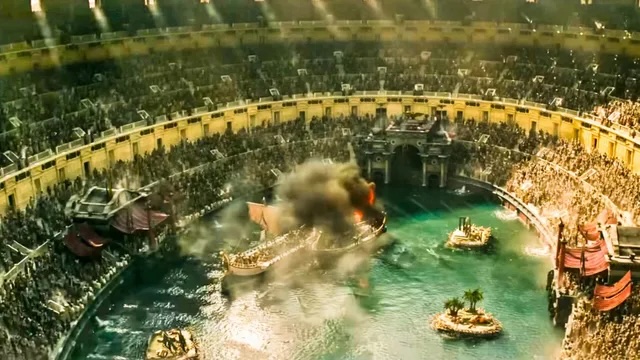
But if the aim of this film was to go bigger and louder than what came before (and I suspect that was exactly the object of the exercise) then it has succeeded in spades. The sequence where a pitched sea battle is enacted in the flooded coliseum is an extraordinary slice of action cinema (and, before you Google it. let me assure you such things did actually happen – though the addition of sharks might be a touch of artistic license). Likewise, Scarpa’s cast of characters is, for the most part, loosely based around real historical figures.

I know I say this a lot but don’t wait for streaming. See this on the biggest screen available and, as you watch, ask yourself that all important question:

“Am I not entertained?” For me, the answer is, most definitely a resounding, “Yes, I am entertained!”

4.5 stars

Philip Caveney

A Quiet Place: Day One

06/07/24

Cineworld, Edinburgh

The arrival of A Quiet Place in 2018 had a dramatic effect in cinemas across the world. Customers even ate their popcorn extra-quietly, not daring to make a noise that might summon one of the predatory aliens that were the film’s raison d’etre. In 2020, a sequel arrived and, against all the odds, managed to pull off the trick a second time. Some viewers will remember that the sequel opened with a brief glimpse of the aliens arriving in New York and that’s where the action from this prequel also plays out.

There are few franchises that can successfully stick the landing a third time and the project’s creator, John Kransinski, has handed over the reins to writer/director Michael Sarnoski, giving him carte blanche to do something a little different.

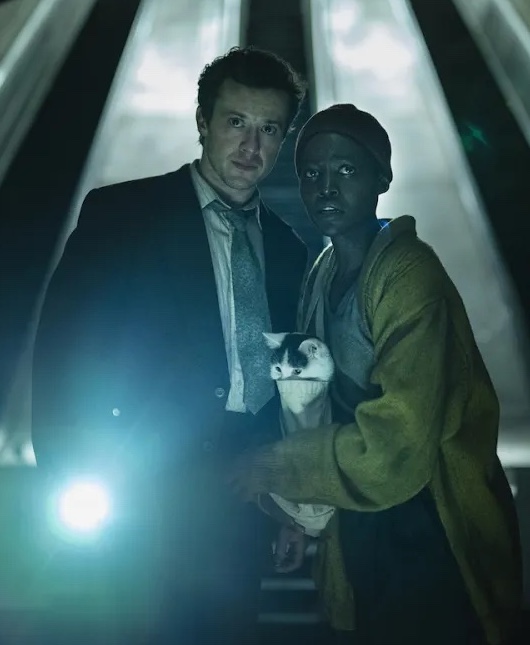
Day One begins in a hospice in New York, where terminally-ill patient, Samira (Lupita Nyong’o), is coming to terms with her own imminent demise, comforted only by her regular companion, Frodo, a cat. Friendly nurse, Reuben (Alex Wolff), manages to persuade Samira to accompany the other patients on a trip into the city, where they will visit a marionette theatre. That’ll cheer her up. She agrees – on the stipulation that she will be able to buy pizza at Patsy’s.

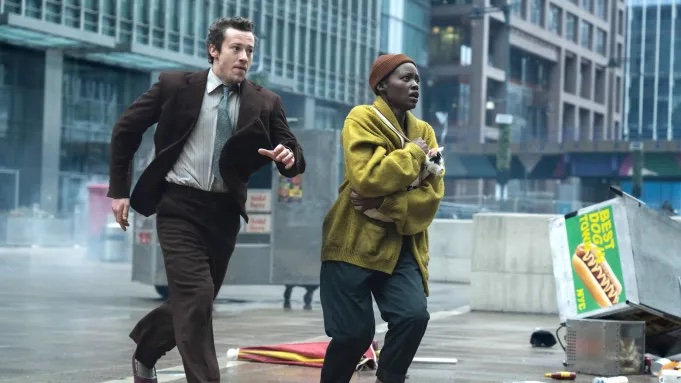
Inevitably, the visit is rudely disrupted by the arrival of those pesky aliens, who, as in the previous films are only truly scary when we barely glimpse them. These early scenes of devastation are the film’s strongest suit: the ensuing chaos feeling pretty immersive. Samira eventually hooks up with English law student, Eric (Joseph Quinn, last seen in the low budget Hoard), who is understandably terrified, and the three of them – Samira, Eric and Frodo – set about the tricky task of staying alive. From this point the film becomes less a sci-fi horror and more a story of friendship and loyalty; whilst I applaud the valiant efforts to change up from what has gone before, I feel that the concept doesn’t entirely come off.

Although there are some admittedly touching scenes here, the atmosphere of steadily-mounting terror exhibited in Parts 1 and 2 feels somewhat eroded.

And then there’s Frodo. I appreciate that a lot of people adore our feline friends, but I nearly lose count of the times that the cat inadvertently plunges his human companions into peril. Quite how they manage to persuade themselves not to hurl him into the jaws of the nearest alien is beyond me. But maybe that says more about me than it does the film.

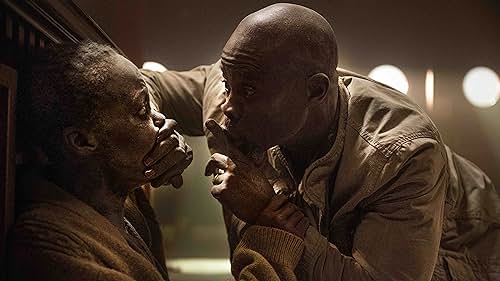
Suffice to say that, while the beginning and the end are well-handled, Day One has a decidedly flabby mid-section and, the more I see of the aliens, the less fearsome they become. Eagle-eyed viewers will spot a fleeting cameo from Djimon Hounsou as Henri, who had a bigger role in Part 2. Barely anyone else in this film gets a look in, other than a startled expression seconds before they are messily consumed. While Day One is by no means terrible, it still feels like a sizeable step down and I shall certainly be thinking twice should a fourth instalment rear its scaly head over the cinematic horizon.

Meanwhile, those who enjoy the antics of cute-but-irritating cats in disastrous situations should check this out.

3.6 stars

Philip Caveney

Hoard

19/05/24

Cineworld, Edinburgh

It’s London, some time in the 1980s. Cynthia (Hayley Squires) and her daughter Maria (Lily Beau Leach) are very close, with a whole host of funny rituals and secret games. They watch movies, threading popcorn on string; they dance until they fall over laughing; they go out at night, scavenging from bins.

The house is full to bursting. When she comes home from school, Maria has to climb over the detritus blocking the front door. Her pet ferret, Pearl, goes missing for days. She can’t find her PE kit. In trouble – again – for ‘forgetting’ it, she snaps at her mum. “I hate us. I’ve been to other people’s houses. They’re not like this.”

When the teetering mounds of junk literally crush Cynthia, Maria is taken into care.

Fast forward to 1994. Maria (Saura Lightfoot Leon) is sixteen now. ‘Mum’ is Michelle (Samantha Spiro), who’s been fostering her for years. Despite still being something of an outsider, Maria has been functioning quite well. But there’s a perfect storm brewing: she’s left school but doesn’t have a job; her only friend, Laraib (Deba Hekmat), is moving away; and news comes in of Cynthia’s death. Enter thirty-year-old Michael (Joseph Quinn), an ex-foster kid of Michelle’s who needs a place to stay for a few weeks. He’s a refuse collector, and Maria finds herself drawn to him, his smell kindling childhood memories. And then she begins to emulate her mother’s hoarding ways…

There’s a lot to admire about Hoard. It’s an ambitious piece, and debut writer-director Luna Carmoon depicts Maria’s fracturing mental health with an unflinching eye, managing to convey both her inner turmoil and how she appears to those outside. The thread of images – fireworks, sherbert, tin drums, irons – is boldly interwoven; and the metaphor-made-literal bullfight scene is particularly memorable. Both Leach and Leon evoke empathy for Maria, convincingly portraying her complex character. Squires is wonderful as Cynthia too, her brittle joie de vivre always just about to crack.

The first act is brilliant, but the early stretches of the second are less compelling: I find it hard to believe in Maria’s relationship with Laraib and in her interactions with the people at the pub. I don’t understand why the lovely Michelle would keep inviting her friend, Sam (Cathy Tyson), to bring her daughters over to visit, when she knows that they bully Maria.

Things pick up again as Michael and Maria fuel each other’s neuroses, spinning further and further out of control. It’s a tough watch – even stomach-churning – but that’s okay; it should be. The resolution, when it comes, is perhaps a little pat, but it’s a relief nonetheless. A short coda provides a clue as to where the story comes from, apparently inspired by events from Carmoon’s own life.

If the ambition sometimes exceeds the execution, Hoard is never less than interesting, and Saura Lightfoot Leon is certainly one to watch.

3.2 stars

Susan Singfield