
06/03/26
Traverse Theatre, Edinburgh
“I am not a part of the story you tried to write
I am the story
And it ends when I say so”
Filicide – the murder of one’s children – is mercifully rare but, in the context of parental separation, it’s predominantly fathers who perpetrate it as revenge. Euripides’ 2500-year-old story of Medea stands out because she is a woman, and there’s nothing we perceive as more monstrous than a non-maternal mom.
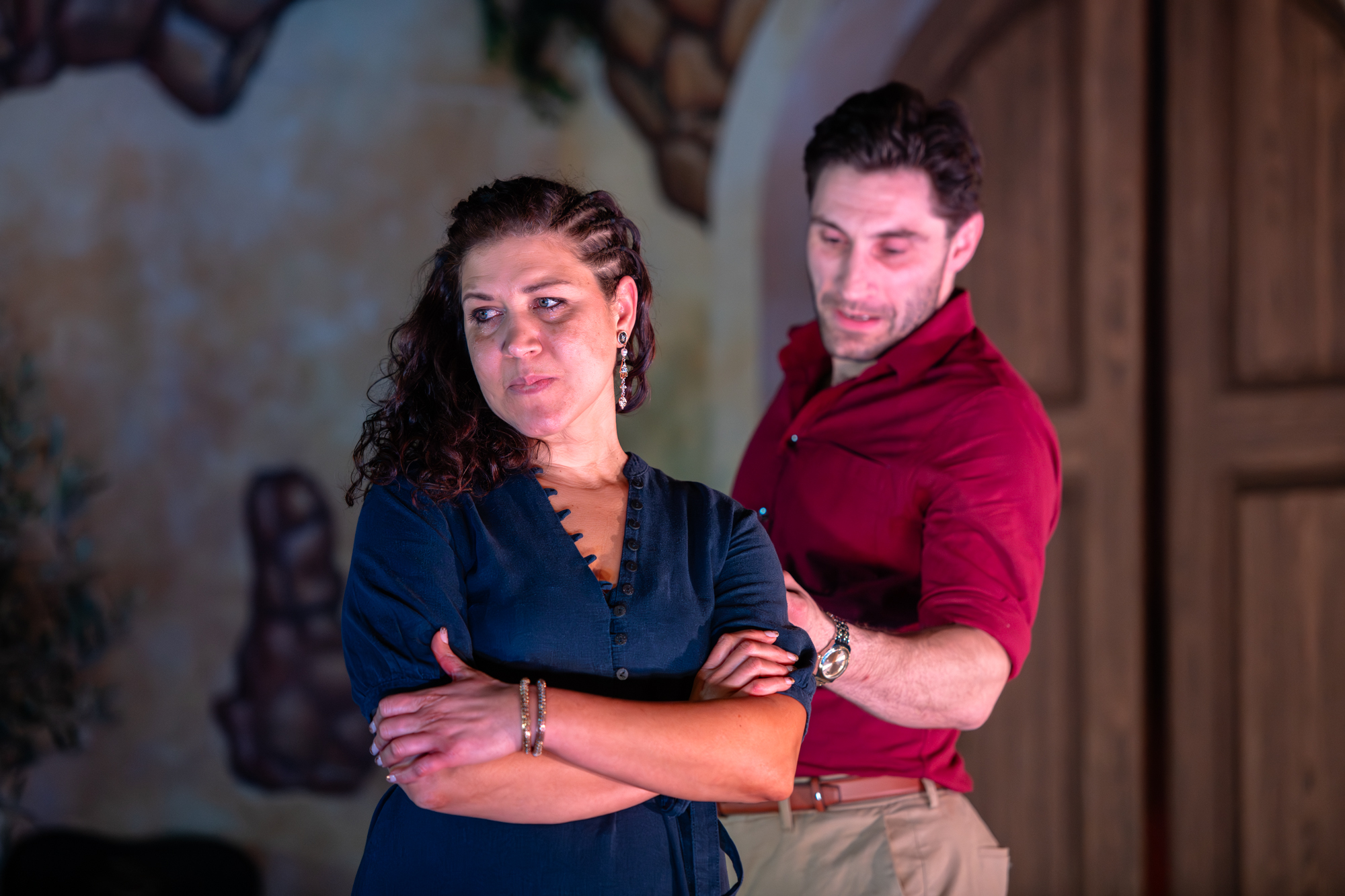
Bard in the Botanics’ contemporary retelling, written by Kathy McKean and directed by Gordon Barr, is essentially an exploration of Medea (Nicole Cooper)’s motives, helping us to understand what leads her to this dreadful act. Although her children are never seen, their centrality is immediately established, as the play opens with their Nurse (Isabelle Joss) and their Tutor (Alan Steele) discussing Medea’s emotional reaction to her husband’s abandonment. We can infer the boys’ youth and innocence from the clothes the Nurse hangs on the washing line – a small dinosaur hoody, some bright blue shorts – and the toys that lie where they’ve landed, under the table or by the wall.
McKean’s Jason (Johnny Panchaud) is a swaggering cad, still revelling in the glory of his golden fleece adventure. Over the years, he’s managed to erase Medea’s contribution from his story, claiming all the credit for himself. Their love – for which she sacrificed everything she’d ever known or cared about – is no longer enough for him; he thinks he’s worthy of more. Why shouldn’t he pursue Glauce, an actual princess? After all, it’s not as if he and Medea were ever actually wed, is it? Besides, Medea’s being pretty selfish denying him this new relationship, because he’s only really marrying Glauce to ennoble their sons, and does she really want to deny them the chance to better themselves?
It’s no surprise that Medea grows to hate him, and Cooper’s depiction of her furious heartbreak is utterly compelling. We see her simultaneously as a broken woman, hurt beyond reason, and a towering force, refusing to give in. Cooper is magnetic in the role, desperately pleading with individual members of the audience to help her (we’re stand-ins for the chorus), and convincing us that Medea’s vengeance is justified. In all honesty, we’re kind of on board with the murders of Glauce and King Creon (Steele), so it comes as a shock when she finally performs the act she’s most famous for, and it’s every bit as nightmarish as it should be. Under Barr’s direction, the filicide itself is quiet, symbolised by Medea’s intertwining of two small sweaters on the floor, as she lays her children down for their final sleep, the silence eventually shattered by Jason’s loud, appalled reaction.
Medea’s is a difficult tale, and McKean’s writing never shies away from the complexity of her character. Instead, we are shown the personal and societal forces that foster her dark urges, allowed to understand – but not excuse – her horrible revenge.
Little wonder this story has endured, with its irresistible mix of mayhem and melodrama, its excavation of human depravity and the lengths we’ll go to when we’re hurt. Although there’s only one more night at the Traverse here in Edinburgh, the tour of Scotland continues until 11th April, so there are plenty of opportunities to catch it if you can.
4.6 stars
Susan Singfield


 Bouquets & Brickbats