

04/02/22
Cineword, Edinburgh
Joanna Hogg’s The Souvenir was a well deserved indie hit back in 2020. It relates the story of young film student, Julie (Honor Swinton Byrne), whose life becomes inextricably entangled with the mysterious Anthony (Tom Burke), a secretive alpha-male who claims to work for the foreign office. Julie quickly learns that Anthony cannot be trusted and that he has a propensity for selling off her treasured belongings in order to fuel an all-pervading drug addiction. It’s a powerful story, one with a heart-rendingly tragic conclusion.
It therefore came as something of a surprise to learn that a sequel had been commissioned. Shot last year, and newly arrived in the cinemas, it’s already been garlanded with high praise and five star reviews from many of the UK’s most prestigious critics. Like the previous film, it boasts Martin Scorcese as executive producer and takes up where the last film ended, with Julie trying to come to terms with Anthony’s suicide, whilst simultaneously attempting to continue her schooling, working alongside a bunch of fellow students to produce her graduation film.
Along the way, Julie experiences a disastrous one-night-stand with actor Jim (Charlie Hutton) and continues to kindle the scorn of the egomaniac fledgling director, Patrick (Richard Ayoade), who offers some of the film’s funniest lines. ‘You’re literally forcing me to have a tantrum!’ he screams at one point. It’s the late 80s, which probably explains why nearly every character we meet smokes continuously – on film sets, at the dinner table, even in the cinema. The film occasionally feels as though it should carry a government health warning.
As before, Hogg makes no attempt to disguise the fact that Julie is rampantly over-privileged. Here is a student with no side-job, who nevertheless lives alone in a swanky, central-London apartment, and is able to call upon her rich parents, Rosalind (Swinton-Byrne’s real life mother Tilda Swinton) and William (James Spencer), to further fund her filmmaking efforts to the tune of ten thousand pounds, which they are able to do without an eyebrow being raised.
The first half of the film works well, concentrating on Julie’s efforts to process her grief. She makes regular visits to a counsellor, visits Anthony’s parents and even drops in on some of his shadier acquaintances in her search for answers. The second half of the film takes us headlong into the filmmaking process, with Julie struggling to get her ideas across to the cast and crew who’ve been assigned to work on her vision. A decision to abandon her original project (a film about the working classes in Sunderland) is probably a wise move – anything she might have had to say about that subject would have smacked of appropriation.
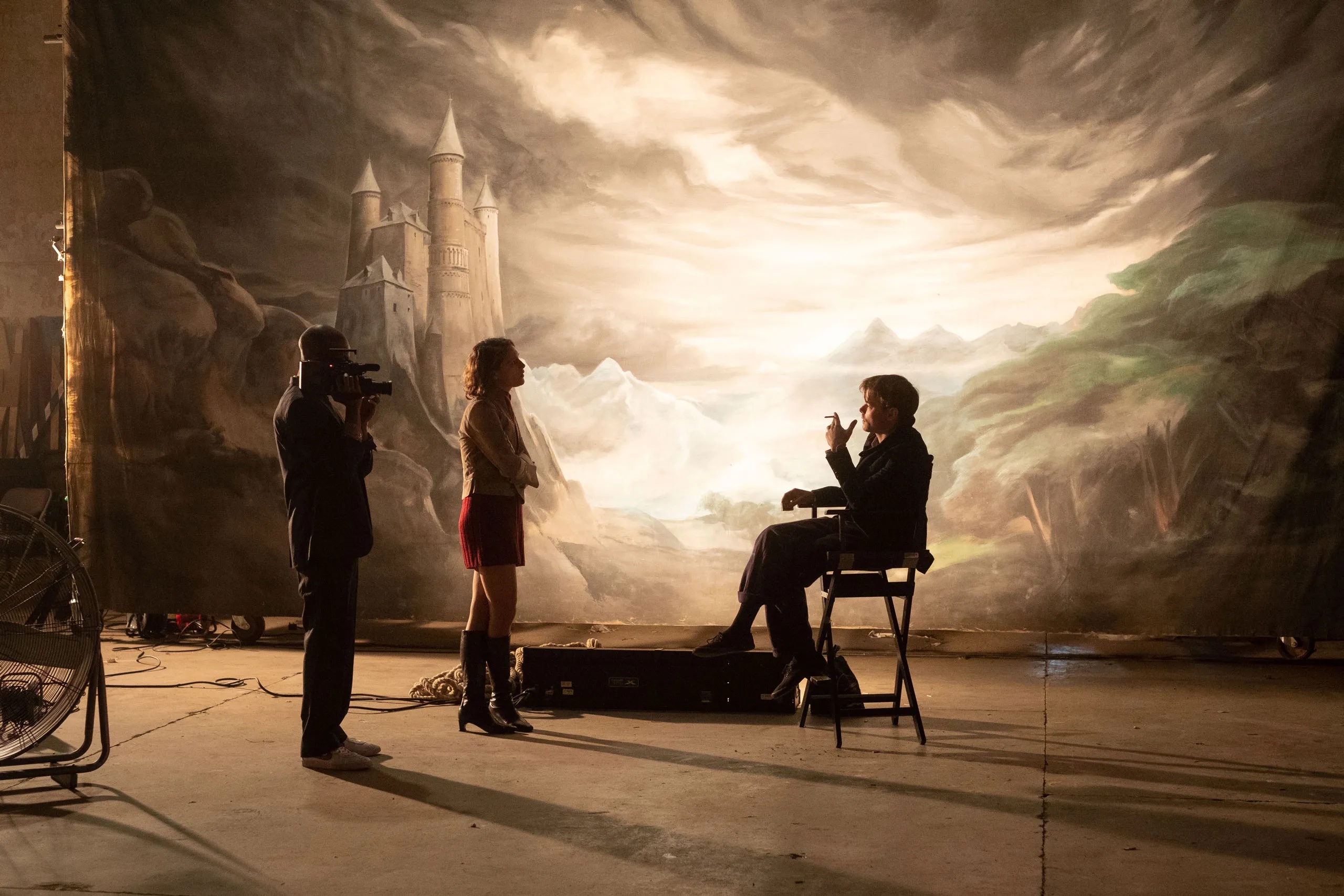
Instead, she tries to capture the details of her doomed relationship with Anthony on film. This is meta to say the very least. Now we’re watching Julie watching actors playing her and Anthony, enacting scenes from her recent history – and then, when we see the finished film, it’s viewed through Julie’s gaze so she appears to be starring in a film about her own life titled… er… The Souvenir.
To my mind, this second half is both more ambitious and less cohesive than what’s gone before. Which is not to say that there isn’t plenty here to admire, just that it feels a bit scattershot – and the film’s final sequence would have impressed me a lot more if I hadn’t recently seen it done better – and more confidently – in TV series Landscapers.
But that’s hardly Hogg’s fault. She’s clearly a talented filmmaker, but I’m hoping now she’ll apply those talents to something entirely different, rather than The Souvenir: Part Three.
Only time will tell on that one.
3.8 stars
Philip Caveney


 Bouquets & Brickbats