Hiyao Miyazaki

Flow

23/03/25

Cineworld, Edinburgh

We managed to catch nearly all of this year’s Oscar nominated films at the cinema before (or shortly after) the event, but news that the widely-admired The Wild Robot hadn’t taken the gong for ‘best animation’ came as something of a surprise. Only a few minutes into Flow, which is finally on general release, that surprise is quickly annihilated. I often think that the word ‘masterpiece’ is overused but this groundbreaking animation by Latvian director Glints Zilbalodis is so accomplished, it’s all-too easy to see why it was handed the top award. The fact that it was made for a budget of three-million dollars – utilising free software package, Blender – only adds to the accomplishment.

Zilbalodis – who co-wrote the story with Matiss Kaza and Ron Dyens – eschews any of the long-established tropes we’ve come to expect from this genre. There are no talking animals voiced by well-known actors, the creatures that make up the cast can only miaow, bark, screech and grunt at each other and yet, somehow, that all adds to the wonder of the thing. The influences on the verdant look of this strange new world are more Miyazaki than Disney. Much of what I see on the big screen is quite simply breath-taking.

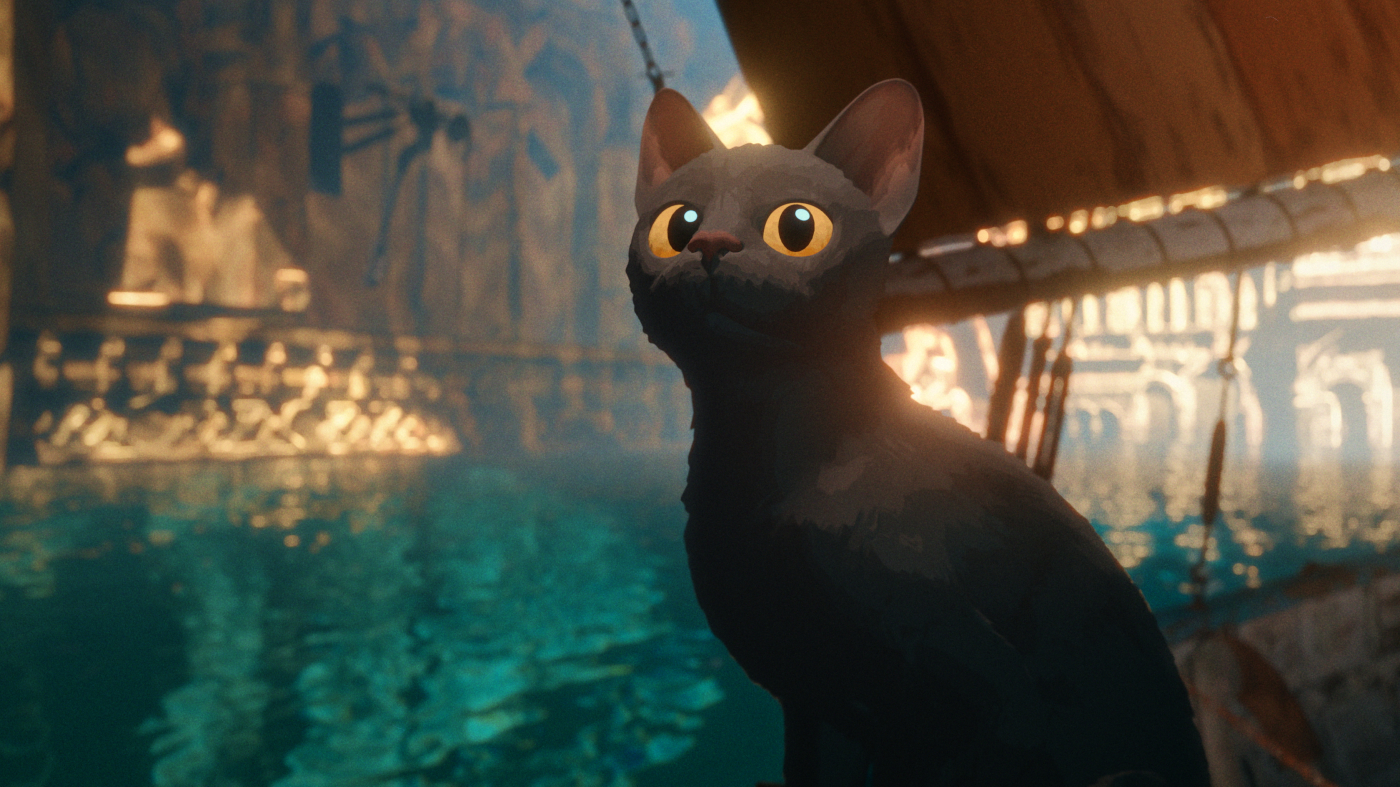
We’re somewhere in the near future and, while initially the world looks intact, there’s no sign of any humans, other than their empty houses and the everyday things they’ve left behind. Our hero is a black cat, who wanders across the countyside engaged in a never-ending search for food. He has a run-in with a pack of dogs, one of them an affable-looking golden retriever, but the confrontation is rudely interrupted by the arrival of a herd of fleeing deer. This is followed by a sudden and unexplained tsunami, a biblical flood that sets water levels rising at a terrifying speed.

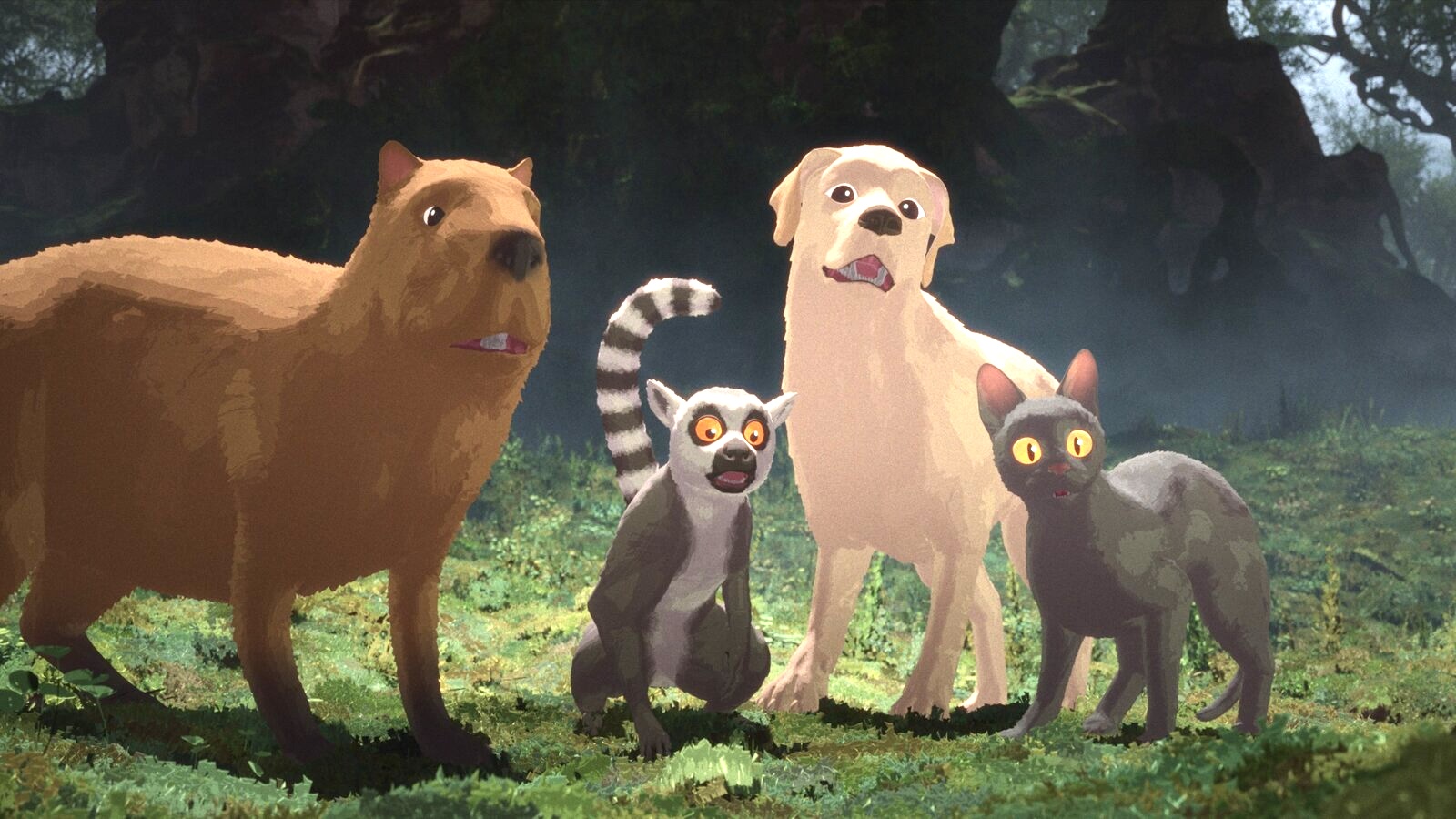
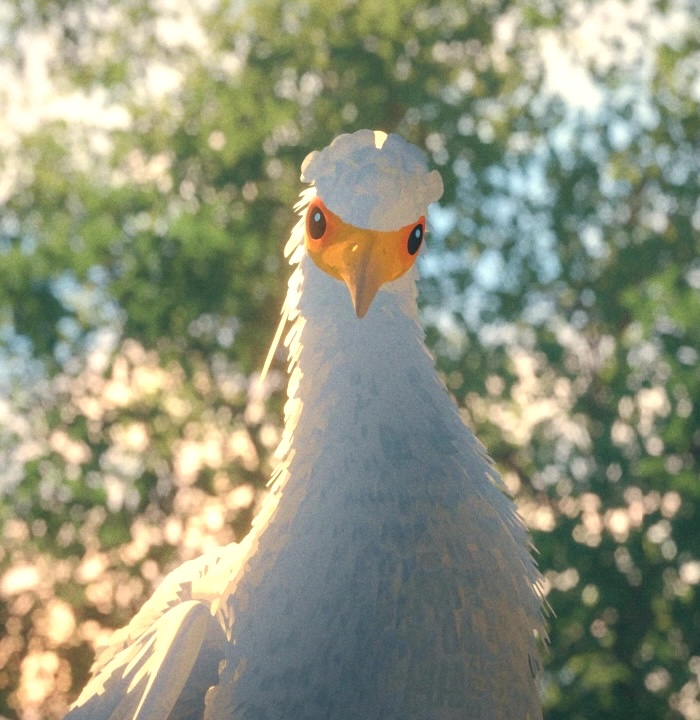
The cat is lucky enough to encounter a sailboat drifting on the torrent but, once aboard, he finds it is already occupied by a capybara; though the two creatures have nothing in common, they quickly learn to co-exist. It’s not long before they are joined by the aforementioned retriever, an acquisitive lemur and a lanky secretary bird, who – it turns out – is pretty good at steering boats. Together they sail onwards, heading now towards a mysterious range of peaks on the far horizon. But what’s waiting for them there?

Flow is a great big allegory wrapped up in an enigma, one that fairly bristles with references. Climate crisis? Right there. Biblical references? Yup, you’ve got them – and not just Noah’s Ark. Allusions to death and what happens when creatures confront it? Oh, yes. It’s probably worth mentioning that there’s a lot of peril in this U certificate story and that some of its strands may not be suitable for younger viewers. While there’s no real violence to speak of, there is evidence of nature red in tooth and claw, so parents should think carefully before taking their smaller offspring along.

For older children and grown-ups, there’s a wonderful feast of viewing to be had, backed by soaring electronic music – composed by Zilbalodis (is there no end to this man’s talents?) with Rihards Zaļupe. Afterwards, there are great discussions to be had about all the different themes touched on by this ambitious, inspired, and sometimes downright challenging story.

It took five years to create Flow – and I’m already looking forward to exploring wherever Zilbalodis takes me next.

5 stars

Philip Caveney

From Up On Poppy Hill

20/05/20

Netflix

In these troubled times, isn’t it great to have something dependable to tune in to? Looking through the crop of Studio Ghibli animations on Netflix, we find another one we failed to catch on its release. From Up on Poppy Hill first graced screens in 2011. It’s scripted by the legendary Hiyao Miyazaki, directed by his son, Gorô, and is set in the early 60s, when Japan was readying itself to host the Olympic Games. Unlike many Ghibli films, the setting (Yokohama) is authentically Japanese in just abut every detail.

Predictably, the story focuses on a plucky teenage girl. Umi (Masami Nagasawa) is a hardworking sixteen-year-old. Her father died during the Korean war and her mother, a medical professor, is away studying in America. So Umi is helping to run the family’s boarding house, cooking and cleaning whenever she’s not attending High School. It’s here that she first encounters, Shun (Jun’chi Okada), a fellow student. It’s clear from the outset that the two of them have an attraction.  Shun is an enthusiastic supporter of the school’s club house, the Quartier Latin, where various societies pursue their myriad interests. When the shabby old building where everything happens is threatened with demolition, Umi and Shun work together to try and avert disaster and, inevitably, their relationship deepens.

But a series of tragic events that occurred during the Korean war threatens to destroy any chance of a relationship between them…

This may not be one of Ghibli’s big-hitters but it’s nonetheless an appealing tale, sensitively told – and, as ever with this studio, the magic is all in the detail. There are some truly breathtaking images here, particularly in the depictions of the city at night; I especially enjoy a delightful extended sequence that begins just before twilight and effortlessly moves through a ravishing sunset and into the evening.

It’s true that the story’s resolution provides no great surprises but I like the realism of it, and the emotional clarity of the storytelling.

4.2 stars

Philip Caveney

Princess Mononoke

25/03/18

The Cameo Cinema’s Studio Ghibli season continues with the 1997 film that many hail as its finest achievement – and it’s easy to understand where that reputation comes from. This superb production, inspired by Japanese mythology, has an epic look and feel that almost seems to transcend the format for which it has been created; indeed, it doesn’t feel an overstatement to claim that some of the battle scenes pictured here rival those of the master director, Akira Kurosawa. Praise indeed.

Princess Mononoke is the story of young warrior, Ashitaka (voiced by Yoji Matsuka), who, when defending his village from an attack by a gigantic possessed wild boar (a truly astonishing creation), finds himself stricken by a dark curse which will eventually claim his life. Taking the advice of a wise woman in his village, he rides into the West in search of the God of the Forest, who, the woman assures him, is the only creature powerful enough to lift the affliction that has claimed him. He sets out, riding his faithful red elk Yakul. On route to his destination, he encounters San (Yuriko Ishida, the Princess of the title), a feral young woman who has been adopted by the pack of wolves she was originally sacrificed to and who now bears a deep enmity for all humans.

Ashitaka travels on and arrives at a huge iron works, presided over by the powerful Lady Eboshi (Yuko Tanaka), a seemingly benign dictator who nonetheless uses muskets to enforce her rule over her rivals and the creatures that dwell in the surrounding forest, which she believes are constantly plotting to usurp her authority. She views the ancient Forest God as a potential threat and is prepared to go to ruthless lengths to ensure that she remains dominant – even if it means conquering this ancient creature with sheer force of weapons…

There’s a powerful environmental story here and also a comment on mankind’s insatiable lust for power. The film unleashes a series of powerful set pieces, each more jaw-dropping than the last and I love the fact that it effortlessly avoids the pat happy ending that would surely have ensued if this were a Disney project. I love the fact that Mononoke features strong, powerful women and that it is so reverent of Japan’s myths and legends. But mostly I am just awed by the incredible animation, the shimmering, transcendent beauty that seems to seep from every frame. Animation is always a labour of love and it’s rarely been more evident than it here here.

It’s interesting to note that every Ghibli films we’ve seen, so far, has been quite different from it’s predecessor – this one features scenes of violent conflict that are a million miles away from the charm and whimsy of something like My Neighbor Totoro – but, if I have to choose one film that stands above the rest, Princess Mononoke is certainly a strong contender for the title.

It’s absolutely stunning.

4.8 stars

Philip Caveney