Guy Pearce

The Brutalist

25/01/25

Cineworld, Edinburgh

It’s evident from the very beginning of The Brutalist that director Brady Corbet is determined to establish his own rules. Instead of rolling vertically, like every other credit sequence you’ve seen, the words slide horizontally across the screen and resemble the work of a groundbreaking graphic designer. Using VistaVision – a screen format popularised in the 1950s – the film has its own distinctive look. It has a prodigious running time of over three-and-a-half hours, but, much like the old epics of David Lean, viewers are afforded a fifteen-minute interval, so we can avail ourselves of a toilet break.

It’s a wonder then that The Brutalist is so utterly compelling that I barely even notice its length. This is monumental in every sense of the word and perhaps the biggest wonder of all is that it’s been created on a budget of less than ten million dollars – a fraction of most films conceived on this scale.

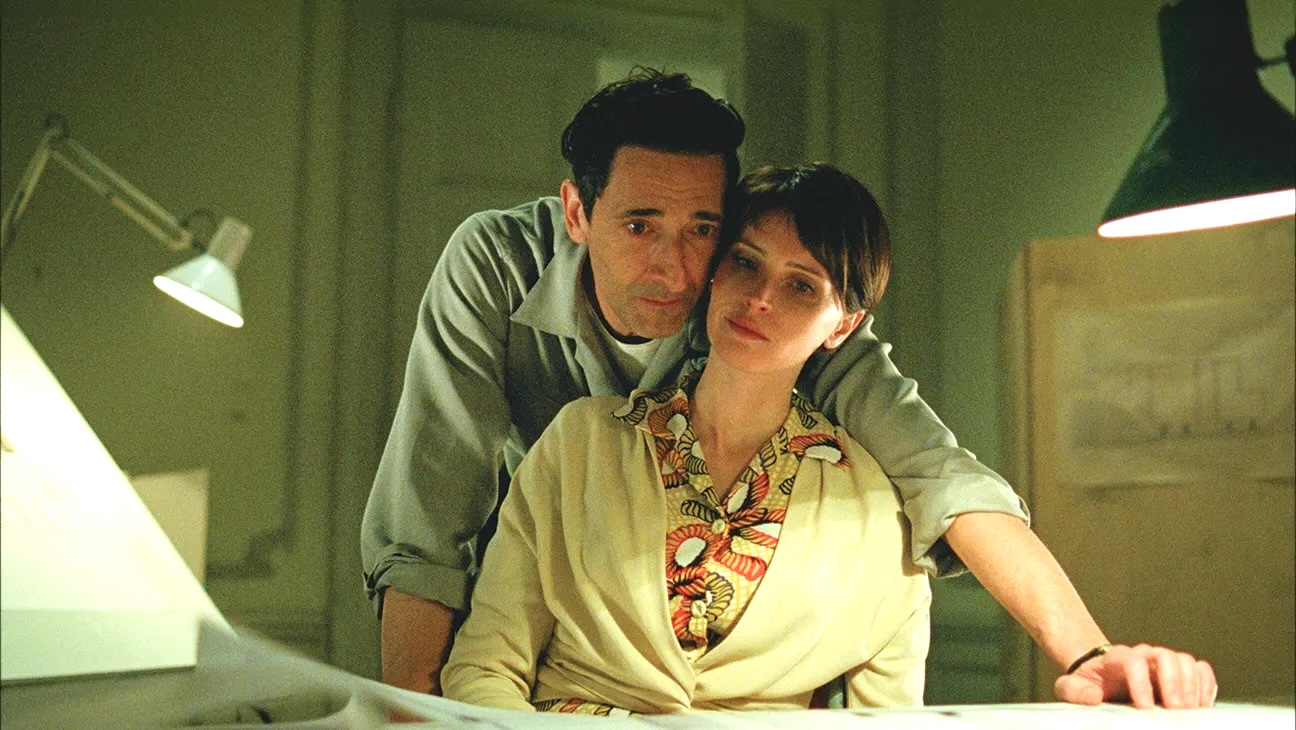
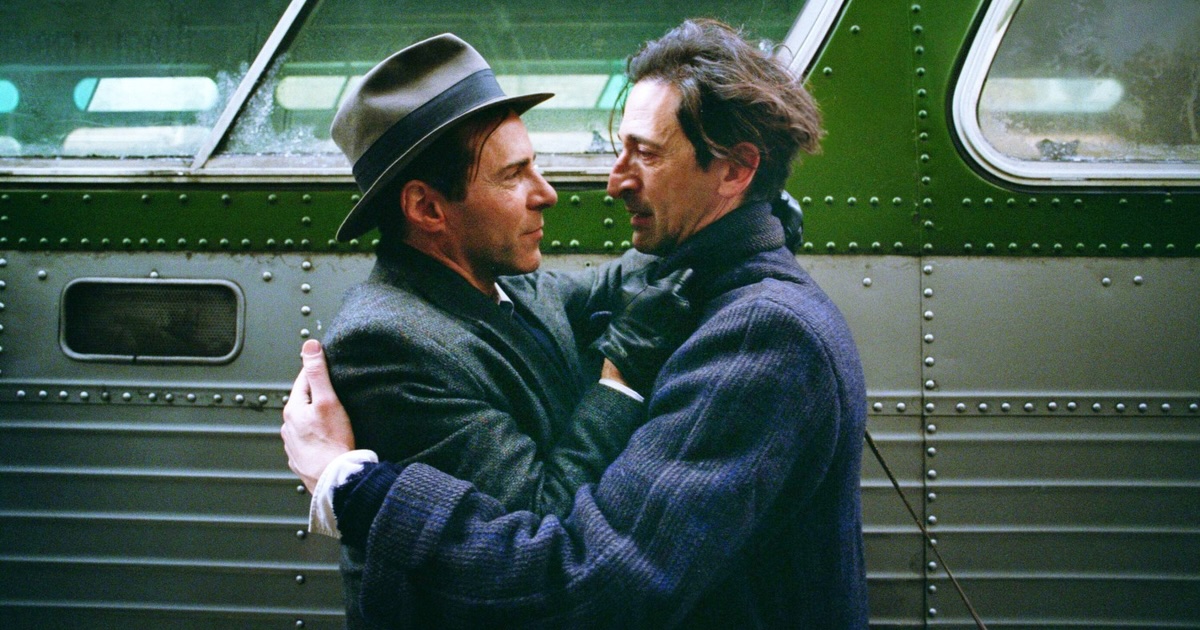
The story begins in 1947 with a series of fragmentary glimpses of Jewish refugee, László Tóth (Adrien Brody) travelling by ship from his native Hungary to begin a new life in America. He has been forcibly separated from his wife, Erzsébet (Felicity Jones), and his orphaned niece, Zsófia (Raffey Cassiday), and imprisoned in Dachau concentration camp for most of the war, but has now been offered sanctuary in Pennsylvania by his cousin, Attila (Alessandro Nivola), and his Catholic wife, Audrey (Emma Laird). The couple run a small furniture store and Attila is well aware that, before the war, László worked as an architect of the Bauhaus School. His design skills, Attila thinks, will come in useful.

Attila is approached by Harry Lee Van Buren (Joe Alwyn), who wants to commission László to redesign his father Harrison’s private library as a birthday surprise. Rather than do a straightforward upgrade, László transforms the room into a stunning work of art. When Harrison (Guy Pearce) arrives home earlier than expected, he clearly doesn’t approve of what’s been done in his absence and flies into a rage, ordering László and Attila to leave. Harry subsequently refuses to pay for the work and, as a consequence, László finds himself thrown out of his cousin’s place, with no better prospect than labouring to earn his daily bread. With his friend, Gordon (Isaac de Bankholé), he sinks into heroin addiction.

But when the redesigned library appears in the pages of an influential style magazine, Harrison undergoes a dramatic change of heart. Suddenly, he wants to be László’s patron, to converse with him, to fully understand his working methods. What’s more, he has influential Jewish friends who will be able to help him to bring Erzsébet and Zsófia over from Hungary to be with him. And then Harrison starts talking about a new commission: a massive civic centre dedicated to his late wife, a place where the local community can meet and enrich their lives.

But in the fullness of time, László will discover that such indulgences come at a price that will utterly compromise his artistic freedom – and will impinge upon his life in ways he could never have anticipated…

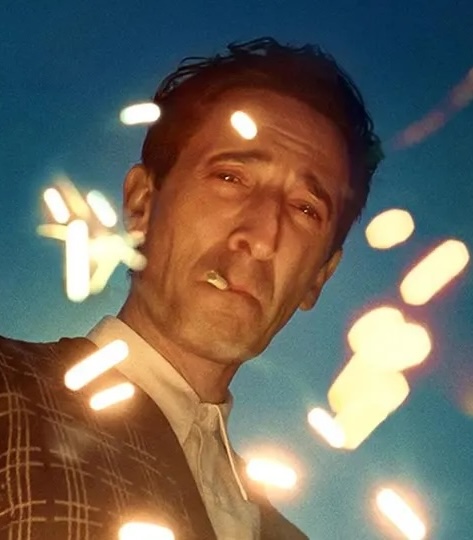
The Brutalist is a remarkable film in so many ways, not least because of Brody’s powerful performance in the lead role, a tortured artist, forced to compromise his talent at every turn. Pearce is also terrific as the self-aggrandising Harrison and Alwyn excels as his sneering, deeply unpleasant son, a man used to getting his own way in everything he approaches. Jones doesn’t enter the story until the film’s second half but submits a beautifully nuanced performance as Erzsébet, a woman still physically tortured by the aftermath of the starvation she suffered during the war. I should also mention Daniel Blumberg’s wonderful score, which provides the perfect accompaniment to Lol Crowley’s eye-popping cinematography.

The film has plenty to say about the creative process and it nails perfectly the powerful seduction that success offers to any artist – the fateful allure of patronage and its unpalatable compromises. Brady’s screenplay, co-written with Mona Fastvold, is wise enough to hint at unspeakable things rather than spelling them out – and it keeps me hooked until the final frame.

Will Brody lift the ‘best actor’ gong at this year’s Oscars? It’s a strong possibility in a year that features a whole bunch of commendable performances. Meanwhile, go and see The Brutalist and marvel at its epic qualities – and, if possible, watch it on an IMAX screen to best appreciate the wonders of VistaVision.

5 stars

Philip Caveney

Mary Queen of Scots

18/01/19

The Tudors are common parlance Chez B&B these days; since downloading the Six The Musical soundtrack, we’ve barely listened to anything else. Of course, this new film is a very different beast, but it does share a few key players, and our recently-discovered interest in the period makes us extra keen to see what’s on offer here.

What Mary Queen Of Scots has in common with Six is its telling of ‘herstory,’ with female experiences placed firmly and unapologetically in the spotlight. The perspectives belong to the women. Not just because they’re the main characters, but because the directors (Josie Rourke and Lucy Moss respectively) are women too, and so everything is reflected through this – sadly still unusual – prism.

Saoirse Ronan is Mary, and she’s every bit as impressive as you’d expect this extraordinary young actor to be. She’s strong and commanding, warm and vulnerable: the heart and heroine of this tale. Margot Robbie, as Mary’s English cousin and counterpart, has arguably the harder role: Elizabeth is less likeable, and burdened with the fact that (spoiler alert!) she has Mary imprisoned and then killed. But Robbie is more than equal to the task, imbuing the English queen with both formidable resolve and an unexpected frailty. The parallels between the two women – and the tragedy that they can not be allies – are central to the film.

The brutality of the era is clearly evoked, with bloody murders a-plenty. Thankfully, there are no extended battle sequences here (I’m a little weary of them); instead, the skirmishes are short and definitive, the armies as small as I suppose they really must have been, the power-grabs and politicking as baffling and depressing as they remain to this day.

The men might be peripheral, but they’re played with panache by such stalwarts as David Tennant (virtually unidentifable as John Knox, with his strange hat and straggly beard), Jack Lowden (as the loathsome, weak-willed Henry Darley) and Guy Pearce (playing William Cecil, chief advisor to his Neighbours stablemate, Robbie). The structural power bias is evident in the way these men succeed in out-manouevring even the redoubtable Mary, and in Elizabeth’s cannier recognition that the only way she can retain her position is by disavowing her gender, and surrendering her happiness.

A fascinating film, and – if the sold-out screening we’re at is anything to go by – one that is likely to do well. Mind you, we are in Edinburgh. And Mary is the Queen of Scots.

4.2 stars

Susan Singfield

Brimstone

28/09/17

Westerns are a pretty rare species in this day and age, but even rarer is the Dutch Western – indeed, I can’t think of any others before Martin Koolhaven’s Brimstone, a long and rather visceral story that seems to be mostly a mediation on the awful treatment meted out to women in the Old West. With a variety of locations in Europe standing in (pretty convincingly) for America, the film plays audacious tricks with chronology, jumping backwards from time to time to reveal what happened earlier. It finally zooms back to its starting point for a violent conclusion.

When we first meet Liz (Dakota Fanning), she is a married woman with a stepson and a young daughter to care for. She is also mute and we learn, fairly quickly, this is because she has no tongue. When not working alongside her husband raising sheep, she is the local midwife, helping to deliver her neighbour’s children. But the arrival of The Reverend (Guy Pearce) sends her into an evident state of terror. It’s clear from the first sight of him that the two of them have history and that he is there to exact some kind of vengeance. As the film progresses, we learn more about their past… and it’s not an appealing story. This is a relationship forged in hell.

While I take Koolhaven’s point that women were treated abysmally at that time, I think there’s a fine line between the depiction of such brutality and inviting viewers to relish in those depictions. As I watch, women have their tongues cut out. They are whipped, punched, sexually violated and generally abused. Mind you, the violence is not confined to the female characters. One man has his innards cut out and wrapped around his neck. Another is hanged whilst trying to take a crap. This is clearly not The Little House on the Prairie. Pearce’s character must be one of the most irredeemably malevolent creatures ever committed to film; indeed, the film hints at the fact that he might not even be human, but some kind of supernatural being that simply cannot be killed. It also seems to be putting forward the suggestion that religion is at the heart of all evil

If you can get past all the violence, it has to be said that Brimstone is superbly filmed and acted – it’s great to see Dakota Fanning back on screen and brilliantly handling what must be a very demanding role. I also particularly like the evocative score by Junkie XL (who wrote the music for Mad Max: Fury Road). But to be honest, this is a hard film to enjoy – too heavy-handed in its sadistic depictions of brutality for my taste, even if it does feature some powerful scenes. Game of Thrones fans may like to know that it also features Kit Harrington in a minor role as a gunslinger.

Those of you with sensitive stomachs may want to give this one a miss – and if you’re already upset by the sheer volume of violence against women in film, it’s definitely not for you.

3.4 stars

Philip Caveney