
17/11/24
Scottish Storytelling Centre, Edinburgh
“You’ve not been here before, have you?” asks Ken (Dougal Lee), addressing a member of the audience who has ostensibly turned up at the Men’s Shed for the first time. “How do you take your tea?”
“Er, just milk,” says the man in Row 2.
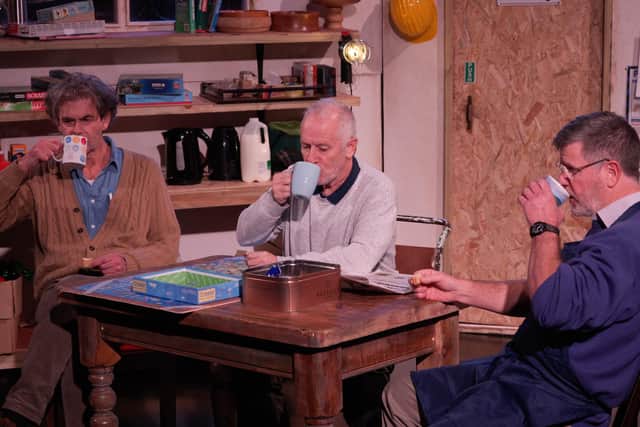
The shed boasts two kettles, Ken tells us proudly, switching one on and putting tea bags into a couple of mugs. While he waits for the water to boil, he chats amiably about why he’s been coming to the Men’s Shed ever since he retired. He needs a bit of space away from his wife, he says. They’ve never been under each other’s feet before. The shed is a place where he can come to enjoy the company of other men. And build a bat box.
He pours water into the mugs, adds milk, squeezes the tea bags and pops them into a food waste bin. Then he hands the mug over to the man behind me. “There you go.”
Writer-director Clare Prenton’s script has an endearingly gentle tone. The atmosphere in the shed is relaxed and understated; it’s easy to see why it appeals to the men who visit it. Based on extensive interviews with real-life Men’s Shed members, Prenton shines a light on the importance of creating spaces where men can talk.
Because they don’t, apparently. Unless they’re shoulder to shoulder, that is, rather than face to face. Men’s Sheds provide opportunities to learn new skills and there’s no pressure on the members to open up about their feelings. But, working alongside one another, helping out with art or craft or DIY projects, it turns out that men begin to feel comfortable sharing their personal stories. And that they are more than willing to put an arm around a pal’s shoulder and support them if they can.
This matters, because men’s mental health is in crisis. Suicide rates are worryingly high. The good news is that change is happening: we no longer tell our children that boys don’t cry; we don’t encourage repression or a stiff upper lip. And Men’s Sheds can play an pivotal part in this shift, especially for older guys.
As well as Ken, we also meet Jimmy (Billy Mack), an alcoholic who needs somewhere to be that isn’t the pub, and Tom (Greg Powrie), a widower who’s taken up woodwork since his wife’s demise. Through these characters and their meandering conversations – which cover PTSD, grief and custard creams -Prenton presents a convincing case, even when dealing with the controversial issue of whether women should be allowed to join. Ken’s the outlier who says no, while the others – including forty offstage members – have all voted yes. No one agrees with Ken but it’s to Prenton’s credit that his impassioned argument isn’t ridiculed, and he isn’t reduced to a clichéd misogynist for expressing this desire.
Today’s performance is BSL interpreted, and I’m impressed by how well the interpreter is incorporated into the action. He’s a named member of the Men’s Shed, greeted as Greg, drinking tea and eating biscuits with the rest of them, nodding hello and then translating what they say. It’s neatly done.
I also love the fact that the detailed, naturalistic set, designed by Frances Collier, has been built by Peebles & DIstrict Men’s Shed. This adds to the feeling that this is a truly inclusive piece, and that Prenton has treated her subject with the respect and gravitas it deserves. It’s a didactic play, but – although I definitely feel that I have learned something – I never feel lectured. And, if I were a man in need of a chat or a new project or simply somewhere convivial to be, I’d certainly be checking to see if there was a Men’s Shed in my locale.
4 stars
Susan SIngfield


 Bouquets & Brickbats