

14/12/25
Cineworld, Edinburgh
I’ve never fallen under the spell of Downton Abbey (even though I loved Gosford Park, the film that spawned it), so I’m more than happy to see the franchise lampooned – and that’s pretty much the motivation behind Fackham Hall. Based by an idea by comedian Jimmy Carr and his brother Patrick (and adapted by three other writers), this sprightly tale thunders along at full gallop, flinging out a whole deluge of jokes, sight gags and historical references as it proceeds. Anyone who’s come to this expecting subtlety has clearly come to the wrong place, but that’s not a criticism. I enjoy the experience and, if a joke occasionally falls flat, well it’s reassuring to know that there’ll be another one along in the blink of an eye.
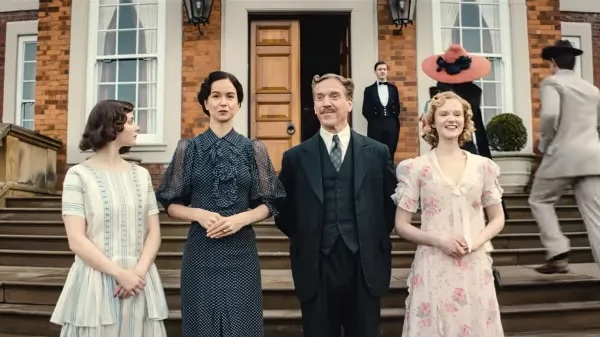
The titular hall is the ancestral home of Lord and Lady Davenport (Damian Lewis and Katherine Waterston). They have two daughters, Poppy (Emma Laird) and Rose (Thomasin McKenzie), and – in the time-honoured tradition of the upper classes – Poppy is due to marry her first cousin, the odious Archibald (Tom Felton), in order to keep their stately home in the family. But on the big day, Poppy simply cannot bring herself to do it – which inevitably puts a lot of pressure on Rose to step up and take one for the team.
But then handsome and homeless young pickpocket, Eric (Ben Radcliffe), is selected to deliver an urgent message to Lord Davenport and, on the way there, he and Rose cross paths. While this is unfortunate in one way – she’s at the wheel of a car and he’s on a bicycle – once they’ve set eyes on each other, it’s clear that romance is their destiny. But if Rose decides to be with Eric, what will happen to their family estate?
And then a key character is murdered – and the plot begins to thicken.
The recent reboot of The Naked Gun seems to have reignited the public’s taste for a decent spoof and, on that level, Fackham Hall doesn’t disappoint. I spend the film’s duration alternately chuckling, groaning and occasionally guffawing out loud at the film’s smörgåsbord of comic offerings. (The sight gags arrive so relentlessly, I’m actually in danger of missing some of them.)
Director Jim O’Hanlon keeps the pot bubbling nicely and the production is blessed with a cast of excellent actors, who appreciate that the secret of a spoof is to play everything absolutely straight. Anna Maxwell-Martin is great as the ruthless housekeeper, Mrs McCallister, and I love Tim McMullen’s deadpan performance as the butler, Cyril, who also doubles as a prototype AI assistant. Carr has a couple of funny cameos as a short-sighted vicar who specialises in making every sermon a series of tortuous misunderstandings. And I’m delighted by one of the Davenport’s house guests in particular: JRR Tolkien, who is working on what will become his best-known book, finding inspiration in the strangest places…
The big ‘reveal’ at the end will come as a surprise to absolutely nobody but, really, in something like this the usual rules of criticism feel somewhat superfluous. Some Downton diehards might clutch their pearls in outrage, but I have a lot of fun with this and no doubt many others – from both upstairs and downstairs – will find plenty to enjoy.
4 stars
Philip Caveney


 Bouquets & Brickbats