EUSC

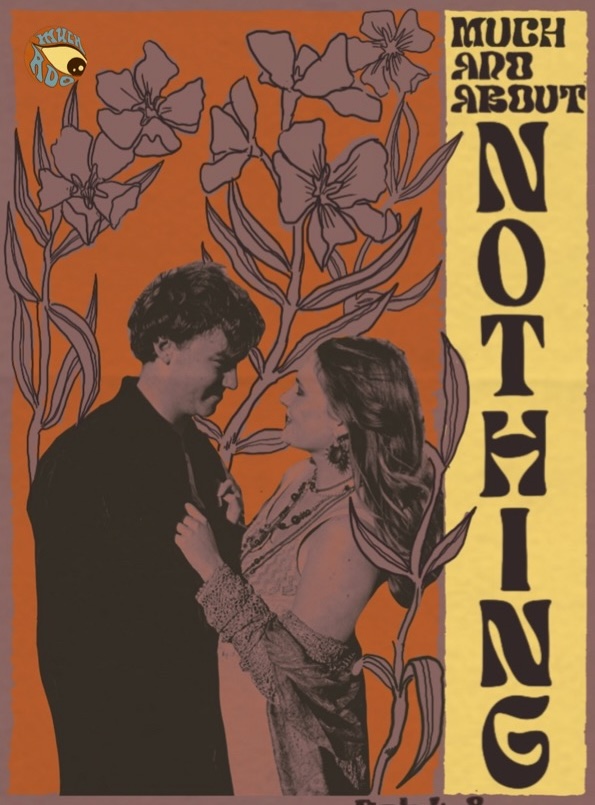
Much Ado About Nothing

06/02/25

Pleasance Theatre, Edinburgh

Let’s face it, judged by plot alone, Much Ado About Nothing is a bit, well… silly. Like most of Shakespeare’s comedies, the humour relies on disguise, misunderstandings and a fickle approach to romance. As an audience, we really have to suspend our disbelief. Would sworn enemies such as Benedick and Beatrice (Benedict Harrison and Verity Mann) really have an immediate change of heart thanks to some very unsubtly orchestrated eavesdropping? Both of them? It seems unlikely. Would a respected celebrant (Dylan Kaeuper) really suggest that a jilted bride should fake her death, or her father embrace the idea – agreeing that “death is the fairest cover for her shame”? Hmm. And would the groom – a mere twenty-four hours later – agree to marry his dead fiancé’s looky-likey cousin without ever setting eyes on her? I mean, that’s a no, right? Meanwhile, we’re also supposed to accept that no one in Leonato (Faolán Ingram)’s household suspects the decidedly dodgy – almost moustache-twirling – Don John (Cameron Broadly) of being a villain, despite the many outward clues. But still. It is what it is, and there’s a lot of fun to be had along the way.

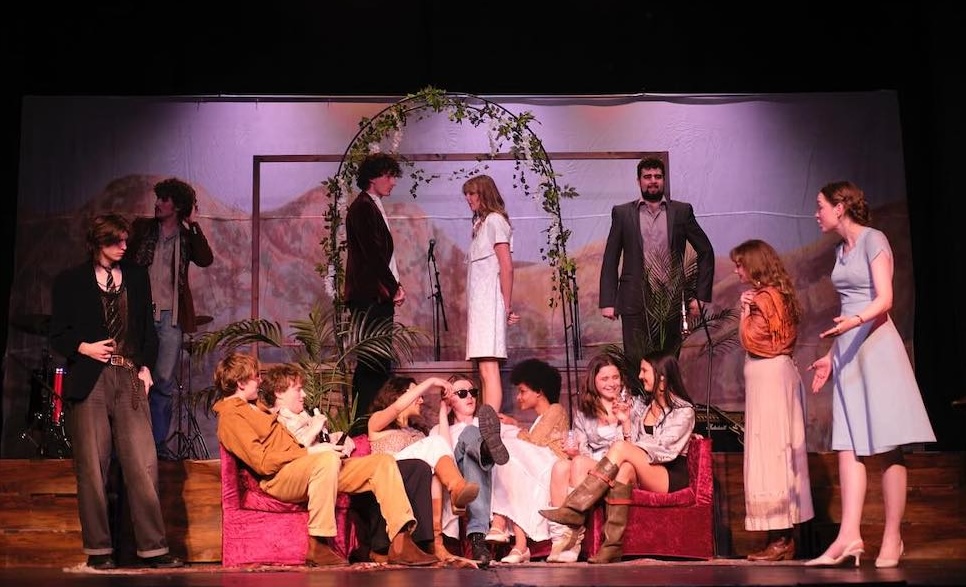
EUSC’s production of this sprawling play is sprightly and engaging. The directors (Madeleine Brown, Marina Funcasta and Anna Simurda) have chosen to emphasise the humour, eliciting larger-than-life performances from their actors rather than aiming for anything subtle – and I think this is a wise move. The action has been moved from Italy to California, from the 16th century to the 1970s but, while the period is clearly-evoked, I’m less certain about the place. There’s certainly a laid-back Summer of Love vibe, but most of the music is British (Bowie, Bolan, The Sweet, The Police) and the majority of characters speak with English accents, so it all feels a bit more Camden Town than Haight-Ashbury.

Leonato’s estate is Party Central as he and his wife, Antonia (Maria Wollgast), play host to the local socialites. What better way to make a match for their beloved daughter, Hero (Francesca Carter)? The dope is plentiful, the drinks are flowing – and love is in the air. Claudio (Rider Hartley) fancies his chances with Hero, and she’s rather keen on him as well. But “the course of true love never did run smooth” (yes, I know – wrong play), and what could go wrong with Don Pedro (Eric Parker)’s complicated plan to woo the girl on his friend’s behalf? Throw in some meddling servants, a fabulously drunken henchman (Fraser Murray), a local constable (Robbie Morris) and a veritable army of liggers – and the scene is set for some merry mayhem.

It’s a great idea to have a live band on stage, although I can’t help feeling they’re under-utilised. Still, the young cast are clearly having a ball, dressed up to the nines in flares and sequins (floppy hats off to costume designers Paloma Leigh-Stevenson, Alex Dunlop and Bea Fitz), their delivery as bold and brash as the script demands. Not everyone has a lot to do, but they all make the most of what there is, and there are some lovely moments of background detail, such as Margaret (Mia Dé)’s horrified realisation that her tryst with Borachio is being used to frame Hero. Harrison (Benedick) and Carter (Hero) are the standouts for me, but all of the actors and musicians perform with gusto, and I am thoroughly entertained.

There are just two more chances to catch this groovy rendition of Much Ado, so why not head on down to the Pleasance and hang loose with the hippies? Be sure to wear some flowers in your hair…

3.4 stars

Susan Singfield

The Taming of the Shrew

09/02/24

Pleasance Theatre, Edinburgh

It’s hard to believe it’s five years since we saw EUSC’s last version of The Taming of the Shrew; it feels much more recent. Directed by Tilly Botsford, it was a marked success.

Any notion we have that it might be too soon for the student company to revisit this controversial play is soon dispelled when we realise how very different this interpretation is. Director Minna Gillett’s gender-swapped adaptation cleverly unearths the humour, reminding us that it was always intended to be a comedy, just like the fabulous 10 Things I Hate About You, which Gillett cites as inspiration.

Of course, the central relationship between ‘Petruchia’ (Maria Wollgast) and ‘Kit’ (Ted Ackery) is irredeemably toxic – she bullies and gaslights him into submission – but it doesn’t feel as problematic as the Petruchio/Kat pairing: Petruchia doesn’t have the weight of an entire patriarchal system behind her, and Kit isn’t institutionally broken. It’s still horrible on a personal level, less so on a political one.

Usually, the shrew is the lead role but here the tamer takes centre stage, and Wollgast shines as the suitor, oozing charisma as she struts and frets her hour upon the stage. Ted Ackery clearly relishes his turn as the brattish Kit, imbuing him with a surly teenage petulance and playing up the comic elements. Fraser Murray (as Tranio) has the house in stitches, while Anna Yarwood (as Grumia) and Juliet Gentle (as Biondella) both prove excellent clowns. Indeed, the whole company performs well; there is no weak link here.

The set, designed by Émilie Noël, is suitably fresh and contemporary, and impressively professional. In fact, everything about this show feels right. Gillett has got to the very heart of the piece, nimbly side-stepping or overturning all the problematic aspects in a simple, unfussy way.

This Shrew is a triumph.

4.6 stars

Susan Singfield

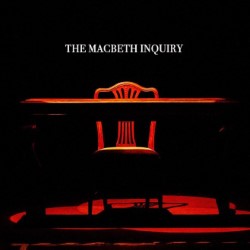
The Macbeth Inquiry

16/08/22

The Space at Niddry Street, Edinburgh

We’ve seen a few of Edinburgh University Shakespeare Company’s productions over the years, and we’ve always been impressed. We’re interested to see what happens when they get “Shakesperimental” with this contemporary reimagining of Macbeth as a politician, only metaphorically stabbing PM Duncan in the back.

It’s a nice idea, and the blending of Shakespeare’s script with the current vernacular is – for the most part – convincingly done by the three writers (Izzy Salt, Clara Wessely and Freddie Stone). Ted Ackery’s Paxman-like news reporter is an interesting addition. Ackery is a strong actor (he excelled as Joe in Miller’s All My Sons, which we saw earlier this year), and this shows in the blistering exchanges he has with the various ministers who dare to be interviewed by him. I’m less convinced, however, by the comic exchanges between him and weather reporter, Claudius (Rorke Wilson), which derail rather than enhance the production. Wilson performs well, but these moments seem to come from another play, and I feel like I’m watching a series of in-jokes that probably seemed hilarious in rehearsal, but don’t really fly on stage. I don’t get it. Is Claudius supposed to be funny just because he’s camp? It seems somewhat regressive, if so.

Maddy Brown’s trouser-suited, city-slicker version of Lady Macbeth is perhaps the standout performance here, her vaunting ambition dismayingly credible – but the characterisations are all good. Archie Turnbull (as Macbeth) delivers some key speeches with real gravitas, commanding the audience in a way that makes us believe the people might just vote for him.

I’m not mad about the frequent blackouts, used to mark the ending of each scene. It doesn’t help that today’s audience decides to applaud whenever the lights go down, as if every section were a mini-play. It’s a bizarre response, and not one I’ve seen before in all the hundreds of times I’ve been to the theatre. The blackouts make the action seem a little stilted, and I think the flow would be much improved by more imaginative transitions.

All in all, while there’s much to admire here, The Macbeth Inquiry just doesn’t quite work for me. Still, I applaud EUSC for giving this a go. At least they haven’t lost “the good we oft might win, by fearing to attempt”.

2.7 stars

Susan Singfield

A Midsummer Night’s Dream

09/03/22

Assembly Roxy, Edinburgh

EUSC’s A Midsummer Night’s Dream is a real treat. I’m feeling a bit tired and grumpy before we set off for the theatre – a culmination of late nights and hayfever – but this sprightly production soon puts a spring in my step and, by the time I leave, I’m all smiles.

There’s something endearing about the audiences for these student productions: they’re always so vocal in their enthusiasm. It really helps to cement the whole ‘shared experience’ feeling of live performance, and debunks the idea that theatre only appeals to the middle-class and middle-aged. Their liveliness feeds the atmosphere, which is almost as charged off-stage as on. I love it.

Director Sara Cemin deftly braids the disparate strands of Shakespeare’s play. This is a vivacious, playful production, subtly updated with occasional asides (I mean, I don’t think “Fuck’s sake!” appears in the First Folio), which illuminate the jokes, sending laughter rippling through the auditorium.

The fever dream chaos is nicely realised: the four passionate youths, lost in the woods; the bumbling Mechanicals, desperately sincere in their desire to create something worthwhile; the mischievous faeries, unable to resist the impulse to play tricks. It’s a perfect storm.

The Mechanicals are the standouts. Some of this is down to Billy Bard himself, of course: there’s such a clever balance of scorn and tenderness in his rendering of them. But Cemin deserves credit for drawing this out, for resisting the urge to make them pantomime-ish figures, affording them instead the dignity of working people, striving to make something good (while still gently poking fun). Max Prentice (last seen by B&B in EUTC’s Education, Education, Education in 2018) is perfectly cast as Bottom: he’s clearly a natural comedian, and is instantly engaging. He’s definitely one to watch. But don’t underestimate those in the smaller roles either; this strand highlights the power of ensemble performance.

I do have a couple of minor gripes. First: the dry ice machine. “Fuck’s sake,” as Helena would say. It works well to set the scene when the faeries first appear, but – where cough-inducing smoke is concerned – less is more. Second (and this might just be me): the long interval. I know people need time to go to the loo and buy a drink, but anything longer than fifteen minutes disrupts the momentum, and all the tension that’s been so carefully built in the first act just starts to dissipate. Neither of these is a deal-breaker though.

I love Amelia Chinnock Schuman’s choreography, particularly in the fight scene, which is impressively visceral. The four lovers (Lucy Melrose, Archie Barrington, Isabelle Hodgson and Will Nye) approach this tussle with evident gusto, and the fear of injury seems very real (not least because of the rucked-up rug I keep thinking someone’s going to trip over. Yes, I am a laugh). The music is a satisfying addition too. It’s all original (by Joe Pratt and Mark Sandford), and I applaud the decision to have live musicians on stage. The songs are well-integrated into the production: enhancing rather than intrusive.

No review of AMND is complete without reference to Puck, and Priya Basra seems made for the role. She imbues the goblin with the necessary likability, so that we can witness his careless cruelty without abhorring him. She has eye-rolling down to a fine art.

All in all, then, this is an absolute delight. There’s only one night left. Buy a ticket – quickly!

4.3 stars

Susan Singfield

The Taming of the Shrew


13/03/19

Pleasance Theatre, Edinburgh

I’ve never seen The Taming of the Shrew. I know the play, of course (I’ve even written essays about it), and I’ve been entertained by a number of intriguing reinterpretations in various forms: Kiss Me Kate, 10 Things I Hate About You, Vinegar Girl. But I’ve never seen it staged. Maybe because it’s arguably Shakespeare’s most contentious play – although The Merchant of Venice certainly has its issues too – and difficult to reconcile with modern sensibilities.

For those readers who need a quick reminder, the ‘shrew’ of the title is Kate, a wayward young woman, whose volatility deters any would-be beaux. Her father – based on some labyrinthine reasoning – imposes a bizarre rule: her sweet-natured sister, Bianca, cannot marry before Kate. But Bianca is a popular girl, and her suitors do not want to wait. Enter Petruchio, with a plan to break the older girl’s spirit. He bullies, half starves, gaslights and manipulates her into submission. In a modern play, this would be the midway point; we’d see Kate regain her equilibrium and Petruchio punished. But here, this is the denouement. It’s most uncomfortable.

And it’s not just the gender politics that make TTOTS problematic. The plot is convoluted and over-contrived, the humour weirdly at odds with the central relationship. It’s a tough call for any theatre company, let alone one so young as the EUSC.

But, under Tilly Botsford’s direction, this is a marked success. We’re never in any doubt that Petruchio (played with chilling self-righteousness by Michael Hajiantonis) is an awful man: he treats his servants with the same foul aggression as his wife. I applaud the decision to cast women as the servants too, emphasising the power of the patriarchal structure, and underscoring the theme of domestic violence.

Sally MacAlister is marvellous as Grumio. She clearly relishes the role, and imbues the much put-upon servant with humour and brio. Nathaniel Brimmer-Beller also stands out as Vincentio: he inhabits this small role with a natural ease that is very impressive.

Of course, Anna Swinton has the hardest job: she’s Kate, and it’s a tough part to play. Perhaps, in some earlier scenes, her body language could be less languid and more combative, but this is a small point. Because her often mute response to Pertuchio’s bullying is nuanced as well as unequivocal, and – in that final moment – when she delivers her speech about why a wife should submit to her husband – the desperation of this broken woman is heartbreaking to witness.

This EUSC production shows then that it is perfectly possible to deliver this controversial play exactly as it stands, without compromising our changed values. A difficult undertaking, but most worthwhile.

4 stars

Susan Singfield