Emma Laird

Fackham Hall

14/12/25

Cineworld, Edinburgh

I’ve never fallen under the spell of Downton Abbey (even though I loved Gosford Park, the film that spawned it), so I’m more than happy to see the franchise lampooned – and that’s pretty much the motivation behind Fackham Hall. Based by an idea by comedian Jimmy Carr and his brother Patrick (and adapted by three other writers), this sprightly tale thunders along at full gallop, flinging out a whole deluge of jokes, sight gags and historical references as it proceeds. Anyone who’s come to this expecting subtlety has clearly come to the wrong place, but that’s not a criticism. I enjoy the experience and, if a joke occasionally falls flat, well it’s reassuring to know that there’ll be another one along in the blink of an eye.

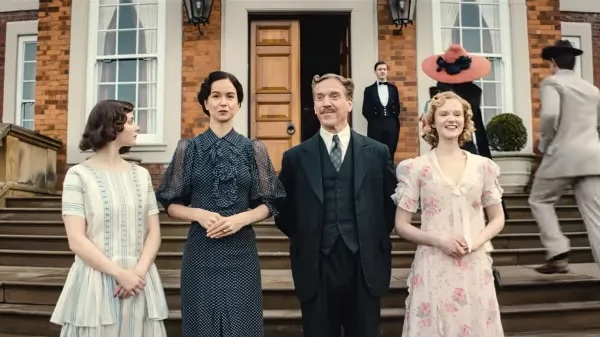
The titular hall is the ancestral home of Lord and Lady Davenport (Damian Lewis and Katherine Waterston). They have two daughters, Poppy (Emma Laird) and Rose (Thomasin McKenzie), and – in the time-honoured tradition of the upper classes – Poppy is due to marry her first cousin, the odious Archibald (Tom Felton), in order to keep their stately home in the family. But on the big day, Poppy simply cannot bring herself to do it – which inevitably puts a lot of pressure on Rose to step up and take one for the team.

But then handsome and homeless young pickpocket, Eric (Ben Radcliffe), is selected to deliver an urgent message to Lord Davenport and, on the way there, he and Rose cross paths. While this is unfortunate in one way – she’s at the wheel of a car and he’s on a bicycle – once they’ve set eyes on each other, it’s clear that romance is their destiny. But if Rose decides to be with Eric, what will happen to their family estate?

And then a key character is murdered – and the plot begins to thicken.

The recent reboot of The Naked Gun seems to have reignited the public’s taste for a decent spoof and, on that level, Fackham Hall doesn’t disappoint. I spend the film’s duration alternately chuckling, groaning and occasionally guffawing out loud at the film’s smörgåsbord of comic offerings. (The sight gags arrive so relentlessly, I’m actually in danger of missing some of them.)

Director Jim O’Hanlon keeps the pot bubbling nicely and the production is blessed with a cast of excellent actors, who appreciate that the secret of a spoof is to play everything absolutely straight. Anna Maxwell-Martin is great as the ruthless housekeeper, Mrs McCallister, and I love Tim McMullen’s deadpan performance as the butler, Cyril, who also doubles as a prototype AI assistant. Carr has a couple of funny cameos as a short-sighted vicar who specialises in making every sermon a series of tortuous misunderstandings. And I’m delighted by one of the Davenport’s house guests in particular: JRR Tolkien, who is working on what will become his best-known book, finding inspiration in the strangest places…

The big ‘reveal’ at the end will come as a surprise to absolutely nobody but, really, in something like this the usual rules of criticism feel somewhat superfluous. Some Downton diehards might clutch their pearls in outrage, but I have a lot of fun with this and no doubt many others – from both upstairs and downstairs – will find plenty to enjoy.

4 stars

Philip Caveney
The Brutalist

25/01/25

Cineworld, Edinburgh

It’s evident from the very beginning of The Brutalist that director Brady Corbet is determined to establish his own rules. Instead of rolling vertically, like every other credit sequence you’ve seen, the words slide horizontally across the screen and resemble the work of a groundbreaking graphic designer. Using VistaVision – a screen format popularised in the 1950s – the film has its own distinctive look. It has a prodigious running time of over three-and-a-half hours, but, much like the old epics of David Lean, viewers are afforded a fifteen-minute interval, so we can avail ourselves of a toilet break.

It’s a wonder then that The Brutalist is so utterly compelling that I barely even notice its length. This is monumental in every sense of the word and perhaps the biggest wonder of all is that it’s been created on a budget of less than ten million dollars – a fraction of most films conceived on this scale.

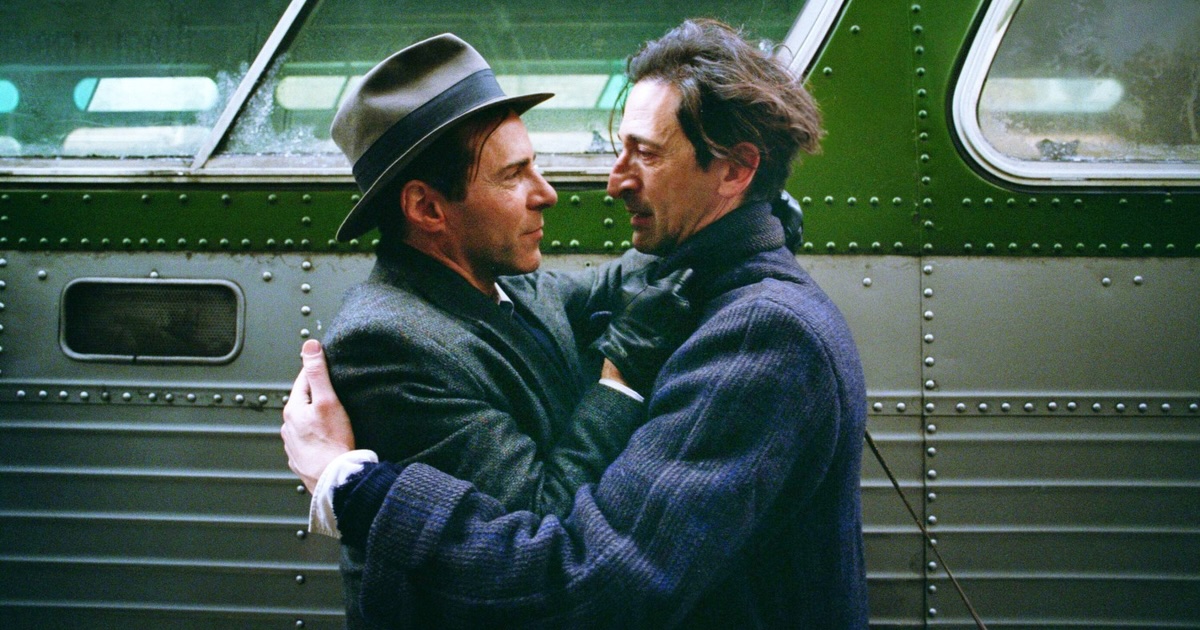
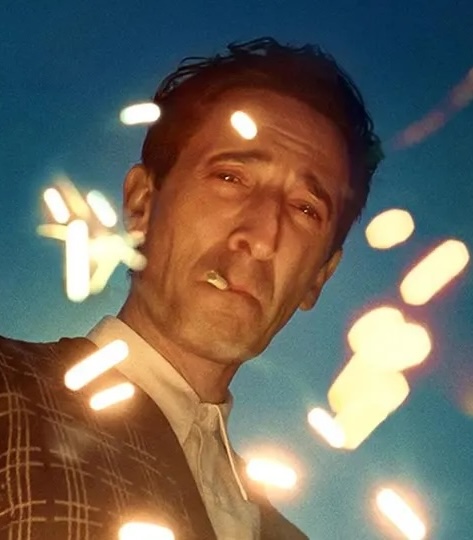
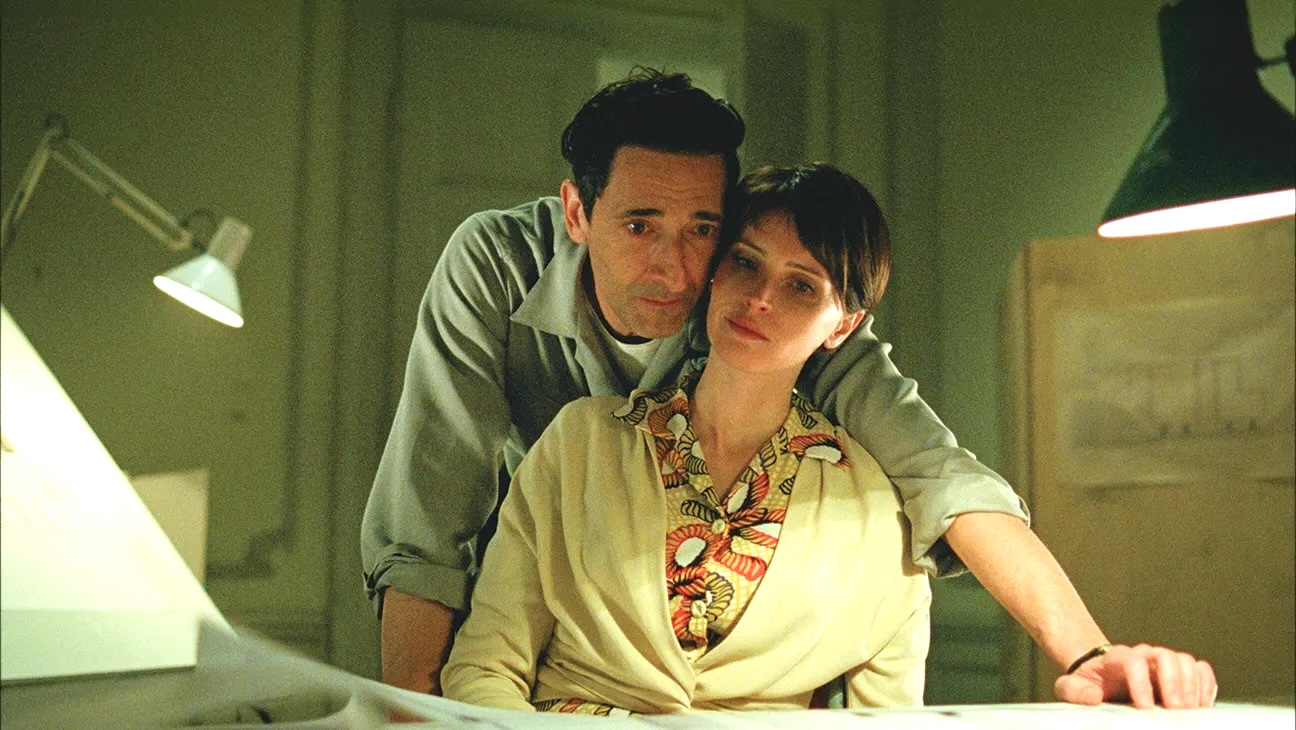
The story begins in 1947 with a series of fragmentary glimpses of Jewish refugee, László Tóth (Adrien Brody) travelling by ship from his native Hungary to begin a new life in America. He has been forcibly separated from his wife, Erzsébet (Felicity Jones), and his orphaned niece, Zsófia (Raffey Cassiday), and imprisoned in Dachau concentration camp for most of the war, but has now been offered sanctuary in Pennsylvania by his cousin, Attila (Alessandro Nivola), and his Catholic wife, Audrey (Emma Laird). The couple run a small furniture store and Attila is well aware that, before the war, László worked as an architect of the Bauhaus School. His design skills, Attila thinks, will come in useful.

Attila is approached by Harry Lee Van Buren (Joe Alwyn), who wants to commission László to redesign his father Harrison’s private library as a birthday surprise. Rather than do a straightforward upgrade, László transforms the room into a stunning work of art. When Harrison (Guy Pearce) arrives home earlier than expected, he clearly doesn’t approve of what’s been done in his absence and flies into a rage, ordering László and Attila to leave. Harry subsequently refuses to pay for the work and, as a consequence, László finds himself thrown out of his cousin’s place, with no better prospect than labouring to earn his daily bread. With his friend, Gordon (Isaac de Bankholé), he sinks into heroin addiction.

But when the redesigned library appears in the pages of an influential style magazine, Harrison undergoes a dramatic change of heart. Suddenly, he wants to be László’s patron, to converse with him, to fully understand his working methods. What’s more, he has influential Jewish friends who will be able to help him to bring Erzsébet and Zsófia over from Hungary to be with him. And then Harrison starts talking about a new commission: a massive civic centre dedicated to his late wife, a place where the local community can meet and enrich their lives.

But in the fullness of time, László will discover that such indulgences come at a price that will utterly compromise his artistic freedom – and will impinge upon his life in ways he could never have anticipated…

The Brutalist is a remarkable film in so many ways, not least because of Brody’s powerful performance in the lead role, a tortured artist, forced to compromise his talent at every turn. Pearce is also terrific as the self-aggrandising Harrison and Alwyn excels as his sneering, deeply unpleasant son, a man used to getting his own way in everything he approaches. Jones doesn’t enter the story until the film’s second half but submits a beautifully nuanced performance as Erzsébet, a woman still physically tortured by the aftermath of the starvation she suffered during the war. I should also mention Daniel Blumberg’s wonderful score, which provides the perfect accompaniment to Lol Crowley’s eye-popping cinematography.

The film has plenty to say about the creative process and it nails perfectly the powerful seduction that success offers to any artist – the fateful allure of patronage and its unpalatable compromises. Brady’s screenplay, co-written with Mona Fastvold, is wise enough to hint at unspeakable things rather than spelling them out – and it keeps me hooked until the final frame.

Will Brody lift the ‘best actor’ gong at this year’s Oscars? It’s a strong possibility in a year that features a whole bunch of commendable performances. Meanwhile, go and see The Brutalist and marvel at its epic qualities – and, if possible, watch it on an IMAX screen to best appreciate the wonders of VistaVision.

5 stars

Philip Caveney