17/11/24
Cineworld, Edinburgh
Back in the year 2000, Gladiator was a significant game-changer. Ridley Scott’s sword and sandal epic, starring a lean, mean Russell Crowe, wowed audiences and critics alike. It was nominated for twelve Oscars and actually won five, including Best Picture and Best Actor for Crowe. Over the intervening years, Scott has often stated his intention of doing a sequel, if only he could find the right story. And finally, nearly twenty-five years later, I’m sitting in front of an IMAX screen, eager to see what he’s come up with.
I seriously doubt that Gladiator 2 will be picking up any awards (except perhaps for special effects) because I suspect that galley has sailed. And to be honest, in most respects it plays more like a re-run of the original than an honest-to-goodness sequel. But don’t let that put you off.
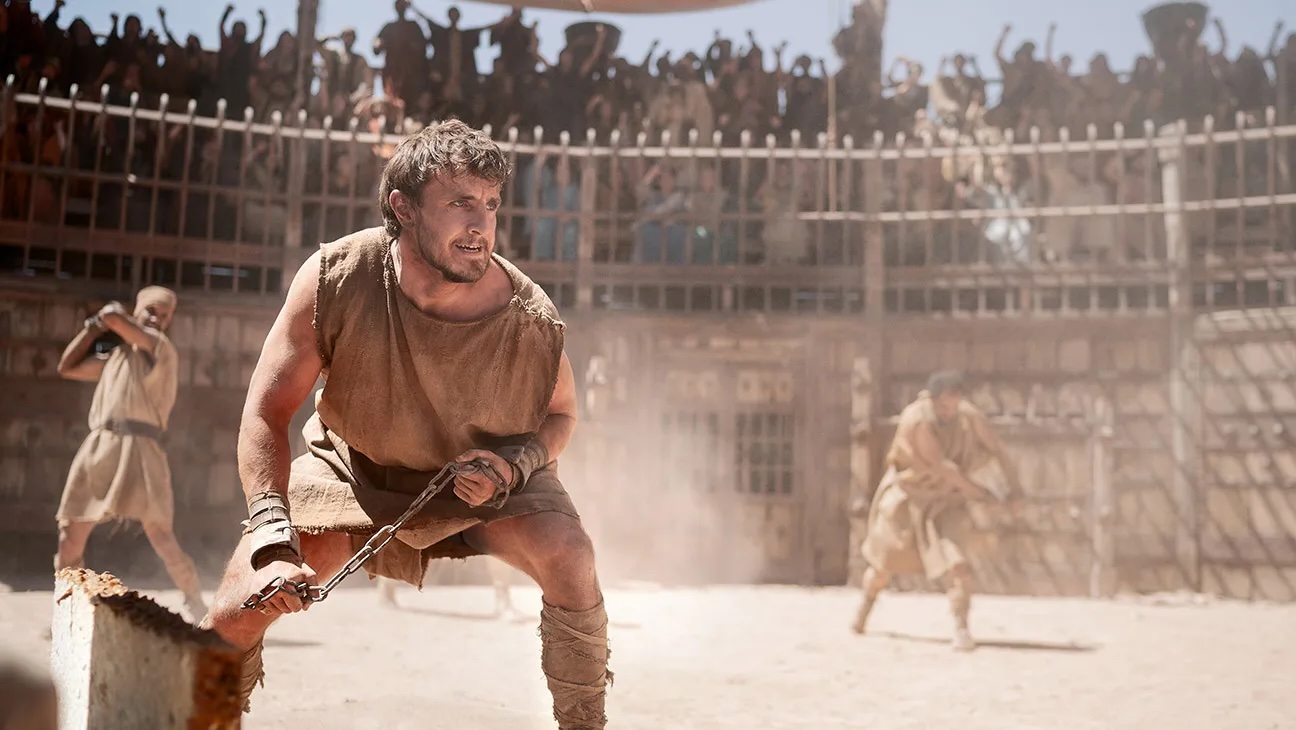
It’s some thirty years after the death of Maximus when we first meet Lucius (Paul Mescal), a soldier living and working in Numidia, alongside his wife, Arishat (Yuval Gonen.) But it isn’t long before a huge fleet of Roman warships, led by General Marcus Acasius (Pedro Pascal), appears on the horizon. As ever the Romans are looking to extend their empire and this is just the next step in their bid for world domination. An epic battle ensues, replete with giant trebuchets and fusillades of arrows. In the carnage, Arishat is killed and Lucius taken prisoner and ferried back to Rome. On the long sea voyage he (understandably) nurtures a desire for revenge on Acasius.
Rome is no longer the glorious empire it once was. Ruled by despotic brothers, Geta (Joseph Quinn) and Caracalla (Fred Hechinger), it’s become a place where corruption holds sway and where cunning players like gladiator-master, Macrinus (Denzel Washington), can rise to positions of influence. Does the latter have bigger ambitions than buying and selling gladiators? Well, naturally he does.
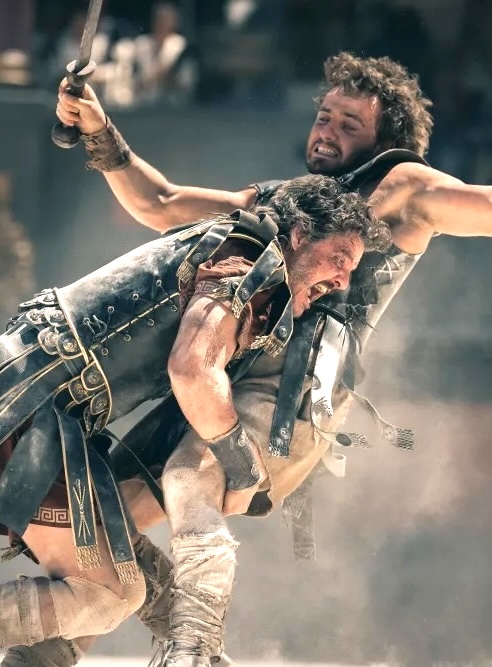
Macrinus quickly spots a quality in Lucius that he feels he can exploit and gets him into the arena at the earliest opportunity. Lucius, it turns out, has the ability to pulverise all who oppose him, even if he does pause every so often to quote Virgil. Could it be that he has some connection to the late Maximus? When we learn that Acasius’s wife is Lucilla (Connie Nielsen – the only major character to return from the original film), it soon becomes clear where this story is headed…
Gladiator 2 could justifiably be criticised for failing to explore new ideas, but this film’s DNA is all about its sheer sense of scale. Scott has always been a master of battle scenes, and lovers of spectacle can hardly complain about being short-changed in that department. Deep into his eighties now, Scott is a director who knows how to capture massive action set-pieces at testosterone-fuelled levels that are rarely even attempted these days. Wherever possible, he utilises real sets and thousands of extras in order to convey their magnitude.
There are some call-backs to the first film – scenes featuring wheat, whole lines of dialogue lifted from Gladiator 1 and that trope of stooping down to pick up a handful of earth, as though such actions can be inherited. And screenwriter David Scarpa even throws in a cheeky ‘I am Spartacus’ moment, which I think is fair enough under the circumstances. A suitably beefed-up Mescal effortlessly places a sandal-clad foot onto the A list while Washington is clearly having a whole ton of fun, camping it up as a devious player, who will seemingly let nothing get in the way of his rise to power.
There are a couple of missteps. An early dust-up in the Colosseum has Lucius and his fellow-captives pitched against a tribe of what appear to be shaved baboons, CGI creations that seem to have wandered in from some kind of demented science-fiction movie – and quite how the skinny, blonde-haired kid from the flashbacks has grown up to be Paul Mescal is one for the geneticists of the world to figure out.
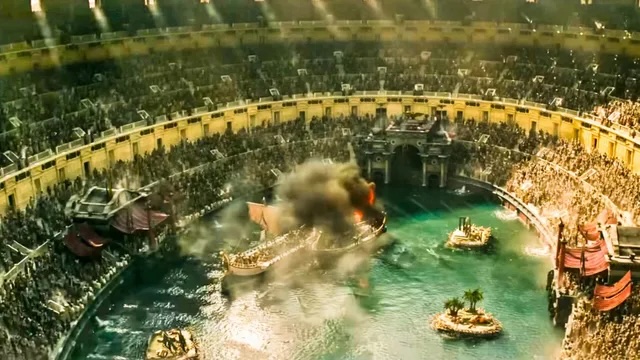
But if the aim of this film was to go bigger and louder than what came before (and I suspect that was exactly the object of the exercise) then it has succeeded in spades. The sequence where a pitched sea battle is enacted in the flooded coliseum is an extraordinary slice of action cinema (and, before you Google it. let me assure you such things did actually happen – though the addition of sharks might be a touch of artistic license). Likewise, Scarpa’s cast of characters is, for the most part, loosely based around real historical figures.
I know I say this a lot but don’t wait for streaming. See this on the biggest screen available and, as you watch, ask yourself that all important question:
“Am I not entertained?” For me, the answer is, most definitely a resounding, “Yes, I am entertained!”
4.5 stars
Philip Caveney


 Bouquets & Brickbats