Chekhov

Two Sisters

15/02/24

Royal Lyceum Theatre, Edinburgh

As the title suggests, there’s more than a nod to Chekhov in David Greig’s new play, Two Sisters, currently premiering at Edinburgh’s Royal Lyceum Theatre, where he’s also artistic director. And it’s not all about the gun…

That’s not to say that this is an adaptation; it’s not. The plot, structure and cast of characters are very different. And yet it is, despite all that, a cleverly updated version of the same idea, embracing the Russian’s major themes – suffering, love, longing, change – and distilling his bitter humour and nihilistic worldview into something immediately recognisable to a modern audience.

Emma (Jess Hardwick) is a corporate lawyer, married to a hotshot businessman with his own plane. She’s also pregnant and sees her impending motherhood as some kind of deadline: if she can’t pen a novel before the baby’s born, then it will be too late. With this in mind, she books herself a caravan at the holiday park she used to visit with her family as a child. A whole week to herself, reminiscing and writing. What could be more perfect?

But she’s reckoned without her flaky older sister, Amy (Shauna Macdonald), who’s always ricocheting from one crisis to another. This time, her long-suffering husband has caught her shagging the plumber, so she’s come to cry on Emma’s shoulder. 

And rekindle an old flame…

Directed by Wils Wilson, this is a slow-paced piece, reflecting the characters’ inertia. The chorus of teenagers embodies this listlessness too, at once pulsing with life and stymied by lethargy. They hang around the park, aloof and watchful. Nothing escapes their attention. It all matters too much, and yet it doesn’t matter at all.

Macdonald and Hardwick are a charismatic duo, the former’s sharp edges and barely-suppressed longing contrasting perfectly with the latter’s languid determination. Their relationship feels real and convincing. 

Lisbeth Burian’s wonderful set is like a brutal mirror, emphasising the grottiness of the seaside resort, with its peeling edges, dingy caravans and rusting climbing frame. Emma might be blind to the park’s fatal decline, indulging in nostalgia-fuelled fantasies of restoration, but we in the audience are all too aware that it is a lost cause. 

There are a few false notes. I find myself distracted by Lance (Erik Olsson)’s assertion that he’s only ever left Fife to visit Ibiza, when he clearly has a Swedish accent. I wonder too why Amy’s been sleeping in her car when she’s got a job in television; surely she can afford a hotel? These are minor points, but they snag, pulling me out of the drama. I also think that the fourth-wall-breaking teenage chorus could be given more to do; the play comes to life whenever they’re involved.

In true Chekhovian spirit, there is no easy take-home message here; the characters are not gifted with a happy ending, and the threads are not neatly tied. Instead we’re left with a sense of  melancholy. “Our life is not ended yet. We shall live! The music is so happy, so joyful, and it seems as though in a little while we shall know what we are living for, why we are suffering… If we only knew – if we only knew!”

4 stars

Susan Singfield

Group Portrait in a Summer Landscape

05/10/23

Lyceum Theatre, Edinburgh

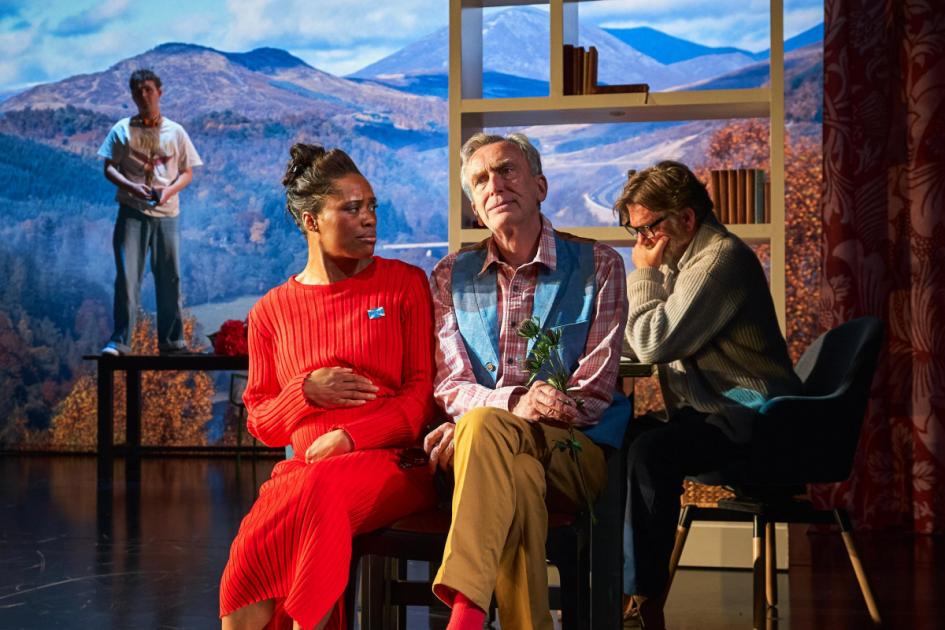
Patriarch Rennie (John Michie) has invited a disparate group of people to his retirement party. He’s had to keep the guest list secret from his wife, Edie (Deirdre Davis), because – with the exception of her old pal, film star Jimmy Moon (Benny Young) – there’s no way she’d agree to hosting the people he has in mind. En route to the couple’s country house in the Scottish Highlands is their daughter Emma’s ex-husband, for example – even though their wedding ended acrimoniously and Charlie (Matthew Trevannion) is renowned for wreaking havoc wherever he goes. Of course, he maximises the antagonism by bringing along his latest girlfriend, Jitka (Nalini Chetty), and why wouldn’t Rennie ask the newly-betrothed Frank (Keith Macpherson) and Kath (Patricia Panther) to join the party? It’s not as if Frank’s always been in love with Emma (Sally Reid) or anything, is it? Oops. There’s an uninvited presence too: the ghost of Rennie and Edie’s son, Will (Robbie Scott), who watches over the day’s proceedings with increasing horror…

Playwright Peter Arnott says he set out to to write a ‘Scottish Chekhov’ and to some extent he has succeeded. At first it seems as though, unlike Chekhov, Arnott is looking back at the political moment that nominally serves as the play’s pivot; he has the advantage of hindsight to create dramatic irony. After all, we know the outcome of the 2014 Scottish independence referendum, the divisive topic inflaming the characters. But we soon learn that this is just a distraction: as Charlie says, it’s mere tinkering around the edges while ignoring the real revolution that is on its way, and which only the rich and ruthless will be able to survive.

If Arnott’s script is retro, then David Greig’s direction is decidedly contemporary, a deliberate jarring of styles that helps to illuminate the sense that something is changing, mirroring the mismatch between parochial politics and apocalyptic predictions, Chekhovian naturalism and magical realism. I like the dissonance.

Jessica Worrall’s set also leans into the contrast, a hyper-realistic backdrop juxtaposed with a more figurative interior: a glorious photograph of a Highland glen and a sketched-in kitchen-diner, symbolised by oversized shelving units, enormous tables and vast floral curtains.

Both Simon Wilkinson’s lighting and Pippa Murphy’s sound are integral to the production: the former spotlighting the snippets of conversation that combine to drive the plot, the latter signalling the shifts to the ghost’s point of view, as the sound distorts and fragmented memories play through Will’s Walkman. This supernatural presence is one of my favourite things about the play: Scott physicalises the spirit’s pain and confusion with a beautiful awkwardness.

The first act is very strong, an interesting set-up that promises something the second doesn’t quite deliver. Although the characters are all cleverly depicted, the piece feels somehow unfinished, as if the story arc has been cut short. Rennie’s revelation, when it comes, is anticlimactic, and I don’t quite buy it as a reason for inviting these particular people to his home (why would anyone ever invite Charlie anywhere?). But, even if it’s a little opaque and doesn’t offer any real answers to the issues it grapples with, Group Portrait in a Summer Landscape is an intelligent and ambitious play, leaving us with a lot to think – and talk – about.

3.8 stars

Susan Singfield

Looking Good Dead

05/10/21

King’s Theatre, Edinburgh

Superintendent Roy Grace is the protagonist of Peter James’ popular police procedurals – a diligent but troubled policeman, who’ll stop at nothing to solve a case. In Shaun McKenna’s stage adaptation of the second novel, Looking Good Dead, Grace (Harry Long) is relegated to a supporting role. Instead, the focus here is on the Bryce family, inadvertently caught up in a terrible crime. I think this is a wise move; they, after all, form the crux of the story.

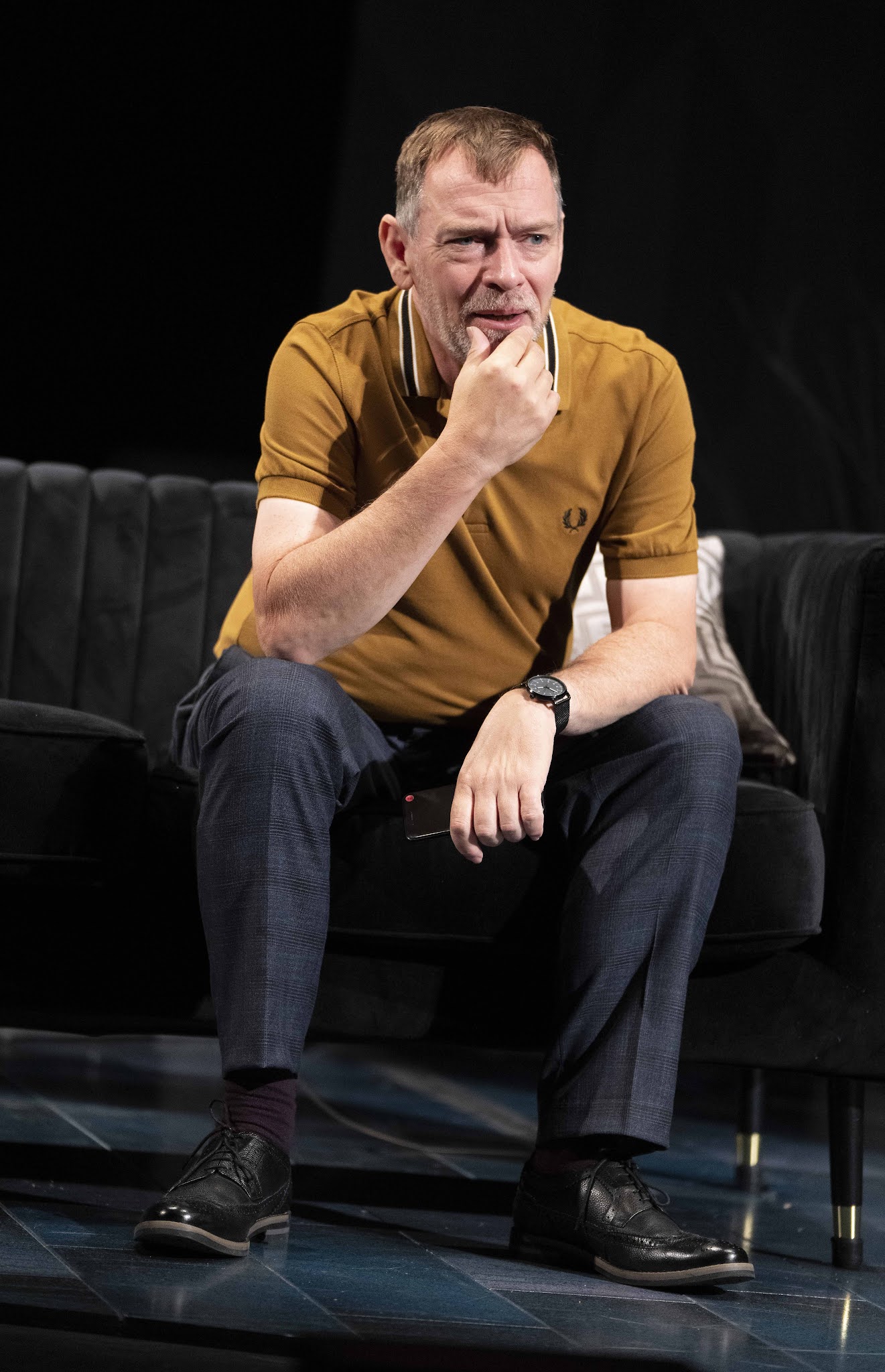
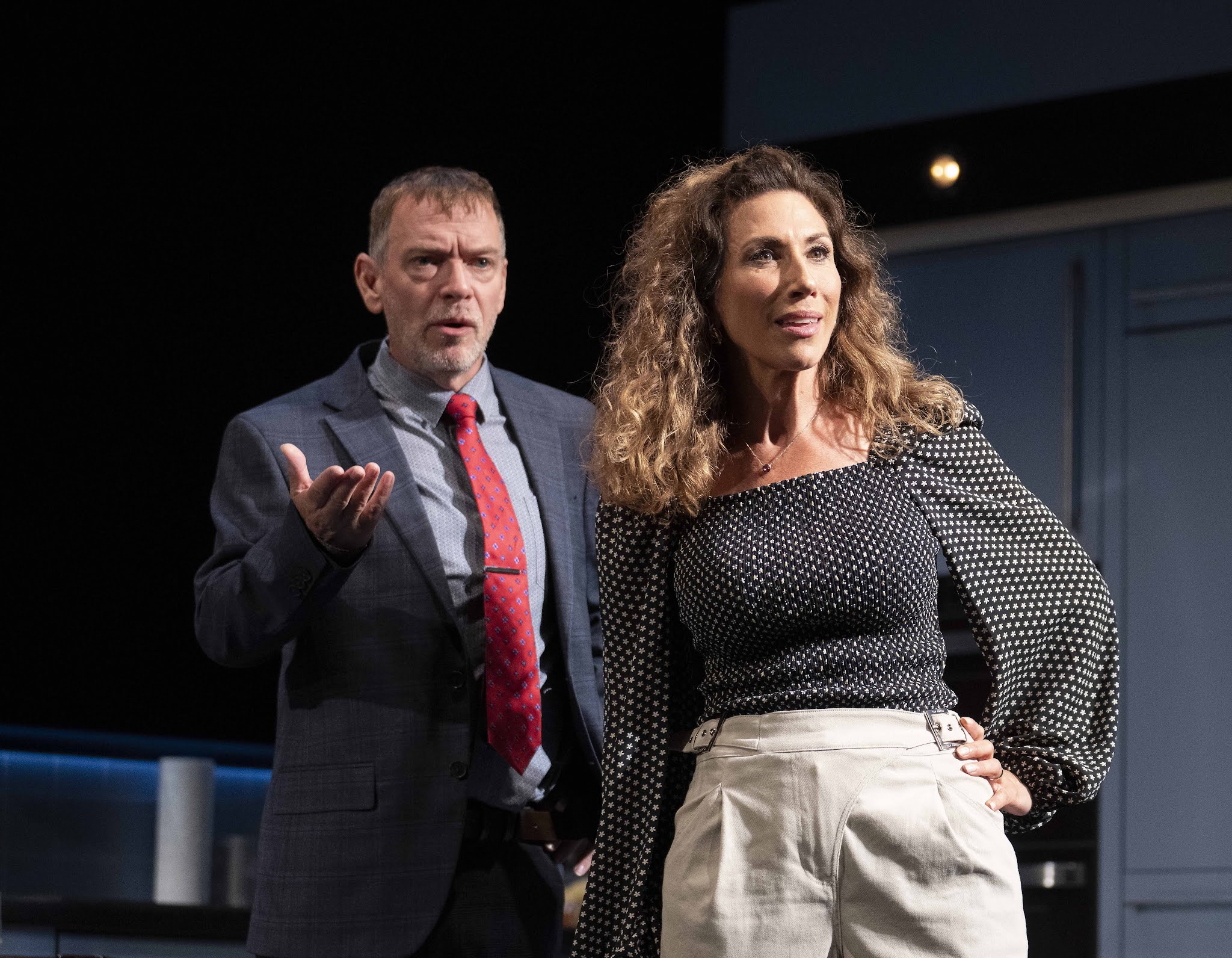
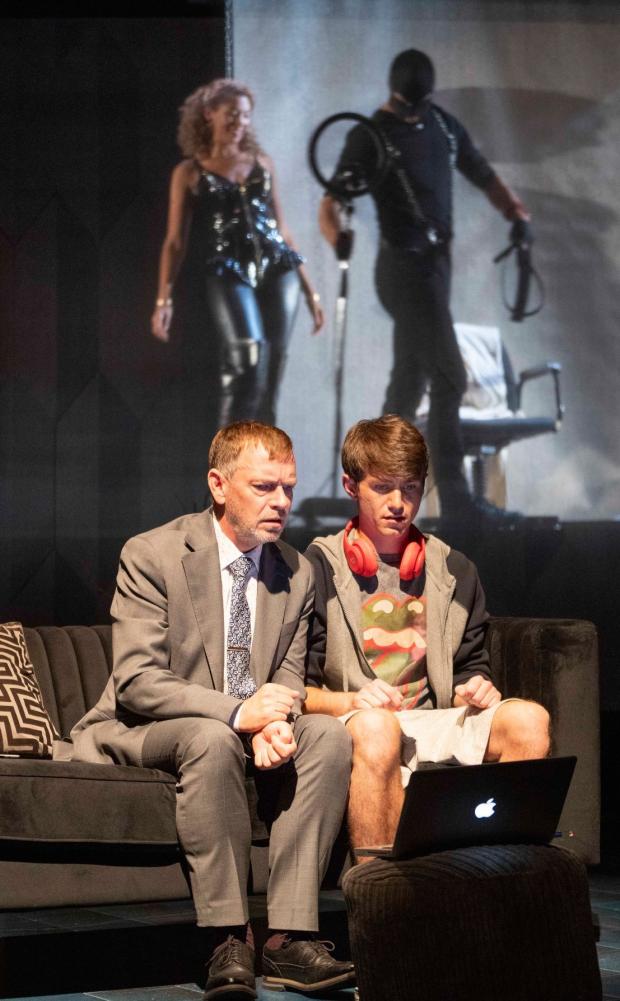
Top of the bill, therefore, are soap favourites Adam Woodyatt and Gaynor Faye, as Tom and Kellie Bryce. They enjoy an affluent, suburban life. Tom works; Kellie cleans a lot; their teenage sons, Joe and Max (Luke Ward-Wilkinson), are – respectively – in Venezuela climbing mountains and on the sofa listening to silence through NOISE CANCELLING HEADPHONES. Did you get that? NOISE CANCELLING HEADPHONES. I’ll mention them again anyway, just in case. (Director Jonathan O’Boyle is clearly a fan of Chekhov’s, holding dear the great playwright’s principle: if, in the first act a character has worn noise cancelling headphones, then in the following act, someone must fail to hear something important.) It all seems fine and dandy until a stranger leaves a memory stick on Tom’s commuter train. Tom makes the rash decision to bring it home; he plans to play the good Samaritan by tracking down its owner and ensuring its return. However, when Max plugs the stick into Tom’s computer, it reveals a link… to a murder. Happening in real time before their eyes. What have they been witness to? And what will the killer do when he realises he’s been seen?

Woodyatt and Faye inhabit their characters convincingly, and I especially enjoy Ian Haughton’s performance as the enigmatic Kent. I like Sergeant Branson (Leon Stewart)’s bad jokes, and the way Grace responds to them; this shift in tone works well to undercut some of the more histrionic scenes. The way Michael Holt’s set design incorporates the villain’s lair as well as the Bryces’ home is ingenious, and I am especially impressed with the decisive way the lighting is used to move us from one to the other at the flick of a switch.

There are some issues though – and the main one is the plot. Quite frankly, it’s risible. I’m more than happy to suspend my disbelief, but this stretches the elastic beyond its capacity. I’m unconvinced by any of the characters’ motivations, and am aghast at the ineptitude of the police, who keep politely agreeing to step outside so that suspected serial killers can have a private chat. And why exactly does everyone keep talking and revealing secrets in a room they’ve been told, quite clearly, is bugged? And why exactly exactly is it being bugged in the first place?

In addition, the police station set seems clumsy in comparison to the slick kitchen/lair: it’s pushed on and pulled off with wearisome regularity, and is so small that the actors seem constrained by it. There’s no space for movement, and they lean and perch awkwardly as they deliver their lines. I’m not a fan of the bigger action scenes either; the direction here just isn’t dynamic or fleet-footed enough.

So yes, there are problems. But do I enjoy myself? Yes, I do. Looking Good Dead might be silly but it’s entertaining, and I am more than happy to be back in the environs of the lovely King’s Theatre.

3 stars

Susan Singfield