Cecil B DeMille

Sunset Boulevard

21/12/25

Filmhouse, Edinburgh

Hard on the heels of seeing one Billy Wilder masterpiece, The Apartment, comes an opportunity to see another, his 1950 film, Sunset Boulevard. I’m eager to watch it, as I haven’t seen it since I viewed it on TV in my youth. Whereas The Apartment looks forward to the new permissive era of the 1960s, this one takes its inspiration from the movies of the silent years, and the vast sea-changes that came in 1927, when Al Jolson became the first actor to talk onscreen in The Jazz Singer.

While the silent era has been revisited in a more lighthearted manner in movies like Singin’ in the Rain, Wilder casts a more meditative light on the previously-bankable stars suddenly left stranded by arrival of the talkies.

The movie is narrated by Joe Gillis (William Holden), a once promising young screenwriter, now struggling to make his way in the highly-competitive world of 50s Hollywood and quickly running out of options. Trying to evade some guys who are attempting to repossess his car, he pulls into the garage of a crumbling Hollywood mansion, assuming that the place is abandoned. But here he meets up with faded silent-movie megastar, Norma Desmond (Gloria Swanson) and her devoted butler, Max (Erich Von Stroheim). When Norma learns that Joe is a writer, she immediately invites him to stay in the guest room, telling him that she’s working on a screenplay of Salome, which she plans to star in when she makes her “return” (for some reason, she hates the term “comeback”). Joe realises she hasn’t a hope in hell of getting the movie financed, but he needs somewhere to kick his heels, so he reluctantly takes her up on her offer and agrees to help her write the script.

But as the days pass, he becomes her constant companion, and he starts to appreciate the full depths of her obsession – and realises that walking away from this situation isn’t going to be as straightforward as he initially supposed…

Of course, Wilder is writing about the same studio system that he himself progressed through, and his sharp, witty screenplay (co-written with Charles Brackett and DM Marshman Jnr) has about it the utter veracity of lived experience. Swanson had actually been a silent-movie star back in the day and exerts an extraordinary screen presence, portraying her possessive, vulnerable and ultimately-tragic character with consummate skill. Von Stroheim, meanwhile, was himself an influential director of silent films. There are also cameos from other real stars, like Cecil B DeMille and (very briefly) Buster Keaton. Holden, of course, is just embarking on his own long and monumental screen career and he makes the perfect foil, calm and measured despite all the madness that surrounds him.

The film’s final scene is one of the most enduring in movie history, as Norma Desmond takes her final prowl down a staircase for the camera and prepares for her close-up, so caught up in her own fantasy, that all the surrounding cops and news reporters somehow become her acolytes.

Sometimes, you return to a classic film after a long absence and wonder what all the fuss was about. But Sunset Boulevard is still a powerful and bitterly-spiced cinematic confection, as fresh and hard-hitting as it was all those years ago – and I feel privileged to have the opportunity to see it on the big screen.

5 stars

Philip Caveney

The Fabelmans

28/01/23

Cineworld, Edinburgh

In the wake of the pandemic, several film directors seem to be have been inspired to take a closer look at at their own roots. Already this year we’ve had Sam Mendes’s Empire of Light, Alejandro G Innarutu’s Bardo and James Gray’s Armageddon Time – though good luck tracking down any cinema or streaming service showing the latter.

Now comes the turn of Steven Spielberg, arguably one of our greatest living directors, who is clearly looking to settle some old ghosts with The Fabelmans. The film is preceded by a short clip featuring an avuncular-looking Spielberg, humbly thanking the audience for coming to the cinema to see his latest offering. What we are about to watch, he tells us, is his most personal film ever.

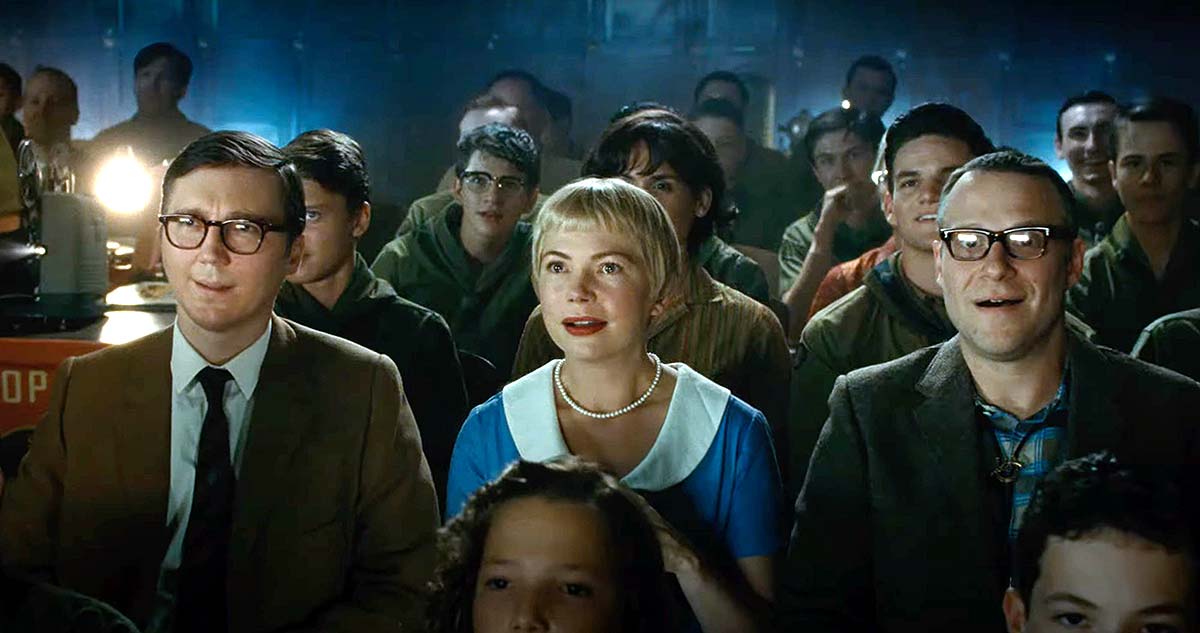
It begins in 1952, when the young Sam Fabelman (Mateo Zoreyan) goes to his very first picture show along with his parents, Burt (Paul Dano), a computer programmer, and Mitzi (Michelle Williams), a talented pianist. Sam is initially apprehensive about the upcoming experience – he’s heard terrible things! – but is transfixed by Cecil B DeMille’s The Greatest Show on Earth, particularly an extended sequence that depicts an epic train crash. That Christmas, Sam is given a lovely toy train set and he cannot stop himself from attempting to recreate what he saw in the movie and, inevitably, capturing it on film.

Time rolls on, and a teenage Sam (Gabrielle LaBelle) is living in Arizona, where Burt has gone for work. He’s still obsessively making amateur movies, aided by his willing schoolmates (including the famous World War 2 on a budget epic Escape to Nowhere) and thinks nothing of the fact that Burt’s friend, ‘Uncle’ Bennie (Seth Rogan), is a constant presence in the family’s life. It’s only when he is editing a film about a recent family camping trip that the camera reveals something he has previously had no inkling of…

The Fabelmans is essentially a family drama, but one that encompasses some weighty topics: mental health issues, the prevalence of anti-semitism and the expectations that parents can sometimes place on their children. Above all hovers the love of cinema, the almost magical ability it has to transform a viewer’s world, to allow them to escape from reality into a variety of uncharted realms. This is a warm and affectionate study of the director’s beginnings and, if it occasionally ventures perilously close to schmaltz, Spielberg is deft enough to repeatedly it snatch back from the abyss. The world he creates here is utterly believable.

There’s plenty to enjoy. I love the brief appearance by Judd Hirsch as all-round force of nature, Uncle Boris – a former silent movie actor, who recognises the nascent director lurking inside Sam and calls him to do something about it. There’s a beautifully nuanced performance from the ever-impressive Williams as a woman who has sacrificed her own creative ambitions to the demands of her family and is suffering because of it, and there’s a delicious, foul-mouthed cameo from (of all people) David Lynch. Throw in Janusz Kaminski’s gorgeous cinematography and legendary composer John Williams’ music, and you’ve got something a little bit special.

And while The Fabelmans is not quite the five-star masterpiece that so many critics have declared it to be, it’s nonetheless a fascinating look at the filmmaker’s roots and one that never loses momentum throughout its duration.

So don’t wait for streaming. See it where it belongs, and Steven will thank you in person.

4.6 stars

Philip Caveney