

Carrie

The Substance

21/09/24

Cineworld, Edinburgh

Every once in a while, a film opens with a sequence so striking that the viewer becomes instantly aware that they are in the presence of a powerful new voice in cinema. The Substance is a perfect case in point. In close-up, an egg is injected with something that causes the yolk to spilt into two. Then we watch as a pair of workmen instal a new star on Hollywood’s Walk of Fame – and, in an ensuing time-lapse, we see that star deteriorating over the decades until it is a cracked, grubby version of its former self, suffering the final indignity of having a burger and fries spilled on it.

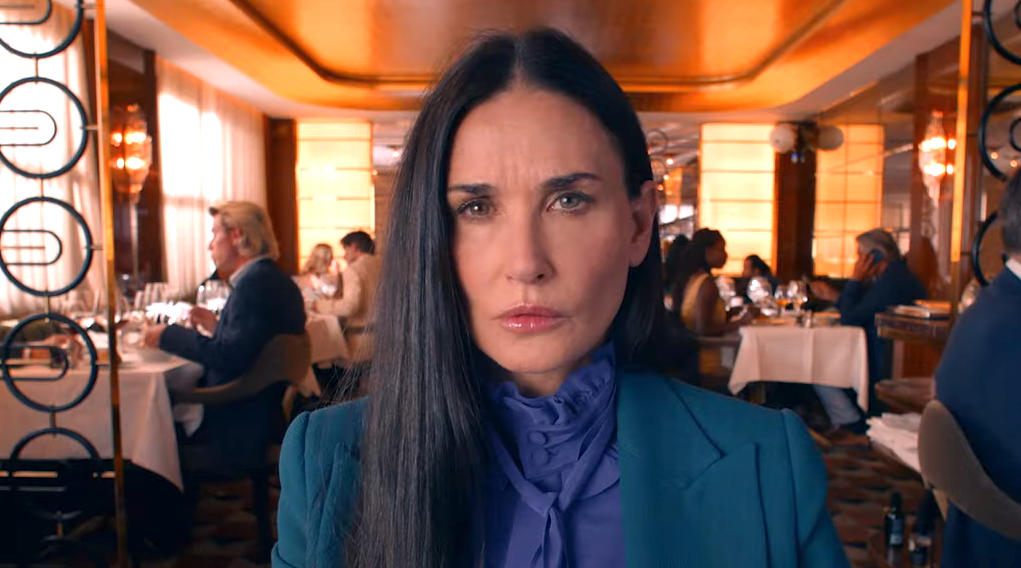
The star belongs to Elizabeth Sparkle (Demi Moore), once a bona-fide movie star, but now the leading light in the world of TV physical fitness shows. She’s fast approaching sixty and still looks great, working hard to keep her physique as she needs it to be. But her world is rocked when she overhears her toxic producer, Harvey (Dennis Quaid), talking on the phone, announcing that Elizabeth is now ‘too old’ for her role and that he wants a replacement as soon as possible – somebody younger.

Then, after a car crash (from which Elizabeth emerges unscathed), a handsome young hospital assistant slips her a note, alerting her to the existence of the titular drug, which promises to release a fresh new version of the user’s self. Like most Faustian deals, it comes with some very strict rules (bend them at your peril) but, in a shockingly visceral sequence, ‘Sue’ (Margaret Qualley) is born.

Now the two women must learn to co-exist, each one spending a week in the real world, while the other sleeps and regenerates. And of course, it’s all doomed to go horribly wrong…

This sophomore project from writer/director Coralie Fargeat – I have yet to see her debut film, RevengeThe Substance plays like a fable, a weird Grimms’ fairytale for the modern age. There are shades of The Picture of Dorian Gray here, allusions to Snow White and her stepmother’s ‘Mirror Mirror’ mantra, and several visual echoes of classic films like The Shining and Carrie. What’s more, the astounding practical makeup effects will remind many older film fans of early David Cronenberg and Brian Yuzna – though the eye-popping splatter sequences used here make movies like The Brood and Society look positively restrained by comparison.

But this is so much more than imitation. The Substance is an adept and powerful meditation on the subject of ageing and the ways in which women are constantly shackled and devalued by it – and how we all fall into the trap of enabling this sad state of affairs.

Moore is extraordinary in this film, delivering what might just be her finest screen performance (certainly her most unfettered), while Qualley makes the perfect foil. And Quaid, who I haven’t seen onscreen in quite a while, is gloriously, revoltingly odious here, making even the act of eating seafood a stomach-churning spectacle.

But it’s Fargeat who really deserves all the accolades. The Substance is surely one of the most provocative and affecting films of the year. I’m already excited to see where she will go next. But a word of warning: this won’t be for everyone. Those who shrink from body horror, blood and nudity are going to find plenty here to trigger them, particularly in the harrowing final stages, where Fargeat keeps pushing the gory imagery as far it can possibly go.

And then, she returns to that Hollywood star, and ties everything up in one delightful, blood-spattered package. If this sounds like your cup of haemoglobin, be sure to watch it on the big screen.

5 stars

Philip Caveney

Pin Cushion

28/08/18

Deborah Haywood’s directorial debut, Pin Cushion, is based, she says, on her own experiences of being bullied at school. I can only fervently pray that she has exaggerated what went on, because this is a relentlessly bleak story from start to finish – which is not to say that it isn’t a good film. On the contrary, it’s powerful and deeply affecting. But as I watch, I find myself praying for a token beam of light to break through the overpowering gloom and, frankly, it never appears.

Lyn (Joanna Scanlan) is a single mum with a multitude of problems. Afflicted by a deformed spine and a pronounced limp, she takes her teenage daughter, Iona (Lily Newmark), to a unnamed town, somewhere in darkest Derbyshire. Lyn and Iona are in search of a new start. Things clearly haven’t gone too well for them in their previous home. They are mutually dependent, referring to each other as ‘Dafty 1’ and ‘Dafty 2’ and even sharing a bed. But Iona is reaching the age where she longs for new friends and new experiences.

Unfortunately, once installed in the local school, she falls under the influence of alpha-female, Keely (Sacha Cordy-Nice), who immediately sets about making the new arrival’s life hell on earth. Lyn doesn’t fare any better, treated with open disdain by her neighbours and even told not to return to a ‘friendship group’ she visits. (Actually, this is the point in the film where  things becomes faintly unbelievable – could anyone act as horribly as the people in this film? I’d like to believe they wouldn’t.)

Lily’s aspirational fantasies, delivered in magical realism style, may have been the director’s attempt to soften the horror of the situation, but they don’t help overmuch. Indeed, there’s an overall fairytale quality to this film, but it’s definitely of the Grimm variety – and some viewers may spot more than a passing resemblance to Brian de Palma’s Carrie. There are superb performances from the two leads. Of course, we come to this expecting Scanlon to be good, but this is Newmark’s first film, and she certainly makes the most of it.

Tonight’s screening at the Cameo Cinema, Edinburgh, is followed by a Q & A with Joanna Scanlan, who clearly feels passionate about the themes raised here and answers the audience’s questions frankly and intelligently.

So can I honestly say I enjoy Pin Cushion? No, not really. It impresses me, and makes me think that Haywood is a name to watch out for in the future. But I emerge from the screening feeling decidedly shell-shocked – and though, of course,  that may have been the director’s intention, in the end it doesn’t feel like enough.

4 stars

Philip Caveney


Carrie

MV5BMTc1MDIyOTkxN15BMl5BanBnXkFtZTgwMTU1NzEzMDE@._V1_SY317_CR0,0,214,317_AL_

28/08/14

Why do they do it? Brian De Palma pretty much nailed this idea in 1976, but as is the way of things these days, somebody has decided that they can put a new spin on it. Except that director Kimberly Peirce completely fails to do that. Apart from a few tiny changes (Carrie’s mum owns a dress alteration business, Sue Snell is pregnant and Carrie’s first period humiliation is shared on Facebook) this is pretty much a shot-for-shot retread of De Palma’s film, minus the fancy split-screen, slo mo tropes that are his (brilliant) signatures. And apart from a bit of contemporary tweaking, they’ve even used Lawrence Cohen’s 1976 screenplay.

And then there’s Chloe Grace Moretz in the title role. Don’t get me wrong, I think she’s fabulous, but she’s too groomed, too wholesome to play the awkward, naive outsider Carrie White. Her transformation into a beauty on prom night is supposed to be a revelation, but she’s easily the best looking person in the film from the opening shot onwards. And while Sissy Spacek may have been too old for the role in the original, by golly, didn’t she convince at every step? Julianne Moore is a better fit for batty, sex-obsessed Momma White, and she cranks things down a couple of notches from Piper Laurie’s histrionic original, but that’s not enough to justify spending so much time and money on this ‘reimagining.’ Oh and that famous final ‘shock?’ Don’t hold your breath.

To my mind, the only reason for doing something like this is to radically reinvent the material. This is decently made, decently acted and if you’ve never seen the famous original, then maybe it’s worth seeing. But why would you bother when De Palma’s iconic movie is still available on DVD?

3.4 stars

Philip Caveney