Cailee Spaeny

Alien: Romulus

16/08/24

Cineworld, Edinburgh

The cinema generally takes a back seat for us in August when the Edinburgh Fringe takes up so much of our time. But a new addition to the Alien franchise has to be an honourable exception. Like most people who say there are Alien fans, it really only applies to the first two films: Ridley Scott’s iconic original and James Cameron’s (IMO) superior sequel, which qualifies as one of my all-time favourites. Since then, it’s been an irritating game of misfires. Even Scott’s two attempts to rekindle the series have been well-intentioned disappointments.

But Fede Alvaraz seems like a decent bet to attempt a reboot. After all, he somehow managed to breathe some fresh er… death into the Evil Dead films. So when I spot a two-hour slot in my schedule, I’m off to the multiplex with high hopes.

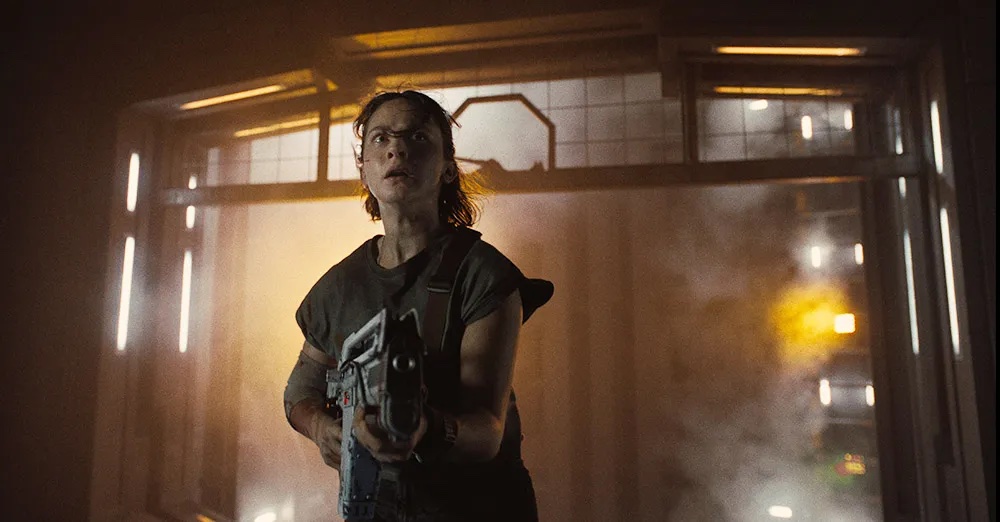
It starts well. Rain (Cailee Spaeny) lives and works on a horrible planet where it’s eternally dark. Her adopted brother, Andy (David Jonsson), does his best to look after her. He’s a synthetic, rescued from a rubbish dump by Rain’s father, but his aging technology means that he has a tendency to glitch and he is regarded with suspicion by a lot of the planet’s inhabitants. When Rain tries to get permission to leave – she’s desparate to get some sunshine – she’s denied the chance and told she’ll be transferred to the mines, so when her friend Tyler (Archie Reneux) suggests an alternative, it’s timely to say the very least.

It turns out that there’s a decommissioned Weyland-Utani space station in the sky above them and Tyler reckons they can gain access to it using Andy (who is a Weyland-Utani creation) to get aboard. There are just thirty-six hours left before the station hits an asteroid belt but it will almost certainly have sleep pods aboard, which the threesome – and their accomplices – can use to make the nine-year journey to the nearest inhabited planet. What can possibly go wrong? Rain reluctantly agrees to give it her best shot and it isn’t long before the gang are approaching their destination…

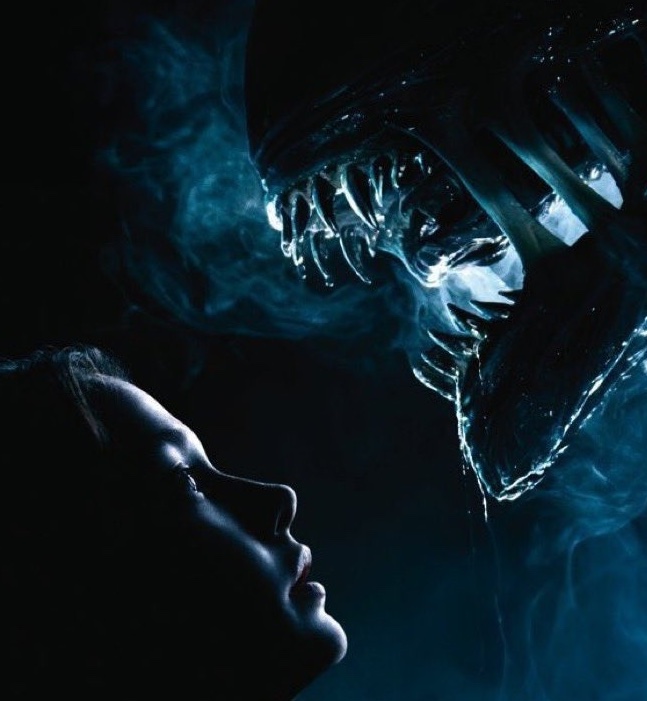
I like the fact that the protagonists are young. If the mature astronauts of Alien: Covenant seemed to constantly make stupid decisions, the recklessness of youth makes for a much more acceptable premise – and, once aboard the ship, which of course features more face-huggers and chest-bursters than you could shake a stick at, Alvarez and co-writer Rodo Sayagues manage to keep the pot of suspense bubbling nicely. There are visual references to the earlier films and the audacious decision to bring back a character from the first film – or rather, half of him – just about pays off. What’s more, Andy is given an upgrade which makes him faster and better – but way more logical, a development that means his loyalties now lie with the corporation that owns him rather than with Rain.

There are some new ideas in here too. A situation where the space station’s gravity keeps switching off in order to reboot really ramps up the torment, while a solution to all that acid blood flying around is an interesting development. Spaeny is terrific in the lead role, managing to fill Ripley’s action boots with aplomb and Jonsson (who made such a good impression in Rye Lane), is also memorable as her unreliable sidekick.

It’s only as the film thunders into the home straight that it takes a wrong turn. I almost stand up and shout at the screen, as Alvarez makes the baffling decision to homage Prometheus and all those hard-won plus points make a swift exit through the nearest escape hatch. It’s a shame, because it is so nearly home and dry.

Overall, Romulus is a decent addition to the canon, certainly the third best offering in the series, but still light years behind films one and two.

3.8 stars

Philip Caveney

Civil War

14/04/24

Cineworld, Edinburgh

With the situation in the Middle East rapidly approaching flashpoint, it seems a particularly propitious time for Alex Garland’s Civil War to open at UK cinemas. If it was devised as a kind of warning for the near future, then it now seems doubly unnerving. Set in an unspecified year, the film opens with the president of the United States (a suitably Trumpian Nick Offerman) rehearsing a speech telling his followers that all is well and that the seditionary forces opposing him will soon be vanquished. But in reality, the civil war which that has been raging for some time is now approaching its inevitable conclusion as the aforementioned insurrectionists converge on Washington DC. And they haven’t come to shake the president’s hand.

Renowned photojournalist Lee Smith (Kirsten Dunst) and her colleague Joel (Wagner Moura) are both determined to be at the capital in time to witness what happens, and – more importantly – to capture it on film. But getting there will involve a long and hazardous trip across the war-torn country. The night before they leave they pick up a couple of fellow travellers: veteran newshound Sammy (Stephen McKinley Henderson), more cautious than the other two, but still determined to be in at the kill – and young novice Jessie (Cailee Spaeny), who actually idolises Lee and wants to – quite literally – follow in her footsteps…

Civil War has been criticised by some for failing to pin down exactly who is attacking whom in the various conflicts the foursome encounter – but I think that’s entirely the point. Garland (who also wrote the screenplay) wants to show the confusion of warfare, the fact that all kinds of people are pitching into this carnage with manifestos of their own. Against this chaotic background, Garland is much more interested in the photojournalists themselves, the callousness they must possess in order to observe atrocities without ever pitching in to help, the utter determination that propels them to risk their own lives in order to get that one all-important image and document history as it unfolds.

The background in which these scenarios play out is convincingly portrayed. This is production company A24’s most expensive project yet and it shows, the final conflict in the capital rendered with absolute veracity. There’s a powerful sense of unease that builds steadily throughout the film and I’ve rarely seen urban warfare depicted with such unflinching realism and attention to detail. Watch out for a powerful cameo from Jesse Plemons as a merciless soldier in a particularly dread-charged sequence and marvel too at the clever device that repeatedly halts cinematographer Rob Hardy’s adrenaline-charged action sequences to pick out one black and white image.

I’ve occasionally had issues with some of Garland’s endings (Men in particular, where he seemed to be pounding home his final message with a sledgehammer) but this keeps me gripped right to the final frame. Civil War’s conclusion may be too cynical for some, but I feel it’s absolutely spot on. Furthermore, I’d go so far as to suggest that this might be Alex Garland’s most fully-realised film so far.

But be warned. You’ll most likely leave the cinema feeling pretty grim about the future.

4.6 stars

Philip Caveney

Priscilla

22/12/23

Cameo Cinema, Edinburgh

Priscilla

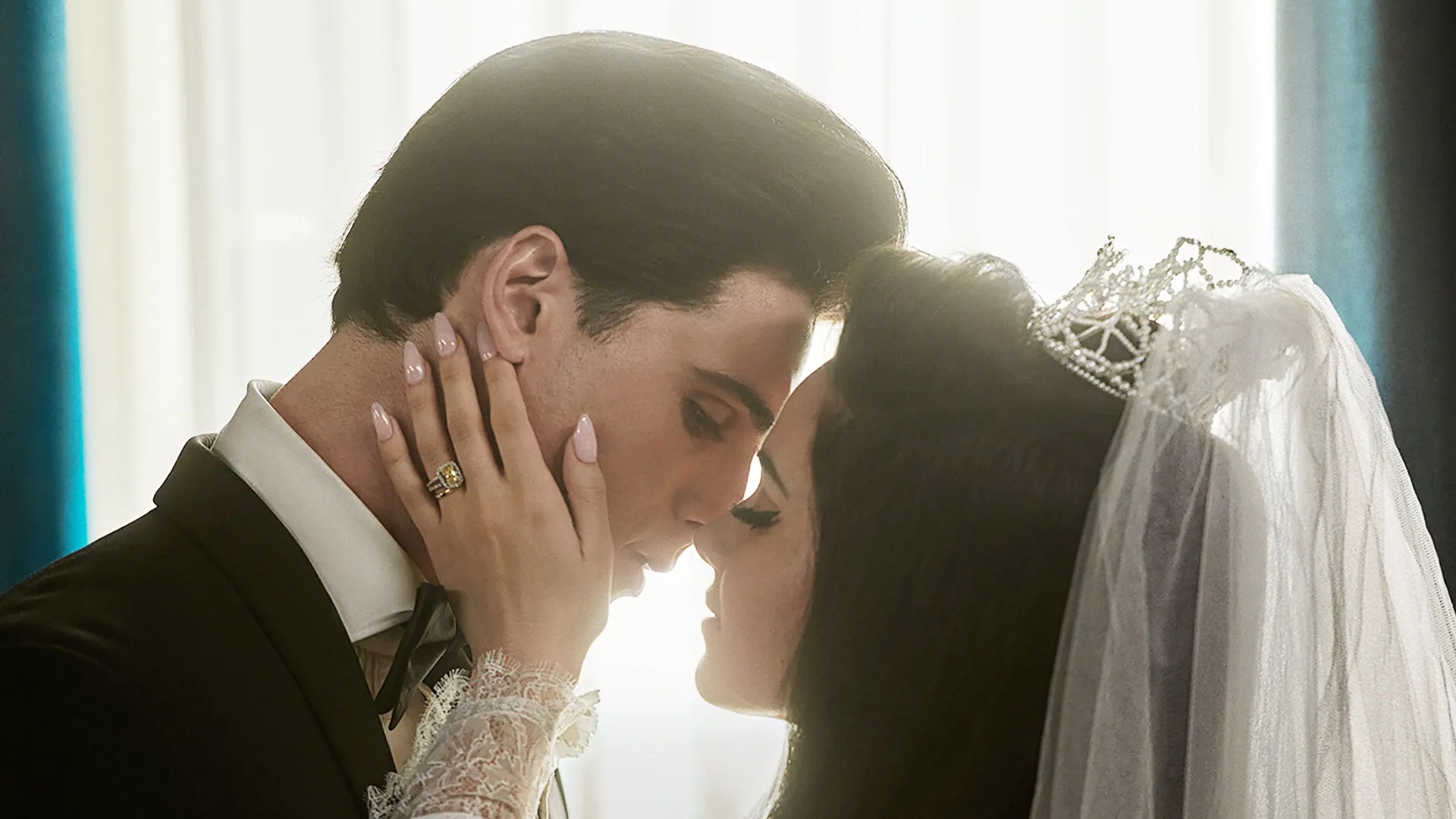
If Baz Luhrmann’s Elvis was a dazzling celebration of the singer’s career, Priscilla offers the polar opposite of that film – a true story with a dark underbelly that, viewed with the gift of hindsight, feels almost shockingly transparent. Presley emerges as a toxic human being, a man who manipulated and exploited a naive fourteen year old girl for his own purposes. 

And before you say, “Well that’s just director Sofia Coppola’s interpretation of what happened,” let me add that her screenplay is closely based on Priscilla Presley’s autobiography, Elvis and Me – and that she was one of the executive producers on the film.

We first meet her as a bored teenager on an Army base in Germany. Cailee Spaaeny submits an impressive performance in the title role, managing to convincingly portray her subject from her early teens to her late twenties. When a young officer approaches Priscilla and casually asks her if she’d like to meet Elvis Presley, of course she says yes! Like most other kids in the late 1950s, she is a big fan. And he is arguably the most famous person on the planet.

So, to the understandable consternation of her parents, Priscilla heads off to Elvis’s house and is soon chatting to the man himself, as played by Jacob Elordi, last seen being quintessentially English in Saltburn, but managing to inhabit Presley’s mumbling, brooding persona with considerable skill. The pair hit it off, big time.

When Elvis is posted back to America, a lengthy interval suggests that he may have forgotten about her but, out of the blue (and again, much to her parent’s understandable concern), she’s summoned to his new home, Graceland, where she’s invited to become a permanent fixture. No sex yet, not until she’s of age, but plenty of smooching and much manipulation from Presley, who coaxes her to change her hair, her makeup and her fashions – to become, in effect, his dream girl.

As Presley grooms Priscilla (and there really isn’t a more appropriate term for what he’s doing), so her own identity becomes increasingly erased – and who knows where it’s all going to end?

Coppola’s accomplished film is handsomely mounted, the period detail convincingly evoked over the changing decades and it’s interesting to note how cinematographer Phillippe Le Sourd keeps everything murky and claustrophobic in the film’s early stretches, mirroring young Priscilla’s view of the world she’s obliged to exist in. Le Sourd returns to the gloom in the film’s later scenes, as Presley slips inexorably into addiction to prescription drugs. In between, the screen sizzles and pops as the odd twosome actually begin to enjoy the advantages of being a couple.

Weirdly, I knew about their story from my own childhood. My sister was a member of Presley’s fan club and received a monthly magazine. In the early sixties, I read repeatedly about the man’s developing relationship with Priscilla. Of course, back then, I wasn’t mature enough to fully appreciate how profoundly creepy the whole arrangement was. Priscilla’s age was an open secret to the world but, blinded by Presley’s fame, we just kind of accepted it. Shame on us.

This is a fascinating film, one that digs a lot deeper than Lurhman’s (admittedly very enjoyable) biopic, exposing the ugly bumps and warts that lay beneath the shimmering surface of stardom. To say that it’s an eye-opener would be something of an understatement. 

4.3 stars

Philip Caveney

On the Basis of Sex

28/02/18

I really want to like On The Basis of Sex. Not just because Ruth Bader-Ginsburg is a truly inspirational woman who deserves a decent film, but also because we’re seeing this one with a couple of friends, and it’s much more fun to enthuse collectively than it is to disparage. I’ve read a few lacklustre reviews, so I’m far from certain I’ll get what I want. But the cinema-gods are smiling down on us tonight, and I’m pleased to report this is a cracking biopic.

Okay, so Daniel Stiepelman’s script isn’t especially innovative or radical; this is a traditional telling. But that’s no bad thing: the writing is tight and concise, intimate and focused. Given that Ginsburg’s activism is of the quiet variety – all research and paperwork and detailed knowledge of tax laws – and her marriage was harmonious and free from high drama, it’s no mean feat to have made such a compelling movie from her tale. The shocks are all in the blatant sexism; it’s hard to believe this is only (really) a few years ago. Thank goddess for RGB and other pioneers.

Mimi Leder’s subtle direction takes us with Ginsburg from her 1956 enrolment in Harvard Law School up to her landmark 1970 case, where she forces the court to concede that gender discrimination is actually a thing. In this instance, it’s a tax code penalising a man: he can’t claim tax relief for the nurse he employs to care for his mother while he’s at work; if he were a woman (or, indeed, married), he would however qualify. After years of suffering discrimination on the basis of sex – unable to get a job as a practising lawyer, lumbered with a professorship that isn’t what she really wants – this is Ginsburg’s chance to nudge the floodgates. Once gender discrimination has a legal precedent, other laws can be challenged.

Felicity Jones is made for this part, I think, effortlessly conveying a surface of dignity and composure but a core of steel and fire. Ginsburg must surely be delighted with the way she’s been portrayed. Armie Hammer is also disarming, as Ginsburg’s devoted husband, Martin, as supportive a partner as anyone could wish for. And Cailee Spaeny (last seen by B&B in the criminally overlooked Bad Times at the El Royale: not a single awards nomination – really?) as the Ginsburgs’ daughter, Jane, surely has a bright future ahead? She’s arresting, even in this small role.

It’s a charming film, and an important story. It’s scary to think how recent this all is, and how hard-won the rights we now enjoy. There were no women’s toilets at Harvard Law School when RBG went there; there were laws – actual laws – that stated women couldn’t e.g. fly aeroplanes.

How far we’ve come.

4.6 stars

Susan Singfield