
Blythe Duff

Wild Rose

20/03/25

Lyceum Theatre, Edinburgh

Rose-Lynn Harlan (Dawn Sievewright) has a dream: to appear on the stage of Nashville’s legendary Grand Ol’ Opry, belting out a country song – not a country and western song, mind you. It’s an important distinction. So, being banged up in prison for a year wasn’t part of the grand ol’ plan – but now she’s served her time and is finally able to head back to her mum, Marion (Blythe Duff), who has been dutifully looking after Rose-Lynn’s two young children, Lyle (Leo Stephen) and Wynonna (Jessie-Lou Harvie).

Rose-Lynn is dismayed to find that her kids have become disaffected by her long absence and that their former trust in her has been all but eroded. What’s more, they view her long-cherished dream as selfishness. And that’s not all that has changed. When she calls in at the Grand Ol’ Opry, Glasgow – where she previously had a residency – she discovers that her regular slot has been handed to the dreaded Alan Boyne (Andy Clark), a long-haired carpet fitter with a sideline as a charisma-free country singer.

Desperate to keep her head above water, Rose-Lynn takes a part-time post as a cleaner, working for the highly-privileged Susannah (Janet Kumah). She’s a go-getter and, once she’s heard Rose-Lynn sing, she becomes determined to put her in touch with legendary DJ Bob Harris, who Susannah believes might be able to offer some good advice.

Rose-Lynn realises that her long-cherished ambitions are still burning as fiercely as ever…

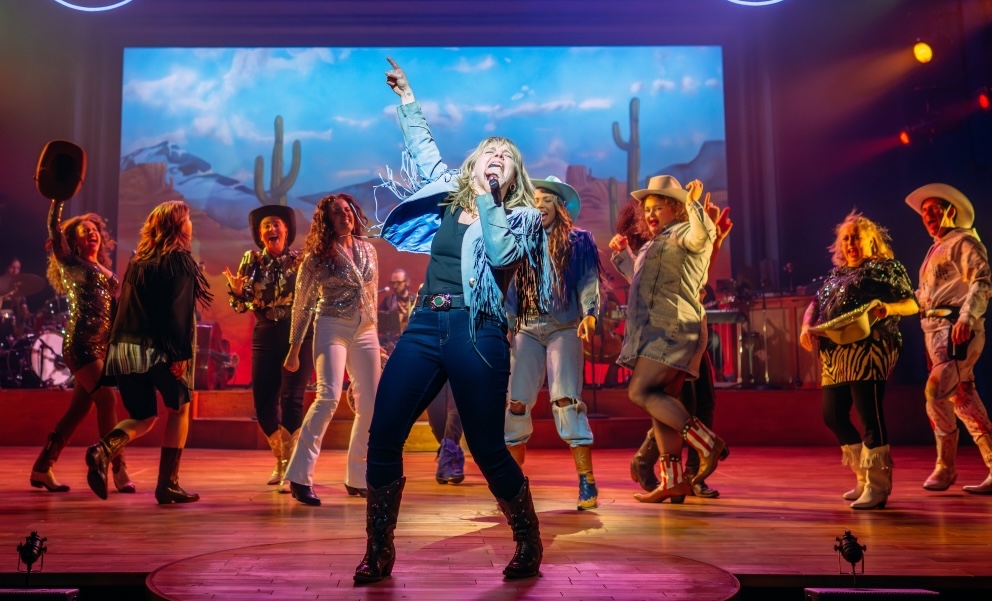
This assured version of the 2018 film (adapted by its original screenwriter, Nicole Taylor) makes a seemingly effortless transition to the stage. A prison-set opening where Rose-Lynn and her fellow inmates launch headlong into a propulsive rendition of Country Girl sets the tone perfectly, with Sievewright stepping into Jessie Buckley’s cowboy boots with absolute authority. An eight-piece band ranged across the back of the stage performs a varied selection of numbers, from banging rockers to lilting, steel-guitar layered ballads. And it’s not just Sievewright supplying the singing.

As bar-owner, Jackie, Louise McCarthy belts out her own fair share of raunchy vocals, Duff does a fabulous job with a haunting song of regret and even the two youngest members of the cast have the opportunity to shine as vocalists. Clark – who takes on a number of roles – proves himself an invaluable asset to the production, as does Hannah Jarrett-Scott, who appears as two (very different) characters.

Chloe Lamford’s simple but effective set design works beautifully alongside Jessica Hung Han Yun’s inventive lighting and Lewis den Hartog’s simple-but-effective video design. John Tiffany handles the directorial reins with absolute aplomb. It’s worth mentioning, I think, that Wild Rose will be the final production under David Greig’s eight-year spell as the Lyceum’s artistic director. He leaves on an impressive high note.

Wild Rose is a fabulously entertaining story about ambition and acceptance, anchored by a knockout performance from Dawn Sievewright. Anyone in search of an uplifting night at the theatre will find it here. And you don’t have to be a die-hard country fan to enjoy this fabulous show.

5 stars

Philip Caveney
Escaped Alone

14/03/24

Traverse Theatre, Edinburgh

First performed at the Royal Court in 2016, Caryl Churchill’s Escaped Alone is a fascinating piece, revealing some essential human truths despite the brevity of its running time.

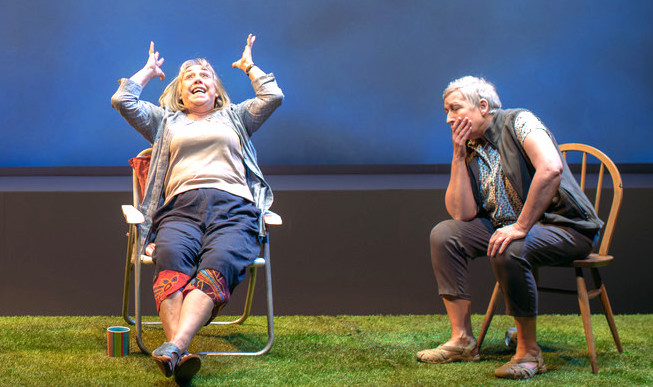
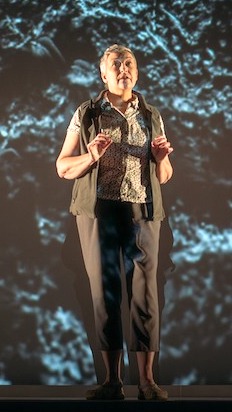
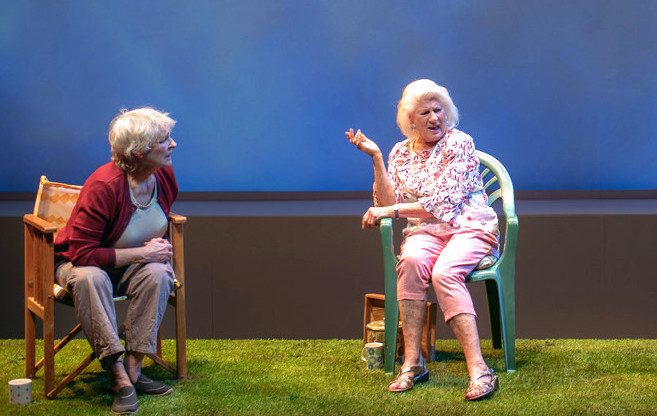
Three retired women – neighbours – sit in a garden, chatting inconsequentially. Mrs Jarrett (Blythe Duff) calls out a greeting as she passes by and is invited to take a seat. On the surface, she fits in, joining in the conversation. But she’s plagued by her knowledge of what’s happening in the news. At regular intervals, while the other women freeze, Mrs Jarrett rises and stands before Lewis den Hertog’s bleak black and white video projection, monologuing about apocalyptic events in the world beyond the garden. It’s like she’s zoning out, and we’re inside her head – and then she’s back again, making small talk, as if nothing has happened.

Although the catastrophes Mrs Jarrett describes are absurd in their extremity – all food has been diverted to TV channels; the hungry only know breakfast as an image on their screens; obese people sell their flesh, cutting rashers from their own bodies – the situation is depressingly normal. Just this morning, listening to the radio, I hear that 300 kidnapped Nigerian schoolchildren are still missing. In Gaza, shots have been fired at starving Palestinians waiting for a food truck. War still rages in Ukraine. It’s horrible. “Should we have curry or pasta for dinner tonight?” I ask my husband. We’re all fiddling while Rome burns.

The set, designed by Anna Orton, heightens the feeling of pretence. The grass is too green, the sky too blue; it’s what the women want to see, not what’s really there.

But, however fervently they cling to the façade they’ve created, real life keeps creeping in. “I’d love to go to Japan,” muses the agoraphobic (Anne Kidd). “Get yourself to Tesco first,” advises the caustic former GP (Joanna Tope), puncturing the daydream. Most resolutely cheerful of all is the ex-hairdresser (Irene McDougall), fresh out of prison for killing her husband. She went down for manslaughter, “but it might have been murder, in actual fact.” Nothing is what it seems.

Under Johanna Bowman’s direction, the performances are pulsing with vitality. There’s an urgency to proceedings that underscores the latent horror. Churchill’s script offers no real plot or character progression and this Tron Theatre production makes sense of that. It’s a snapshot of the way we’re stuck: a never-ending cycle of looking away; distracting ourselves from what’s really happening; ignoring the overpowering emotion consuming us.

“Terrible rage. Terrible rage. TERRIBLE RAGE.”

4.3 stars

Susan Singfield

James IV: Queen of the Fight

05/10/22

Festival Theatre, Edinburgh

For the fourth part of her epic series about Scottish history, Rona Munro chooses to focus her gaze upon a little known episode in the reign of James IV – the influence of two ‘Moorish’ women on the Scottish court and the events that lead to the writing of Ane Blak Moor, a derogatory (and openly racist) poem written by the Makar, William Dunbar (Keith Fleming).

In 1504, Lady Anne (Laura Lovemore) and her servant, Ellen (Danielle Jam), arrive at the Scottish court. Anne is to be lady-in-waiting to James’s young English bride, Margaret (Sarita Gabony), so Ellen is left to form her own alliances. She soon finds a role within the royal household – as an entertainer – and eventually finds herself the confidante/lover of King James (Daniel Cahill). She plays the titular ‘Queen of the Fight’ – a kind of MC – in the symbolic tournaments he leads. But Margaret’s jealousy of the woman she perceives as an interloper will have significant consequences for James and his followers – and shows how, even though the King apparently champions diversity, when push comes to shove, racism rears its ugly head.

The real strength of this production is the way that Munro finds contemporary echoes in these historical characters, who talk and act like the kind of people you might encounter in modern-day Edinburgh. This is particularly apparent in Dunbar, who is obliged to cut his cloth according to the changing mood, in order to eke a meagre living from his writing. His grumpy observations about his precarious existence put me in mind of a typical freelancer, forever having to apply himself to the fickle moods of the court. Clearly some things never change. (No, no, never been there myself…)

This is a handsomely mounted production, from Jon Bauser’s elaborate set designs to the sumptuous costumes by Karen Short. (I love the way the play begins with the characters in contemporary clothes, before they are dressed in their period finery.) There are some wonderfully boisterous fight scenes too, the participants swinging broadswords at each other with wince-inducing gusto.

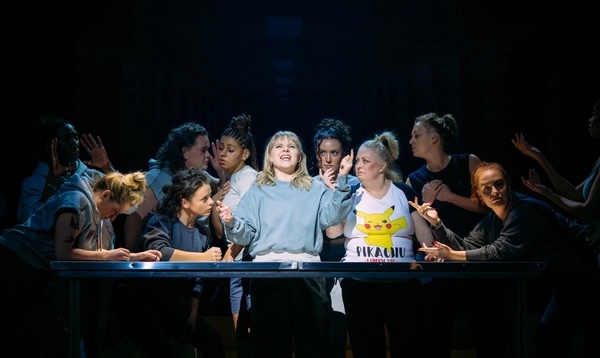
There’s so much to enjoy here – I’m especially amused by Gabony’s petulant, seventeen-year-old bride, too moody to even get out of bed – and there are Dame Phemy’s delightfully caustic remarks (Blythe Duff); she has worked in the court longer than anyone and has everybody (including the King) dancing to her tune.

Queen of the Fight is proof, if ever it were needed, that historical fiction doesn’t have to be dull and strait-laced. Here is a production that positively thrums and pulses with energy and one that genuinely earns an exuberant and heartfelt ovation.

4.6 stars

Philip Caveney

Grain in the Blood

03/11/16

Traverse Theatre, Edinburgh

Grain in the Blood is the second play by Rob Drummond we’ve seen this week, but it’s so different from the rambunctious, slapstick humour of The Broons that it’s hard to believe it’s from the same pen. This is a clearly a playwright who doesn’t want to be pigeonholed, who likes to experiment with a wide range of forms and genres. And this is all to the good, because Grain in the Blood feels like a real one-off, a spare, stark, unnerving chiller that is at once contemporary and classical. Its remote farmland setting is precise and detailed – and yet it could be anywhere. The dialogue is taut and ultra-modern in style, all fragments and silences and unfinished thoughts – but it could be any time. This is a complex, angular, unwieldy play – and it’s fascinating to see the plot unfurl.

Sophia (Blythe Duff) is a retired vet. Her son, Isaac (Andrew Rothney), has been in prison for years, ever since he murdered his wife, Summer. Sophia lives on the family farm, with her sickly granddaughter, Autumn (Sarah Miele), and Summer’s sister, Violet (Frances Thorburn). Autumn is dying; she needs a kidney transplant to survive. Under the careful watch of his minder, Bert (a wonderfully monosyllabic John Michie), Isaac is released from gaol for a long weekend, to meet his daughter and make a decision: will he donate a kidney to help her live?

There’s a sinister atmosphere on stage throughout, an uneasy sense of what might come to pass, accentuated by the presence of the shotgun we know is in the chest, by the slaughtered lambs and the kitchen knives. And the verses, recited by Autumn, conjure up an ancient world of witchcraft and folklore and bloody rituals.

The tension is palpable. There’s a school group sitting in front of us in the auditorium, and they’re so invested in the action that they gasp out loud as one, breathe out a collective “no” as the final plot point is revealed.

Orla O’Loughlin’s direction is subtle: these are actors who have been told to play the silence, explore the stillness, consider proxemics and use the edges of the stage – and this all helps authenticate that all-pervading sense of dread. Autumn’s bedroom, revealed by sliding walls at the back of the living room where everything else takes place, looks like the final picture on an advent calendar: the double doors opening to show an ethereal figure poised between life and death, bathed in yellow light and speaking truths. This potty-mouthed youngster is the moral heart of the play.

Grain in the Blood does what the best theatre should: it entertains, of course, but it also makes you think. It raises questions, demands answers. This is one I highly recommend.

4.7 stars

Susan Singfield