
Bill Camp

Drive-Away Dolls

16/03/24

Cineworld, Edinburgh

Since their auspicious debut with Blood Simple way back in 1984 (when I had the honour of interviewing them for Manchester’s City Life magazine), Joel and Ethan Coen have unleashed a whole barrage of brilliant films. OK, so there have been one or two misfires in there, but few filmmakers have been so consistently prolific and on the button.

A few years ago they decided to take a sabbatical and work on their own individual projects. Older brother Joel landed first with The Tragedy of Macbeth, which – despite having possibly the most self-aggrandising screen credit in history – turned out to be one of the finest Shakespeare movie adaptations ever. Now it’s Ethan’s turn and Drive-Away Dolls, co-written with his wife, Tricia Cooke, is the result. The central story is so sniggeringly phallus-obsessed it might just as easily have been written by Beavis and Butthead.

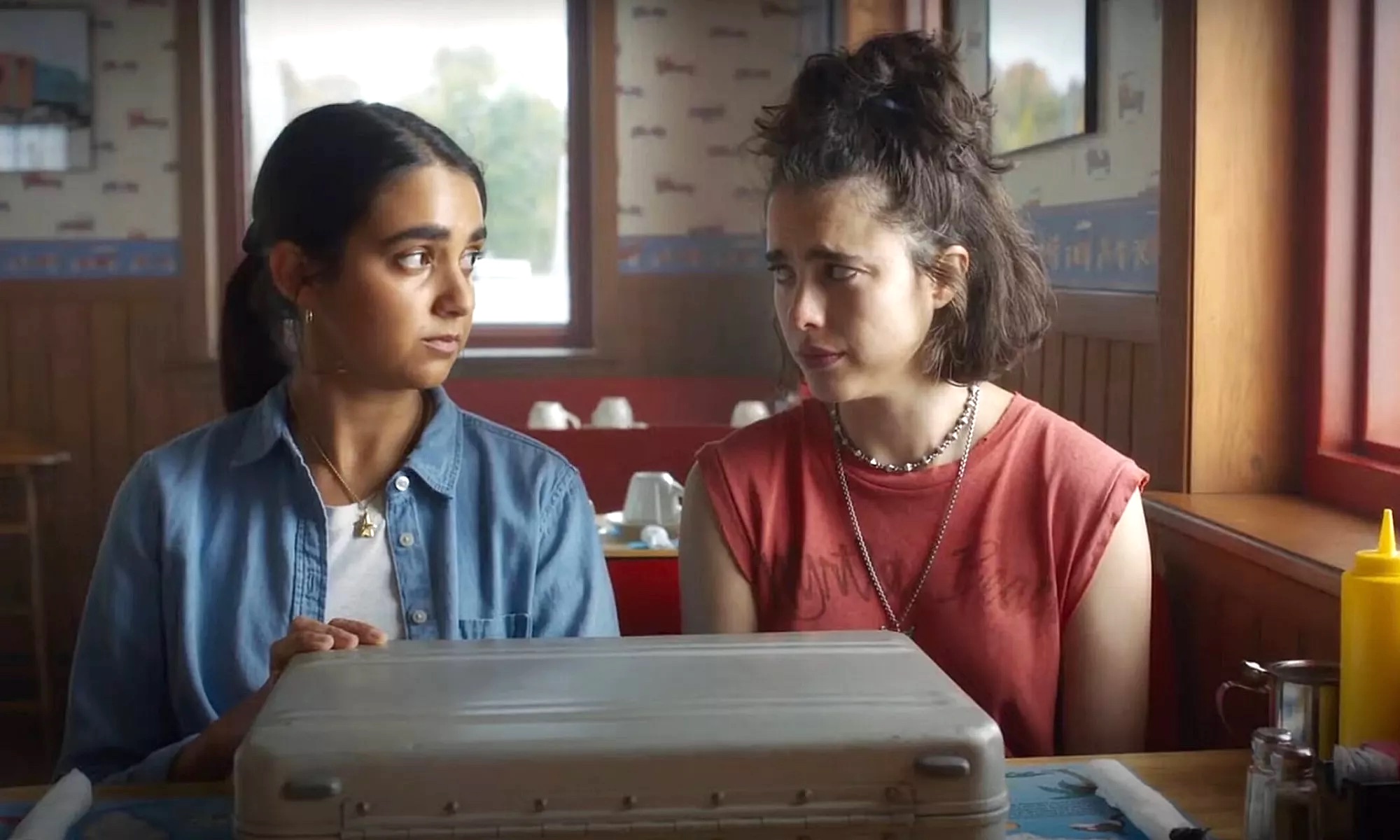
The ‘dolls’ in question are Marian (Geraldine Viswanathan) and Jamie (Margaret Qualley), two lesbian besties. Marian is reserved and socially awkward. She spends most of her spare time reading highbrow literature. Jamie is her polar opposite, with a propensity for raucous and ill-fated relationships. She’s in the process of messily breaking up with policewoman, Sukie (Beanie Feldstein), and urgently needs a change of scenery, so she talks Marian into taking her on a road trip to Tallahassee.

The women hire a drive-away vehicle from Curlie (Bill Camp) and set off on the long drive, blissfully unaware that they have got their wires badly crossed and that the boot of their car contains a metal attaché case containing something of great value. (This device feels so like the MacGuffin in Pulp Fiction, it surely has to be intentional.)

At any rate, Marion and Jamie are being pursued by a trio of bad guys, led by ‘The Chief’ (a criminally underused Colman Domingo), who want what’s in that briefcase. Rough stuff inevitably ensues…

While Drive-Away Dolls feels closer to familiar Coen territory than Shakespeare ever could, it’s exasperating to witness how consistently this fails to hit any of its chosen targets. Viswanathan and Qually are both engaging performers, but Qually in particular is stuck with the unenviable task of delivering slabs of frankly unbelievable dialogue, the kind of lines that no human character would ever utter. Furthermore, the women’s lesbianism is viewed purely through the male gaze: they are incongruously penis-fixated and the camera lingers on their bodies in a salacious fashion, which makes the whole thing feel dated as well as puerile. The villains are so inept that they fail to generate any sense of menace and, meanwhile, a string of A listers, including Matt Damon and Pedro Pascal (who presumably signed up for this on the understanding that it had the name ‘Coen’ attached), are reduced to cameo roles that give them little to do except die.

There are a few funny lines. A couple of weird psychedelic sequences, which seem to have drifted in from an entirely different movie, occasionally attempt to shift this ailing vehicle into a higher gear, but Drive-Away Dolls is a resounding failure that feels hopelessly stuck in first.

The news that the Coens are back together and already working on their next project can only come as a welcome relief.

2.5 stars

Philip Caveney
Passing

10/11/21

Netflix

Passing marks the directorial debut of actor, Rebecca Hall (she also wrote the script), and it’s a project that’s been in gestation for more than a decade, inspired by her first reading of Nella Larsen’s source novel. Hall, it turns out, has some experience of the subject matter. Her own grandfather, a light-skinned African-American, often passed himself of as white back in his youth and so, to Hall, the book consequently felt like his story. Set in the 1920s and evocatively filmed by Eduard Grau in (appropriately enough) black and white, Passing unfolds its story at a sedate pace. For once, I don’t find myself grumbling about having to watch this on a small screen, because the film is intimate and compelling enough to hold my attention throughout.

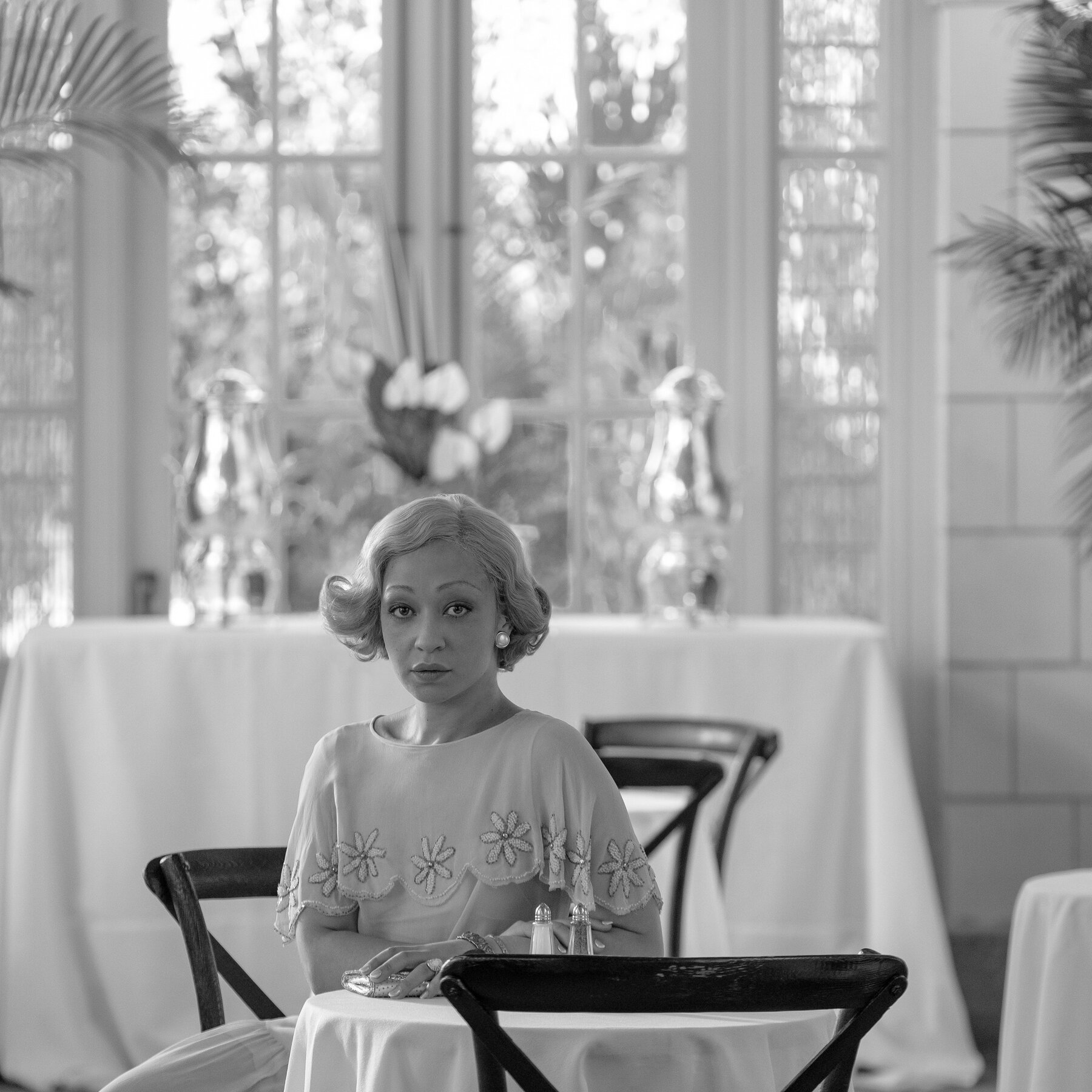
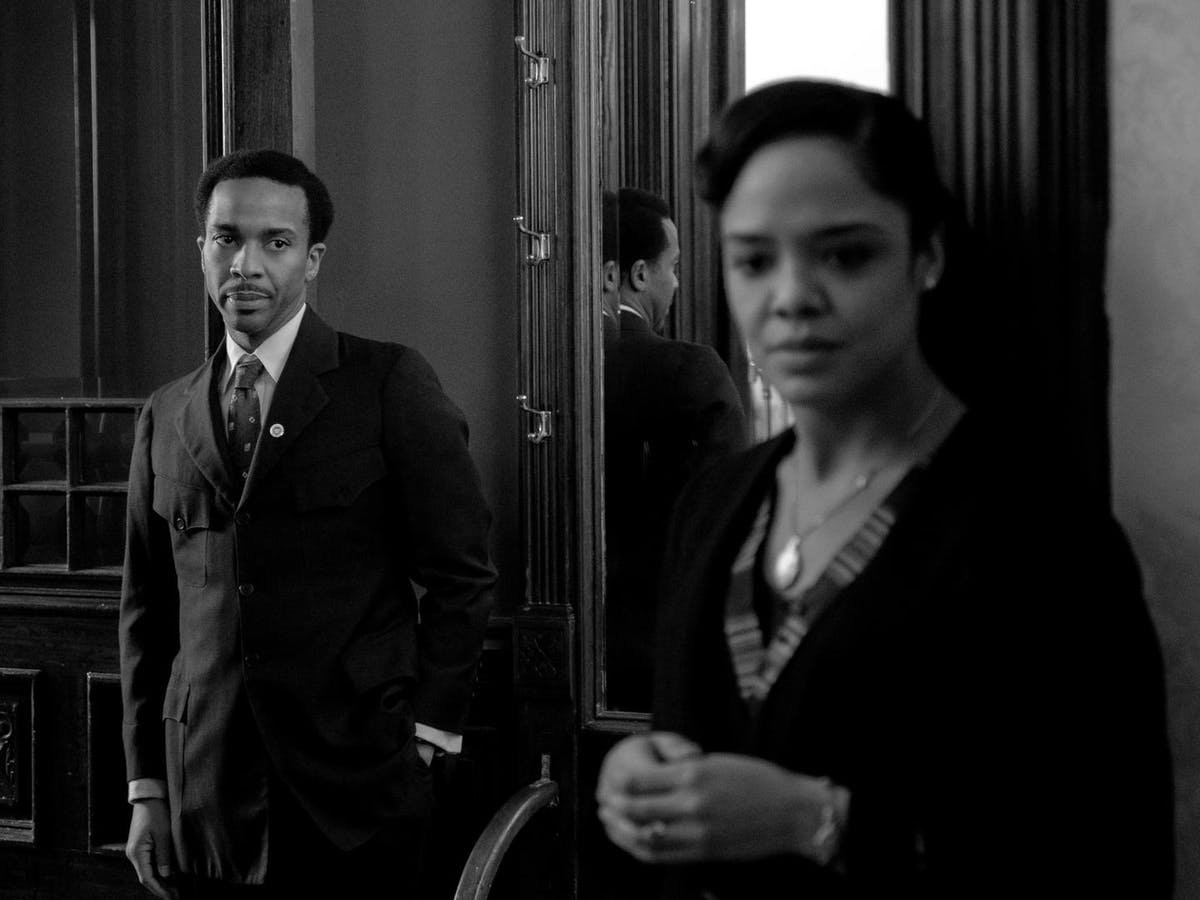
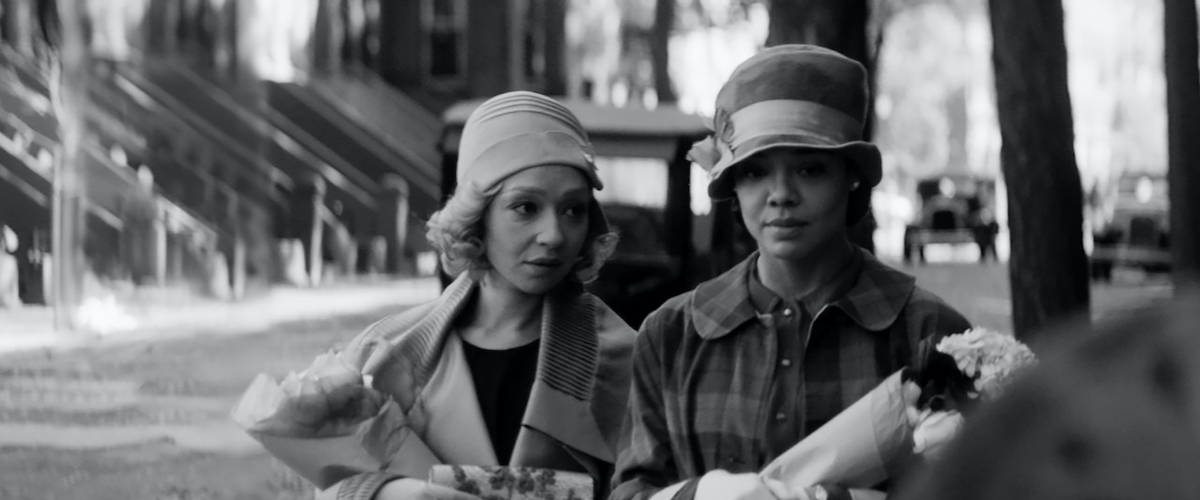
Rene (Tessa Thompson) is a well-to-do Black woman, the wife of successful doctor, Brian (André Holland). Rene occasionally passes herself of as white in order to gain access to the ritzy New York hotels and restaurants she likes to frequent, and that’s what she’s doing when we first encounter her. Sitting in a swish dining room, she is astonished to be greeted by a white woman as though she’s an old friend. Except this isn’t a white woman: it’s her old school chum, Clare (Ruth Negga), who she hasn’t seen in years and who has taken the art of ‘passing’ to the extreme. With her elaborately coiffed blonde hair and carefully rehearsed mannerisms, Clare has erased all traces of her former self. What’s more, she is now married to successful white businessman, John (Alexander Skarsård), who – it turns out – is a bluntly spoken racist, and has no idea about Clare’s origins.

Understandably horrified, Rene excuses herself and tries to forget the encounter, but soon learns that Clare is not a character who’s ready to be conveniently brushed under the carpet. It’s not long before she turns up at Rene’s house and begins to inveigle her way into her former friend’s life, charming Rene’s husband, her two boys, her maid and just about everyone else she is introduced to. Only Rene’s writer-friend, Hugh (Bill Camp), seems to see through her meticulously rehearsed charm-school routines. But then, as a novelist, he’s well attuned to the concept of spinning stories.

As Clare exerts her hold over Rene’s world, so Rene begins to perceive an unspoken threat that lies behind her old friend’s vacuous smile…

This is an accomplished film is so many ways. I love the ambiguity of it. Seen entirely from Rene’s point of view, we’re never entirely sure if Clare really is the threat she appears. Could it be that she has been acting a part for so long, she’s no longer conscious of how avariciously she presents herself? She clearly hankers after the kind of life her deception has denied her – but how far would she be willing to go to reclaim it? Are Rene’s fears merely a product of her mounting paranoia?

Nothing here seems set in stone; indeed, even the film’s tragic conclusion leaves us with many unanswered questions.

Thompson is terrific as the troubled Rene, and Negga wonderfully enigmatic as Clare. The era is convincingly evoked and it’s so refreshing to see a cinematic story about the pervasiveness of racism, even for those Black people not living in grinding poverty. My only issue with the film is the overuse of a jazz-inflected piano motif, which, though appropriate for the 1920s, becomes an irritating ear worm by the time I’ve heard it for the fifteenth time. It’s a minor quibble.

Passing is a fascinating story, effectively told and what’s more, as a debut feature, it’s no mean achievement.

4 stars

Philip Caveney

Dark Waters

01/03/20

This film is something of a departure for director Todd Haynes, a far cry from the languid luminosity of Carol or Far From Heaven. Instead, he offers us a compelling exposé, a true story told with a devastating urgency.

Because there’s no getting away from it: this is urgent. Based on Nathaniel Rich’s New York Times article, The Lawyer Who Became DuPont’s Worst Nightmare, it tells of corporate greed and negligence on a shocking scale. So far, so depressingly predictable. But there’s more: a dastardly cover-up designed to protect profits at all costs. And the costs are high.

DuPont is a massive company, and one of their most successful products is Teflon. Yes, that Teflon, the stuff that makes your pans non-stick and waterproofs your raincoat. There’s no denying its usefulness, nor its ubiquity. Unfortunately, it also turns out that there’s no denying the toxic nature of one of its components, namely PFOA, a ‘forever chemical’ that is very difficult to break down, no matter how it is disposed of. Not that DuPont have proved themselves too worried about its disposal: they’ve just dumped it in landfill, allowing it to pollute the water.

I should confess here that chemistry is not my strong point. Luckily, the script makes clear that hero lawyer Rob Bilott (Mark Ruffalo) is also a bit deficient in the arena of scientific-understanding; he needs the basics explaining, which gives us the chance to learn alongside him. Where Bilott does excel, though, is in the law – and in tenacity, morality and grit.

The movie is unflinching in its revelations, detailing Bilott’s response to farmer Wilbur Tennant (Bill Camp)’s out-of-the-blue request for help. Tennant is not Bilott’s typical client; he’s an environmental lawyer, yes, but of the corporate variety, more used to defending chemical companies than suing them. But Tennant’s evidence is both disturbing and irrefutable: DuPont’s landfill, bordering his farm, has visibly contaminated his creek; his cattle are sick and mad and dying at an alarming rate.

Despite DuPont’s attempt to forestall and stymie his investigations, Bilott persists, and discovers that DuPont have known about the potentially lethal nature of their product for decades. And it’s not just the cows: women working on the Teflon line have given birth to babies with distinctive facial deformities. It’s a poison.

It’s terrifying.

PFOA wasn’t a banned substance then. It is now. But lots of other, similar substances are not. And surely no one on earth is naïve enough to believe that there aren’t countless other companies committing countless other atrocities in pursuit of the mighty dollar, no matter how many of us are endangered by their greed? The 1% don’t even see the rest of us; we’re incidental to them, and if we’re damaged, we’re just collateral.

Yup, this is a spectacularly squalid and depressing tale, as dark and dingy as the cinematography. But there are a few beacons of hope: there is the irascible, taciturn Tennant; there is Bilott, his wife, Sarah (Anne Hathaway), and his boss, Tim Perp (Tim Robbins) – all determined to do the right thing despite the personal costs. A few good people really can make a difference.

And at least in the US they can reach a wide audience, via the robust journalism in some of their broadsheets and through their powerful movie industry. No wonder Todd Haynes felt he had no choice but to make this vital, disturbing film.

4.5 stars

Susan Singfield