Ben Kingsley

The Thursday Murder Club

01/09/25

Netflix

Oh dear. The first film of the month and it’s a stinker. I haven’t read Richard Osman’s best-selling novel (cosy crime isn’t really my thing) but I’m sure it deserves a better adaptation than this. His podcasts (which I do listen to) show him to be clever and erudite. This movie is neither.

All the right pieces are in play: popular source material, a stellar cast, the prettiest of English villages. There’s even cake – but sadly not enough to sweeten this twaddle.

The Thursday Murder Club comprises four wealthy pensioners: Elizabeth (Helen Mirren), Ibrahim (Ben Kingsley), Ron (Pierce Brosnan) and Joyce (Celia Imrie). They live in a stately home called Coopers Chase, which has been converted into the the most luxurious retirement apartments imaginable, and pass their time investigating the cold case files their fellow resident, Penny (Susan Kirkby), a former detective, has somehow managed to hold onto.

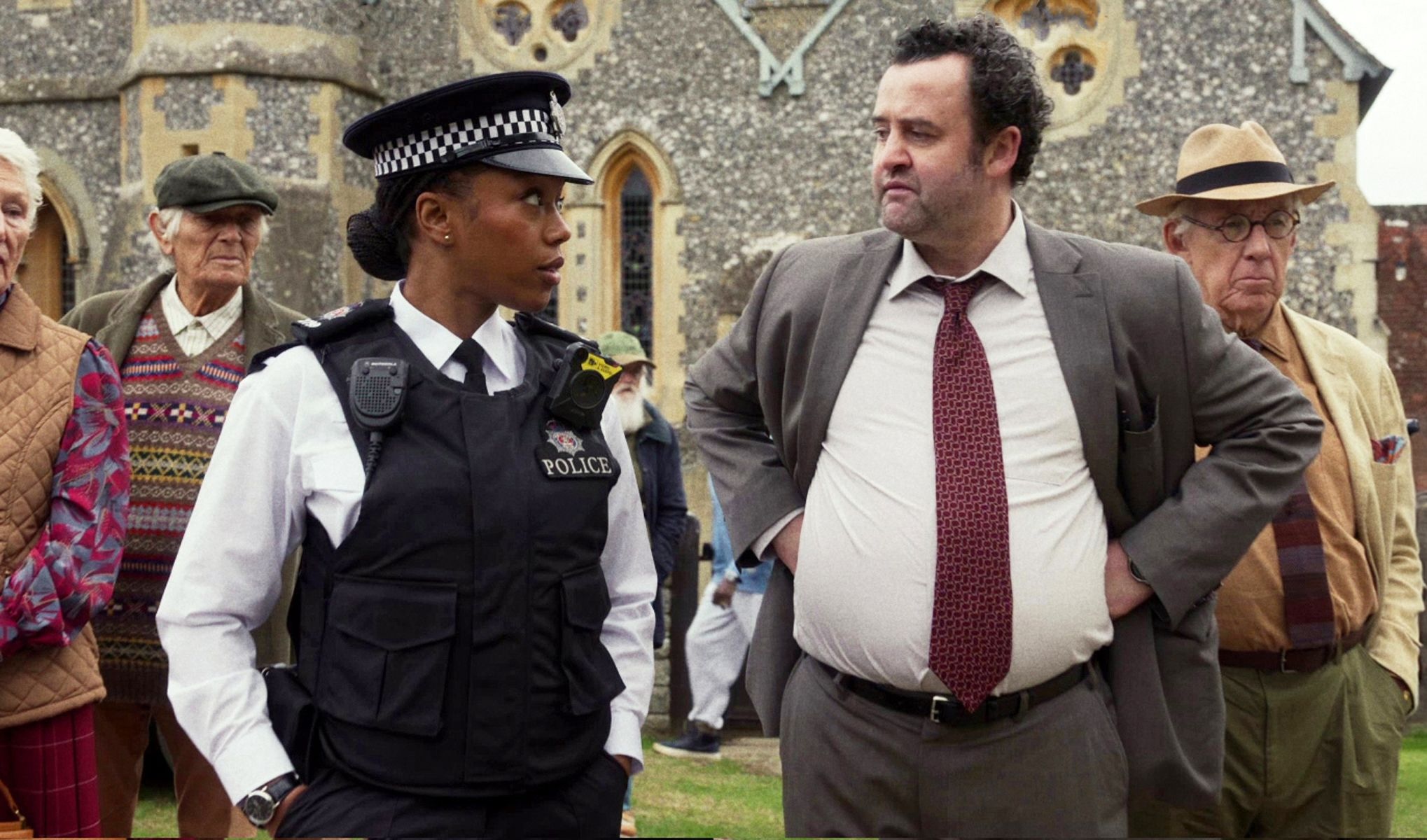
But when money-grubbing landowner, Ian Ventham (David Tennant), reveals his plans to redevelop Coopers Chase, murder is no longer confined to the past. The privileged pensioners can barely conceal their glee at having something real to get their dentures into, much to the dismay of local police officers, Chris Hudson (Daniel Mays) and Donna de Freitas (Naomi Ackie).

Amidst the lightweight sleuthing, some serious issues are raised, including people-trafficking and dementia. But these are hopelessly out of place, treated so glibly that it feels very uncomfortable. There’s some real snobbery at play here too, presumably unconscious: the working-class-man-made-good with his loud voice and tacky McMansion; the upper-class oldies with their mellow tones and oh-so-tasteful decor.

I want to find nice things to say because it’s Helen Mirren, for God’s sake. But hers isn’t even the most wasted talent – at least she’s in a lot of scenes. The wonderful Ruth Sheen barely gets a look in as Aunt Maud. (What’s the purpose of this character? She adds nothing to the plot.)

To quote a catchphrase that’ll only mean something to Gen X, here’s my suggestion: Just Switch Off Your Television Set and Go and Do Something Less Boring Instead.

2 stars

Susan Singfield

Roald Dahl/Wes Anderson

29/10/23

Netflix

A new film by Wes Anderson is always an interesting proposition. Four new films – the longest of which has a running time of just thirty-seven minutes – is a downright intriguing one.

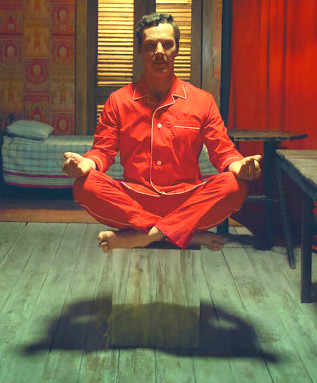
It must be said from the start that these are less motion pictures than illustrated stories (imagine, if you will, a kind of turbo-charged Jackanory and you’ll get the general idea). First up, there’s the aforementioned longest entry in the quartet, The Wonderful Story of Henry Sugar, which – to begin with – is told by Dahl himself (uncannily impersonated by Ralph Fiennes). The author begins to relate the story of the mysterious Imdad Khan (Ben Kingsley), a man who can see without using his eyes. Khan’s story is then picked up by two doctors (Dev Patel and Richard Ayoade) and they, in turn, transfer their attention to the titular character (played by Benedict Cumberbatch), a man who becomes obsessed with the notion of becoming an expert card cheat. (As you do.)

It’s all delivered as narration (at a breakneck pace) and, of course, the set dressing has the usual Anderson style: a series of exquisite puzzle-boxes, expertly linked together, opening and closing as the tale unravels. It’s beautiful to watch, but ultimately the story leaves me with a powerful sensation of so what?

The Swan (narrated by Rupert Friend) is, for me, the strongest narrative here, the distressing tale of a young boy called Peter (Asa Jennings), who is horribly bullied by a couple of local lads with access to a rifle (always a recipe for trouble) and which culminates in a poignant and rather distressing conclusion. The story is delivered by Friend as he wanders along a series of labyrinthine passageways and this is perhaps the most kinetic of the films.

The Rat Catcher features Fiennes as the central character, a rather creepy individual who visits a garage and offers his services to the proprietor (Friend again), while the tale is told by a narrator (Ayoade). The subtext of this one is rather less straightforward, as is the style. I can’t remember ever seeing an actor miming invisible objects in a film before! The rat catcher has assimilated all the qualities of the creatures he’s supposed to be eradicating and, when he fails in his attempts to locate them (in a haystack), he tries to make up for his failure in a demonstration of unpleasantness. Again, I feel that the story’s conclusion is rather underwhelming.

Finally there’s Poison, an account set in post-colonial India, in which Harry (Cumberbatch) lies in bed convinced that a krait (a venomous snake) is lying asleep on his chest and that the slightest move will cause it to bite him. A local police officer (Patel) and a doctor (Kingsley) are enlisted to resolve the situation and, to give them their fair due, they do their level best. The story culminates in a short and rather shocking demonstration of racism, which some viewers will find unsettling, but is surely the whole point of Dahl’s story – that former white rulers will always refuse to acknowledge their own failings. Strangely, Poison seems to have a similar theme to its predecessor.

With such brevity, it seems fairest to judge the four films as a whole – and indeed, Anderson has said that what attracted him to the idea is the notion that they comprise a kind of interlocking narrative. While this quartet is always visually compelling, I can’t help wishing that this inimitable director had settled on some better examples from Dahl’s extensive back catalogue. There are plenty to choose from.

If you have Netflix, they’re certainly worth clicking through. If nothing else, you’ll be charmed by their quirkiness and the uncompromising style that exemplifies Anderson’s approach to cinema.

3.4 stars

Philip Caveney

Shang-Chi and the Legend of the Ten Rings

14/09/21

Cineworld, Edinburgh

I’m somewhat late to this but the word is that Shang-Chi has been one of cinema’s biggest hitters – though the three other people in the audience for my showing doesn’t exactly suggest that Cineworld is being overrun.

This film is an important addition to the Marvel Universe in the same way that Black Panther was – and those like me, who are old enough to remember the impact made by the original Bruce Lee films, will understand how important it is that American Asians have their own superhero to root for. So here he is, played by the extremely likeable Simu Liu as ‘Shaun,’ an unassuming lad working in a valet at a hotel in San Francisco, parking the cars of rich customers, ably assisted by his best friend Katy (Awkwafina).

But Shaun has a secret. He isn’t quite as unassuming as he appears. He is, in fact, Shang Chi, the son of the ruthless – and immortal- Xu Wenwu (Tony Chiu-Wai Leung), the possessor of ten mystical golden rings that give him the power of a thousand men, enabling him to vanquish entire armies single-handedly. Always a useful thing. But when Shaun is attacked by a bunch of armed warriors on a bus, who have been sent by Xu to steal the fancy green amulet that Shaun has worn since he was a little boy, he begins to realise that his toxic dad is seeking to renew their acquaintance – and that Shaun’s sister, Xialing (Meng’er Zhang), is probably going to be drawn into his father’s orbit too. It’s time to stop pretending and step up to face the consequences.

The film opens well (once we’re past a rather po-faced introduction) and the aforementioned bus punch-up is nicely done, with Awkwafina providing some much-needed comic relief as the put-upon-friend in a difficult situation, but it isn’t very long before Shaun and Katy are off on a mission to the mystical village of Ta Lo, where an ancient community lives surrounded by mystical creatures and a helpful water dragon. They also meet Trevor Slattery (Ben Kingsley), a former actor, who can somehow talk to mystical creatures. (Again, file this one in the comic relief section.)

From this point, the story seems to ramp up the pomposity, as Xu Wenwu, who believes he’s being summoned by his late wife, arrives with an army of warriors in tow, intent on setting free an ancient evil dragon who has been locked away in some forbidden cavern… and a massive cosmic punch-up dutifully ensues.

I have to say that, in the film’s latter stages, it loses me somewhat. The stodgy, leaden feel of the story makes two hours seem like three and I feel sorry for the wonderful Michelle Yeoh, who is saddled with a ‘wise auntie’ role and is therefore required to say something profound every time she opens her mouth. While it’s clear that much money has been lavished on the CGI budget and it’s certainly a handsome film, but the final dragon-on-dragon conflict just seems cumbersome and goes on and on, until I’m reduced to checking my watch at regular intervals.

A final coda, with Benedict Wong summoning Shaun and Katy into the extended Marvel Universe, doesn’t feel remotely enticing and I’m unlikely to watch whatever comes next.

In the end, Shang Chi‘s main failing is that it can’t seem to make up its mind what it wants to be. As a kung fu kick- about, it works well enough, but director Destin Daniel Cretton seems intent on making it more than that, overburdening the film with meaning in order to cover all the bases and – for my money at least – he doesn’t really succeed.

3.4 stars

Philip Caveney

The Walk

MV5BNTY4MzA4Mzc5Nl5BMl5BanBnXkFtZTgwNDIzMzk5NjE@._V1_SX214_AL_

11/09/15

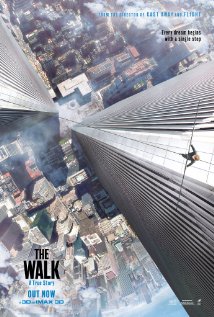
In 1974, tightrope walker Philippe Petit performed a stunt that defied belief. He strung a wire between the twin towers in New York (illegally) and walked backwards and forwards across it eight times while an entranced audience of passers-by watched in stunned amazement. The ‘Coup,’ as Petit called it, has of course already been the subject of a film, James Marsh’s riveting documentary, Man On Wire (2009), but Petit only had a couple of still photographers with him. So this is Robert Zemeckis’s attempt to reconstruct the event.

We open with Petit (Joseph Gordon-Levitt) talking directly to camera. Gordon-Levitt is a charming performer (considerably more charming than Petit himself who was famously unfaithful to his long-suffering girlfriend, Annie, played here by Charlotte Le Bon the night after the Coup, a fact that the film makers choose to ignore). Indeed, the charm offensive may be what skewers the early sections of this, as a young Petit conceives his dream of walking between the towers (in a dentist’s waiting room, as it happens), enlists the help of circus stalwart, Papa Rudy (Ben Kingsley) to teach him the secrets of wire walking – and mawkishly romances Annie, who, when we first meet her is a street performer, bashing out drippy ballads on an acoustic guitar. The tone here is too whimsical for what follows, too self consciously comic for comfort and at times it threatens to derail the film completely. Matters aren’t helped by one of the murkiest 3D prints I’ve ever seen, which sets the first half of the story in deep shadow.

The momentum is happily regained somewhat once Petit and his ramshackle bunch of accomplices actually set about trying to achieve their objective. This section is filmed like a heist movie, with the tension steadily rising as the team try to get everything in place for the walk.

The Coup itself is a hair raising, terrifying, vertigo-inducing nightmare. I sat there, desperately reminding myself that history has already assured us of the outcome of the exercise, but it was to no avail. I’m not particularly good with heights and watching Gordon-Levitt walk back and forth, kneel down and at one point lie down on that narrow steel cable must have taken several years off my life. If the rest of the film had been up to this standard, it would doubtless have been granted five stars much higher score.

As it is, that uncertain first half is hard to forgive, particularly when it’s coming from a director of Zemeckis’s stature. A warning though. If you genuinely suffer from vertigo, this really may not be the film for you.

3.9 stars

Philip Caveney