
05/09/24
Cineworld, Edinburgh
This assured adaptation of Alexandre Dumas’ classic tale feels like something of a throwback – a great big swaggering epic, set over decades, featuring lush locations, a selection of fascinating characters and enough action set-pieces to make its nearly three-hour running time positively flash by. Co-directed by Alexandre de La Patilliére and Mattieu Delaporte, who recently delivered an acclaimed version of Dumas’ The Three Musketeers (which I have yet to catch up with), The Count of Monte-Cristo is an unqualified delight from start to finish.
The plot is complex. The chaotic opening has humble sailor, Edmond Dantès (Pierre Niney), rescuing a woman from a sinking ship, much to the chagrin of his Captain, Danglars (Patrick Mille), who has ordered him not to dive in. But Edmond’s valour is rewarded when he finally gets back to port. Danglars is summarily sacked by the ship’s owner and Edmond is offered the post of Captain, which means he is finally able to propose to the woman he loves. Mercedes (Anaïs Demoustier) comes from an affluent family and her parents would never countenance her marrying a lowly seaman. But a Captain? That’s another matter.
On the couple’s wedding day, Danglars has his revenge, claiming that he has evidence that Edmond is a Napoleonic spy. He conspires with Edmond’s “friend” Fernand de Morcef (Bastien Boullion) and Gérard de Lafitte (Laurent Lafitte), a crooked magistrate, to ensure that the accusation sticks.On what should be the happiest day of his life, Edmond is flung into jail, where he has the prospect of spending the rest of his days.
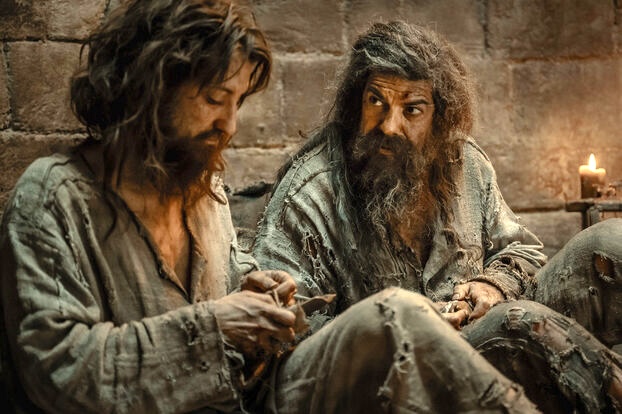
For four years, he has no contact with another human, but one day befriends another prisoner, Abbé Faria (Pierrefrancesco Favino), who claims to be the heir to a fantastic treasure. He explains that all the the two men need to do is dig their way out of the prison and they will share a fortune. But when – ten years later – Edmond finally makes his escape, the treasure is all his for the taking – and he is free to plan his elaborate revenge on Danglars and his co-conspirators…
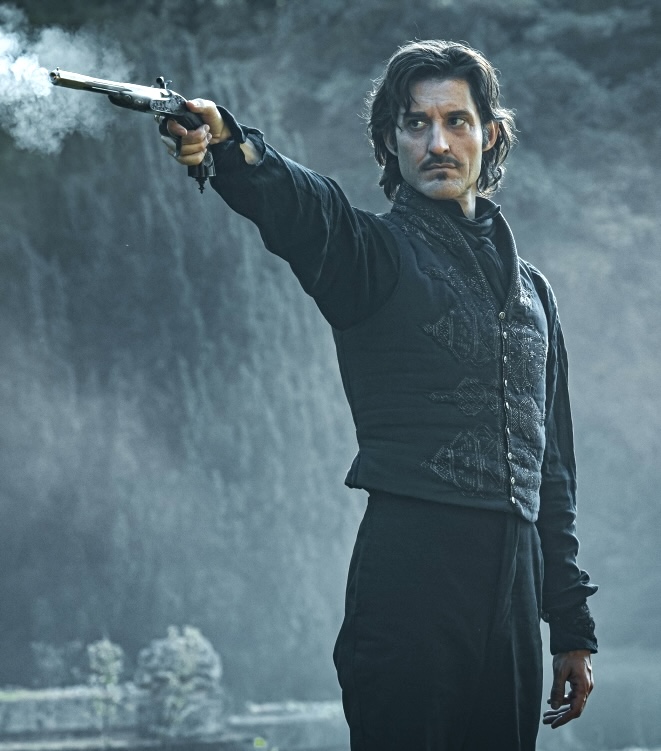
If that sounds convoluted, fear not, because this beautifully-mounted production never leaves me in any doubt as to who is who and how they all relate to one another. There are some fabulous performances here, not least from Niney, who manages to convey the awful longing for vengeance which he has nurtured for so long – and I fully sympathise with his determination to make his revenge as protracted and heartless as possible. Nicolas Bolduc’s sumptuous cinematography and Jérôme Rebotier’s magnificent score make the whole undertaking even more impressive. I love too that, for once, a story of revenge is so much more nuanced than the usual shoot ’em up nonsense.
The only element here that requires me to suspend my sense of disbelief is when Edmond uses a series of Mission Impossible-style masks to disguise himself as a variety of different characters. It seems unlikely that – in that era – prosthetics could have been brought to quite such a fine art, but it’s a detail I’m happy to accept when every other element is so faultlessly achieved.
The sad truth is that an adaptation of a French classic (with those dreaded subtitles) is probably not going to put an awful lot of bums on cinema seats – a tragic state of affairs, considering how generally brilliant this is. Anyone longing for a slice of old-fashioned adventure will appreciate this wonderful, multilayered saga.
4.8 stars
Philip Caveney


 Bouquets & Brickbats