Armando Iannucci

Dr Strangelove: National Theatre Live

29/03/25

Cineworld, Edinburgh

In 1964, I watched Stanley Kubrick’s dark satire, Dr Strangelove, in an RAF cinema somewhere in darkest Lincolnshire. I was thirteen years old, arguably a bit too young to fully appreciate its biting satire, but I remember being absolutely terrified by the apocalyptic ending, which left me feeling decidedly nervous about the world’s future.

Fast forward to the early 1980s, where I attend a stand-up gig at the Old Grey Mare pub in Didsbury, Greater Manchester. Friends have encouraged me to go along and catch a gifted young impressionist called Steve Coogan, who they predict ‘has a promising future ahead of him.’ It costs me fifty pence to get in and the funniest routine is the one where Coogan adopts the persona of a BBC reporter, commentating on a live tragedy unfolding in… er… Camberwick Green.

What I could never have predicted is that in 2025, Coogan would be starring in an adaptation of Kubrick’s film, adapted by Armando Iannucci from the original screenplay co-written by Kubrick and Terry Southern – and, perhaps more pertinently, that a story that played like an outrageous spoof in the 1960s feels suspiciously like a cautionary warning in the present day.

Brigadier General Jack D Ripper (John Hopkins) has a paranoid breakdown and orders a B52 bomber, piloted by Major TJ ‘King’ Kong (Coogan, in one of four roles) to drop a nuclear device on a target in the Soviet Union. President Merkin Muffley (also Coogan), after being briefed by General Buck Turgidson (Giles Terrera), finds himself presented with the tricky task of contacting the Russian President to warn him of the incoming attack. The Russian premier is understandably not too happy about the situation, especially when he learns that the aircraft is maintaining complete radio silence, and that the attack can therefore not be called off.

A whole series of disastrous events ensue…

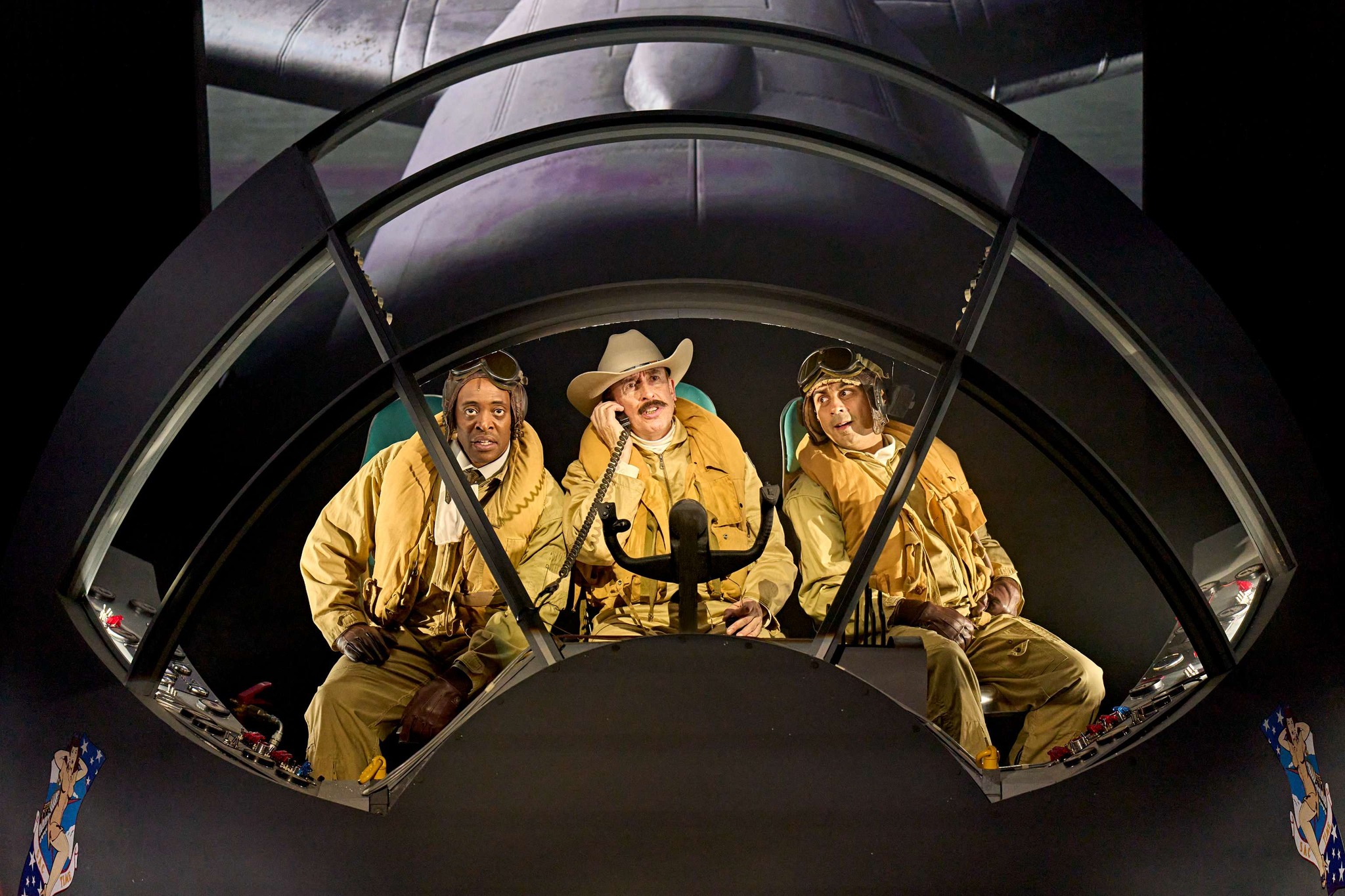
This brilliantly-staged production is a weird hybrid – part play, part film – and at times it is astonishing in its sheer invention. Coogan is extraordinary. Like Peter Sellars before him, he also takes on the role of RAF officer Group Captain Lionel Mandrake and, of course, the titular Dr S, a man who can’t seem to stop himself from making involuntary Nazi salutes… (Now where have I seen that recently?) Some of the lightning-fast costume changes he’s obliged to undergo are so slickly done that I’m left gasping.

But it’s not just Coogan who excels here. Hopkins plays the cigar-chomping, alpha male, Jack D Ripper with panache, while Terrera milks plenty of laughs as the scheming, self-serving Turgidson. There’s a huge cast at work here and every one of them is drilled to perfection.

Hildegard Bechtler’s set design is accomplished, opening and closing to disclose a wild variety of settings, even managing to convincingly place the audience in the cockpit of a B52 bomber, flying over mountainous terrain. Iannucci handles the adaptation with a light touch, capturing the original film perfectly and only occasionally tweaking the script to accommodate more recent references.

You don’t have to have seen the original to appreciate this superb production, but it might prompt many to investigate it on streaming. Kubrick made many great films over his long career and was famously pernickety about his work. But I have no doubt that he would be absolutely delighted by what director Sean Foley and his team have done with what could be the filmmaker’s greatest achievement.

5 stars

Philip Caveney

The Personal History of David Copperfield

21/01/20

I arrive at the cinema expecting great things. The trailer for Armando Iannucci’s The Personal History of David Copperfield promises a rollicking ride through one of Dickens’ best loved tales, and I’m excited to see how it unfolds.

The promise is kept: it is a rollicking ride. A bit too rollicking, if I’m honest, careening  through the 350,000 word novel at breakneck speed. Well, it’s a lot to fit into two hours. There’s nothing here I’d lose – no padding or filler required – but I’d be tempted to add an extra thirty minutes to the running time, just to give the story space to breathe.

Dev Patel is the eponymous hero of his own life, and very good he is too, all genial affability despite his social-climbing and urgent need to impress. Born a gentleman, he’s forced into poverty when his widowed mother remarries, and his stepfather (Darren Boyd) takes against the boy. Young David is not too worried at first: the poverty he’s witnessed so far – visiting Peggotty’s quirky, loving family in their upturned boat/house – has given him a romanticised impression of the working person’s lot. A back-breaking job in a bottle factory soon disabuses him of this worldview, and he determines to find a way to live a better life.

Tilda Swinton and Hugh Laurie form a show-stealing double-act as David’s aunt Betsey Trotwood and her cousin Mr Dick respectively; in fact, there are almost too many perfectly-captured vignettes featuring too many wonderful actors. There’s Anna Maxwell Martin playing school mistress Mrs Strong – whoosh! There’s Benedict Wong as the ever-thirsty Mr Wickfield, and Rosalind Eleazar as his daughter, Agnes – whoosh! Daisy May Cooper’s Peggotty is warmly, wittily portrayed; Morfydd Clark’s Dora Spenlow a frothy, silly delight. I do like the sense of breathless chaos: the lack of deference to period drama genre-norms; the diverse casting that proves it can (and should) be done. There’s just no time to focus in on anything before it’s gone.

In short, each scene is beautifully rendered; each character cleverly drawn. But the story feels a little superficial, with none of the darkness or political poignancy of Dickens’ semi-autobiographical novel.

3.8 stars

Susan Singfield


The Death of Stalin

23/10/17

If there was a prize for ‘Most Unlikely Subject for a Comedy’, the death of Russian premier Joseph Stalin would probably figure on the list of prime contenders. I mean, how amusing can that actually be? But Armando Iannucci clearly isn’t interested in such preconceptions. Against all the odds, he’s fashioned a funny and subversive entertainment from this unpromising source, based on the graphic novel by Fabien Nury.

It’s March, 1953, and Russia is cowering under the brutal regime of ‘Uncle Joe’ Stalin. People can be rounded up and shot for the most spurious of reasons – perhaps they’re intellectuals. Perhaps they belong to the wrong organisation. Perhaps their faces just don’t quite fit. The atmosphere of paranoia is amply portrayed in the film’s opening sequence, where radio director Comrade Andryev (Paddy Considine), is forced to restage a live performance by a symphony orchestra, simply because Stalin has phoned up and asked for a recording of it – and unfortunately no such recording has actually been made. ‘Don’t worry,’ Andryev assures his bemused audience as he ushers them frantically back to their seats. ‘You won’t be killed. I promise.’

Armando Iannucci’s comedy of terrors is a brave and wonderfully assured undertaking, finding comic mileage in the absurdity of day-to-day existence under the jackboot of a tyrant – and from the unexpected possibilities that are unleashed when that tyranny finally comes to an end. When Stalin unexpectedly drops dead from a heart attack, the various members of his government begin the complex task of jockeying for position in the new order and the results are a joy to behold.

The film has been criticised in some quarters for its lack of authenticity, but to be fair, there’s no real attempt to make it feel authentic. Characters talk in a mix of accents from regional British to (in the case of Steve Buscemi’s Nikita Krushchev) broad American, and the script misses no opportunity to go for a well-timed belly laugh.  

The cast is stellar – I particularly like Simon Russell Beale as head of the secret police, Lavrentiy Beria, a smiling assassin who hides his vile nature under a mask of cheerful bonhomie. Jeffrey Tambour is also excellent as Georgy Malenkov, Stalin’s second in command, who suddenly finds himself simultaneously having to lead the country in its collective grief and incapable of coming to a rational decision about anything. Rupert Friend has a lot of fun with the role of Vassily, Stalin’s loose-canon, vodka-swilling son. But the film’s undoubted comic highlight is Jason Isaacs as straight talking ‘Marshall of the Soviet Union’, Georgy Zhukov, the hilarity aided no end by the fact that he talks with a pronounced Yorkshire accent. I’ve no idea why that’s so funny, it just is.

Okay, so this isn’t quite the comic masterpiece that some have dubbed it. The film suffers somewhat from the age-old problem of having nobody in particular to root for, since they all appear to be lying, double-dealing creeps – unless of course, you count Olga Kurylenko’s Maria Yudina, a concert pianist who seems to be the only person in the film brave enough to speak her mind about Stalin’s cruelty; but hers is a cameo role, acted out on the sidelines. The only other character we remotely care about is Stalin’s hapless daughter, Svetlana (Andrea Riseborough), who can only watch the carnage that unfolds in the wake of her father’s death and hope against hope that she’ll somehow make it out of there alive.

Weighing in at a relatively sprightly 106 minutes, The Death of Stalin is a clever and accomplished movie, well worth investigating. This is Iannucci playing to his strengths as a political satirist and mostly coming up with the goods. Interesting though, that despite a script peppered with crackling dialogue, the film’s funniest scene is an entirely visual one. Go figure.

4.2 stars

Philip Caveney