Animation

Spring Awakening

12/03/25

Bedlam Theatre, Edinburgh

It’s mind-blowing to think that Frank Wedekind’s Frühlings Erwachen was written in 1890, when Kaiser Wilhelm II ruled the Deutsches Reich, Queen Victoria was on the British throne and Robert Gascoyne-Cecil (nope, me neither) was our PM. In a world where women weren’t even allowed to show their ankles, it’s not surprising that it was sixteen years before someone dared to stage this controversial exposé of the dangers of repression, with its bold depictions of teenage sexuality – not to mention rape, suicide and abuse.

Steven Sater and Duncan Sheik’s musical adaptation premiered on Broadway in 2006, exactly one hundred years after Wedekind’s play finally opened at Berlin’s Deutsches Theater, under the direction of Max Reinhardt. Despite the addition of some banging rock songs and more than a few profanities, this modern version actually pulls more punches than the original, most notably by omitting the rape and softening the ending. Nonetheless, it still has the capacity to shock, and to remind us that we make sex dangerous by hiding it, by making it taboo.

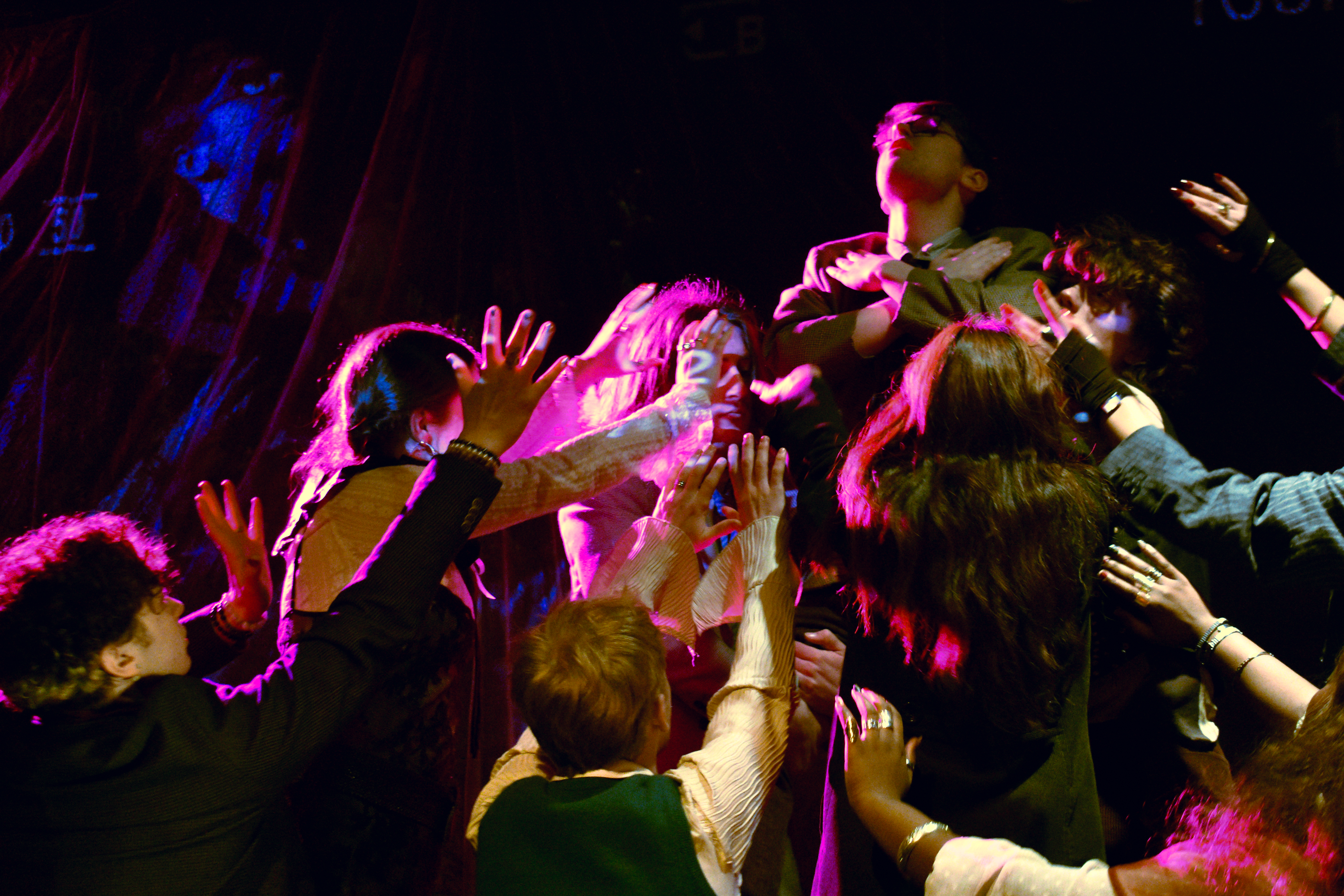
Set in 19th century Germany, this is a story about a group of young people coming of age under the stifling weight of moral expectations. Wendla (Hattie Sumners) asks how babies are made. Scandalised, her mother (Sophie Davis, who plays all the adult women) first shouts and then equivocates, condemning her daughter to an ignorance which will have severe consequences. Meanwhile, Moritz (Shaun Hamilton) is struggling to keep up with his schoolwork, and fear of failure takes him to a devastating place. Melchior (Daniel Fischer) seems stronger than the others: thanks to a combination of intelligence and a liberal mother, he’s more knowledgeable than his friends, and therefore better equipped to cope with life. Still, the authoritarian regimes of school and church soon drag him under too; no one is safe in this society.

Theatre Paradok’s production succeeds in conveying those most fundamental of teenage emotions: exuberance and despair (I’m guessing the student cast don’t have to dig that deeply to remember how raw and overwhelming those feelings can be). Sheik’s eclectic soundtrack is beautifully interpreted by musical directors Nonny Jones and Ruairidh Nicholson, the choral numbers being particularly impressive. The live band – hidden in the wings – are terrific, and plaintive solos by Sumners, Gemima Iseka-Bekano (Ilse) and Hamilton evoke some strong responses.

The show’s aesthetic is great. I love the androgyny of the costumes, with feminine dresses worn over masculine suits; the queer coding is fabulously done. The set is simple but very effective: items of underwear are stapled to a curtain framing a large gauze backdrop, onto which short animations and live videos are projected, creating an ethereal doubling effect and amplifying the characters’ emotions.

Directors Rue Richardson and Jane Morgan manage their large cast with aplomb. The play is dynamic and visually very appealing, from the arresting choreography (by Františka Vosátková, along with Richardson, Morgan and Andrea Adriana Prawono) to the boisterous shenanigans of the teenage boys. The gauze curtain makes metaphors literal: dead characters appear from ‘beyond the veil’, while ‘a veil is drawn’ over Wendla and Melchior’s lovemaking. However, Ernst (Michael Butler) and Hänschen (Max Middleton)’s homosexual relationship is placed boldly centre-stage – perhaps a subtle nod to the idea that some things shouldn’t be re-closeted.

I do have one criticism, and it’s the emergency exit door, stage left, which is open to the elements. Bedlam is a chilly venue at the best of times; tonight, with an outside temperature of 1°C, I could do without sitting in a freezing draught. And it’s not just the cold that’s a problem, there’s the noise of the city too: traffic and sirens and people passing by, all making a claim on my attention. I can see that the options are limited by the need to house the band, but – for the sake of one entrance and one exit – it’s surely not worth making the audience so uncomfortable.

Nevertheless, this production of Spring Awakening is a triumph: a lively, thought-provoking piece of theatre, as relevant now as it was more than a century ago.

4.2 stars

Susan Singfield


Your Name

15/01/20

We missed this smash hit by Makoto Shinkai on its release in 2016, but tonight’s double bill at the Cameo – pairing Your Name with his latest release, Weathering With You – gives us the opportunity to find out what the fuss was all about.

And wow. Each critical superlative, every bit of box-office lucre, is completely merited. Shinkai is, indeed, a worthy successor to Hayao Miyazaki, recently retired head of Studio Ghibli. This is a beautiful animation.

Mitsuha (Mone Kamishiraishi) is a teenage girl, living in the remote rural village of Itomori. Mitsuha feels stifled by her strict father, and by the ancient rituals she is obliged to follow. She dreams of being ‘a boy in Tokyo,’ with the freedom to do what she wants in a bustling city.

And sometimes, it seems, dreams can come true, because Mitsuha wakes up one day in an unfamiliar room – and body. She’s switched places with Taki (Ryûnosuke Kamiki), and suddenly finds herself forced to negotiate the intricacies of a stranger’s life. Where is his school? Who are his friends? Mitsuha embraces the opportunity to hang out in café bars and flirt with Taki’s colleague, Ms Okudera (Masami Nagasawa), at his part-time restaurant job. She relishes the new experience.

Taki, meanwhile, is less enthusiastic about the change, although he can’t help enjoying playing with ‘his’ breasts, much to the outrage of Mitsuha’s younger sister, Yotsuha (Kanon Tani). Still, he goes along with it; what option does he have? And, before long, the teens have navigated a way through their intermittent body swaps, using their cell phones to log notes and reminders to keep things running (relatively) smoothly. I particularly like the way suspense is generated via a repeated motif where their lives almost collide.

So far, so seen-it-done-it-Freaky-Friday, but Shinkai’s movie has another layer, a deeper, more engaging heart, encompassing (without saying too much) fate, time travel and natural disaster. It’s compellingly told, with warmth and sincerity.

But it’s the animation that really makes this film. It’s breathtakingly gorgeous, with a clear delineation between the hard lines of the city and the sumptuous, lush countryside. At times photo-realistic, at others impressionistic, each frame is perfect, each hand-drawn image exquisitely realised.

A masterpiece.

5 stars

Susan Singfield

The Red Turtle

29/05/17

I have to confess to having a bit of a blind spot for animation.  I sometimes have to cajole myself into going along to see one, even though I invariably enjoy myself when I make the effort. I loved Inside Out, for instance – heck, I really liked Frozen, before it became so… over-exposed.

The Red Turtle is more than just another cartoon – it’s a game changer, quite unlike any animated film I’ve seen before. This canny co-production between Japan’s Studio Ghibli and Dutch animator Michael Dudok de Wit seems to exemplify the best traditions of east and west. The Japanese influences are there in the sumptuous forests and the watercolour-like depictions of the landscape – yet the graphic characters could have stepped straight out of the pages of a Herge cartoon. Almost completely wordless but blessed with a sumptuous soundtrack to make up for it, this is fabulous stuff – a powerful and affecting meditation on life, love and adversity.

A man finds himself a castaway on a remote desert island. He spends a lot of time looking for signs of life and when he fails to find another human there, he starts building rafts in an attempt to escape – but his encounters with a mysterious red turtle ensure that he repeatedly ends up right back where he started. As the story unfolds, the man begins to realise that the turtle isn’t what he first thought it was…

It would be criminal to give away more of the plot. Suffice to say that this beautiful allegory, which clocks in at a pacy 80 minutes, will thrill you, amaze you and, unless you’re the most stoic person on the planet, have you in tears at its heartfelt conclusion. For this is a parable about life and there will be elements here that every viewer will identify with. Just in case I’m making this sound a bit too po-faced, let me tell you that there are a family of crabs living on the island, whose playful antics deliver regular doses of comic relief.

The Red Turtle may well be the perfect antidote for people who don’t much care for animation. But those who love the format will have a field day too, because this is an absolute delight that deserves to reach the widest possible audience.

4.6 stars

Philip Caveney