

08/08/25
Gilded Balloon Patterhoose (Big Yin), Edinburgh
“I went to primary school with Baylie Carson’s stepmum.”
I know, it sounds like a Fringe show title, but it’s not. It’s just a fact. Summer 1982, North Wales: while the rest of our class dealt with the big move to high school, Kerry faced a more exciting change, emigrating all the way to Australia. And now, more than forty years later, I’ve climbed the stairs to the third floor of Edinburgh’s Patterhoose to see her stepdaughter perform. It’s a tenuous connection, but feels oddly significant. It’s lovely to see our peers succeed, and somehow even more lovely when it’s their children doing well.
And Carson is doing really well, recently appearing in West End productions of SIX (Anne Boleyn) and Mean Girls (Janis). They’re in the ascendant.
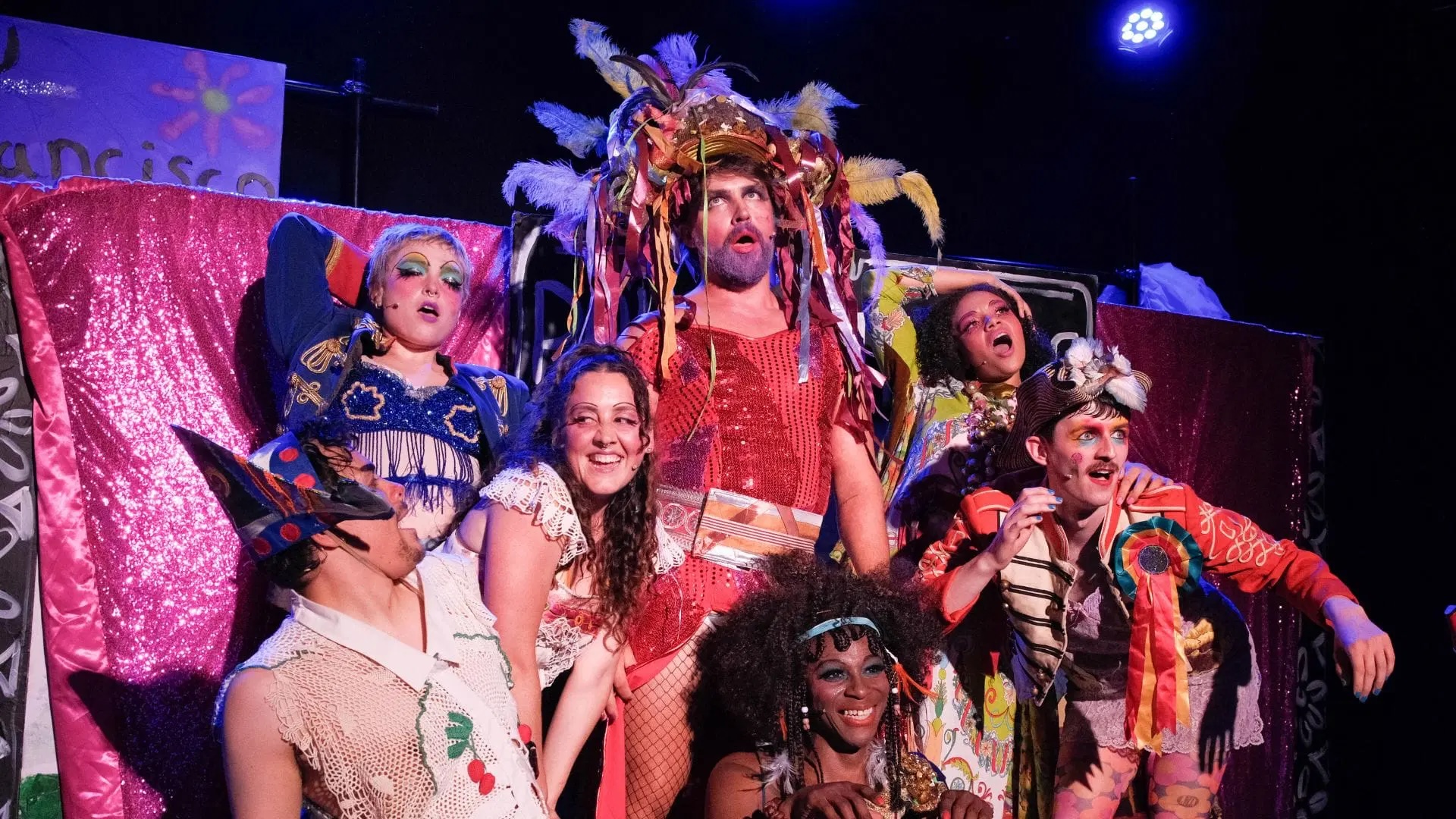
But tonight they’re here, part of a sequin-clad ensemble bringing the little attic room to life with this sparkling production of Midnight at the Palace.
The musical is based on a true story. It’s the late 1960s and San Francisco’s counterculture is booming. Radical Hibiscus (Andrew Horton) and disco-diva Sylvester (Gregory Haney) lead a ragtag group of hippies, freaks and drag-queens, known as The Cockettes, whose performances at the North Beach’s Palace Theater are legendary. As the group becomes successful, however, tensions begin to rise, especially when they get the chance to appear in New York. While the others are drawn by the allure of Broadway, Hibiscus believes that ambition corrupts. He wants to stay in California, true to his ideals, performing for free, refusing to be co-opted by ‘The Man.’
Perhaps to its detriment, Rae Binstock’s book doesn’t really focus on the conflict, but Brandon James Gwinn’s music is great, with some really catchy, memorable songs. The piece works best as a celebration of queer culture: the gaudy costumes and home-made props a riot of colour and joy; the vivacious performers full of sass and vim, gleefully waving two fingers at the normies, swallowing acid and quaaludes; singing, dancing, shagging around. However, there’s not much of a storyline, and it’s a shame that the fascinating political undercurrents are only referenced rather than explored.
Carson is a standout as Pam, the sweet country girl with a yearning for excitement, who hitches her way to The Golden City to find a family of friends. Their song Take Me Home is a highlight of the play. Haney is also fabulous as Sylvester, dominating the stage, while Horton’s A Crab on Uranus is a visual delight. I also really like the puppetry (John Waters and Divine are particularly amusing), and am mightily impressed by the dynamic dance routines Paul McGill manages to choreograph on such a small stage.
Midnight at the Palace is a blast: a spectacular, gender-bending kaleidoscope of fun.
4 stars
Susan Singfield


 Bouquets & Brickbats