Amy Schumer

The Humans

04/12/22

Netflix

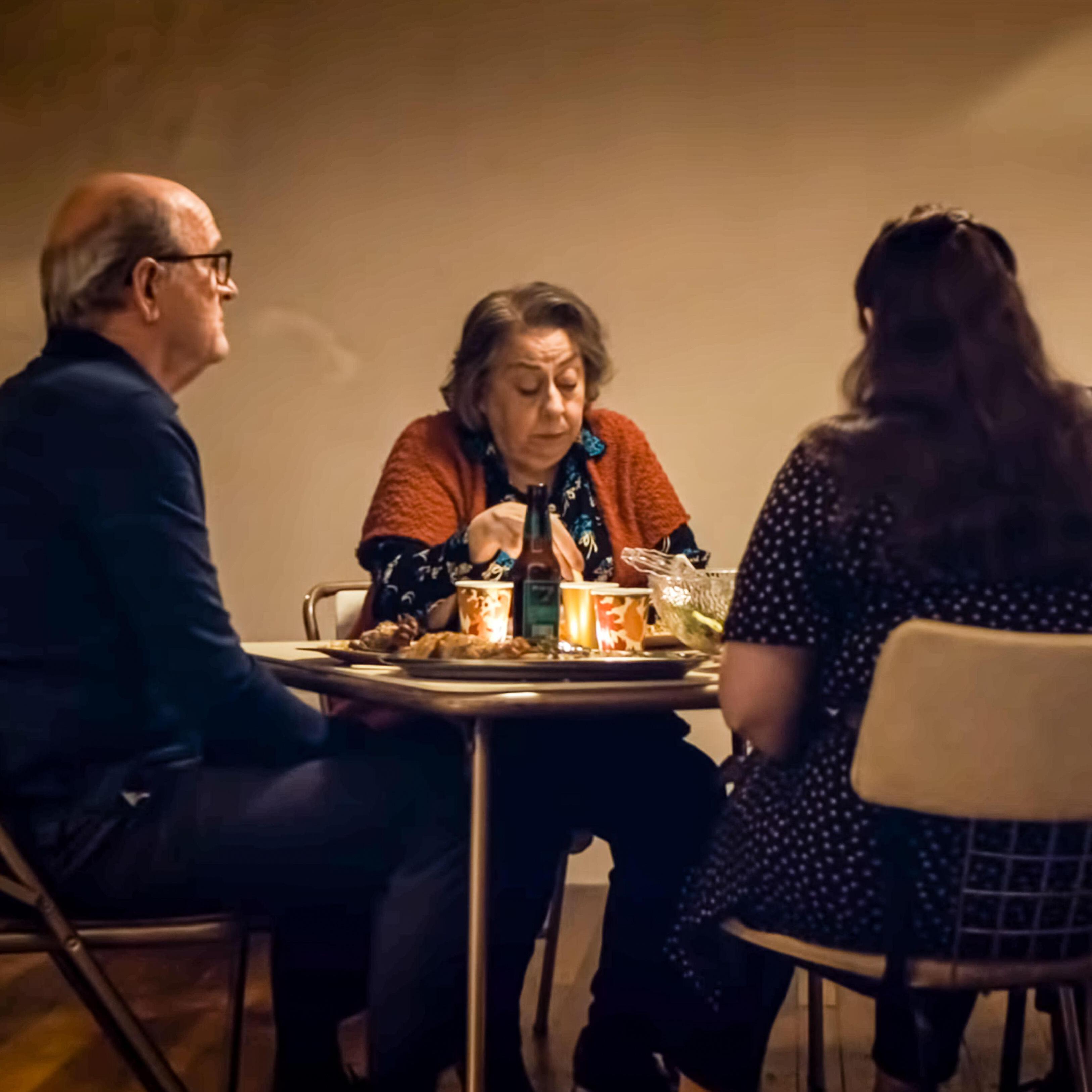
Adapting a stage play into a film can be fraught with difficulties and it’s not often that one manages to rise above the strictures that such a process imposes. The Humans is playwright Stephen Karam’s attempt to do exactly that with his Tony-Award winning drama. His ‘opening out’ procedure is to use the apartment where the action takes place almost as an extra character. As the extended Blake family go about trying to celebrate Thanksgiving, the ugly, ramshackle new home of Brigid (Beanie Feldstein) and Richard (Steven Yeun) has all the grim oppressiveness of a traditional haunted house. We watch the family conversing at the end of a filthy corridor or crammed into an awkward corner. The camera lingers on blistered plaster and rusting metal. It’s almost as though the place is sentient and spying upon them. The sense of impending dread is palpable.

But this is far from being a straightforward ghost story. The Blakes are haunted by their own sense of failure. Patriarch Erik (Richard Jenkins) seems obsessed with the idea that something bad is going to happen, and often refers to the near miss the family experienced with the tragedy of the Twin Towers. His wife, Deidre (Jayne Howdishell), laments another slip-up with her Weight Watchers schedule, while Brigid announces that she hasn’t managed to secure a grant to fund her career as a musician and will have to contemplate working in retail. Brigid’s sister, Aimee (Amy Schumer) is suffering from a debilitating illness and has broken up with her girlfriend, while Richard refers to mental health issues back in his youth. And Erik’s mother, Momo (June Squibb), sits in her wheelchair and unleashes the occasional string of what appears to be rambling gibberish…

The Humans is nobody’s idea of ‘a fun night as the flicks’. Indeed, it’s tortuous, uncomfortable and, at times, dismaying. And yet, it manages to exert a slow, powerful grip on me, as the tension slowly rises to boiling point. If there is no real resolution to the mess of unconnected distress that’s unearthed at the Thanksgiving from Hell, it should also be said that, in its own way, it’s a cinematic offering like no other and – to my mind – that makes it well worth checking out.

3.8 stars

Philip Caveney

I Feel Pretty

13/05/18

I have to admit, my expectations are low for I Feel Pretty. I’ve seen the trailer, and it all looks a bit… silly. I’ve read reviews too, and they’ve not been kind. Amy Schumer, according to some critics, is just too conventionally pretty and relatively slim to convince as an ugly duckling. To these commentators I say just this: I think that’s the whole point.

Because Renée (Schumacher) isn’t supposed to be hideous. She’s just ordinary. She looks fine. But she doesn’t look the way she wants to; she doesn’t fit the image she sees held up as an ideal – an image she’s exposed to even more than most people, because she works for a cosmetics company. Her self-esteem is so low she can’t look people in the eye, whether she’s trying to order drinks in a bar or give her shoe size to a clerk. But a drunken trip to a wishing well followed by a bang to the head in an exercise class give Renée a new-found confidence: when she looks in the mirror, she sees a supermodel. To everybody else she looks just the same; her friends are dumb-founded when she talks about how much she’s changed. But her self-belief yields positive results: the new, bold version of Renée is go-getting and popular. The message, it seems, is a simple one: believe in yourself and others will follow suit.

It’s a sensible message, and Schumer is a strong performer: funny and engaging and easy to like. A shame, then, that the film is so muddled, that – after a strong opening third – it flounders, and seems to lose its way. Take Renée’s first date with Ethan (Rory Scovel), for example. He’s a great character, and their relationship is touching. But the bikini contest (which Renée enters on a whim) is a baffling mis-step, which seems to undermine any positive message about female body image and empowerment that the film lays claim to. How can this ‘baying-men-decide-who’s-the-hottest-girl’ competition fit with that narrative?

There are other issues, mostly of credibility. Why is Renée so needlessly cruel to her friends (Aidy Bryant and Busy Philipps)? It doesn’t seem in keeping with the character (I know she’s been transformed, but it doesn’t match any of her other behaviour, even after the change). And the saccharine ‘we’re all beautiful’ ending makes me want to puke. I mean, c’mon. All this for that?  It’s depressingly trite.

Still, there are redeeming features. Michelle Williams shows once again what a chameleon she is; I hardly recognise her at first as squeaky-voiced company director, Avery LeClaire. A lot of clichés are successfully avoided: the fashion folk are not all vacuous and bitchy; the ‘beautiful’ women are as real as the ‘plainer’ ones. It’s eminently watchable. It’s just not very good.

3 stars

Susan Singfield