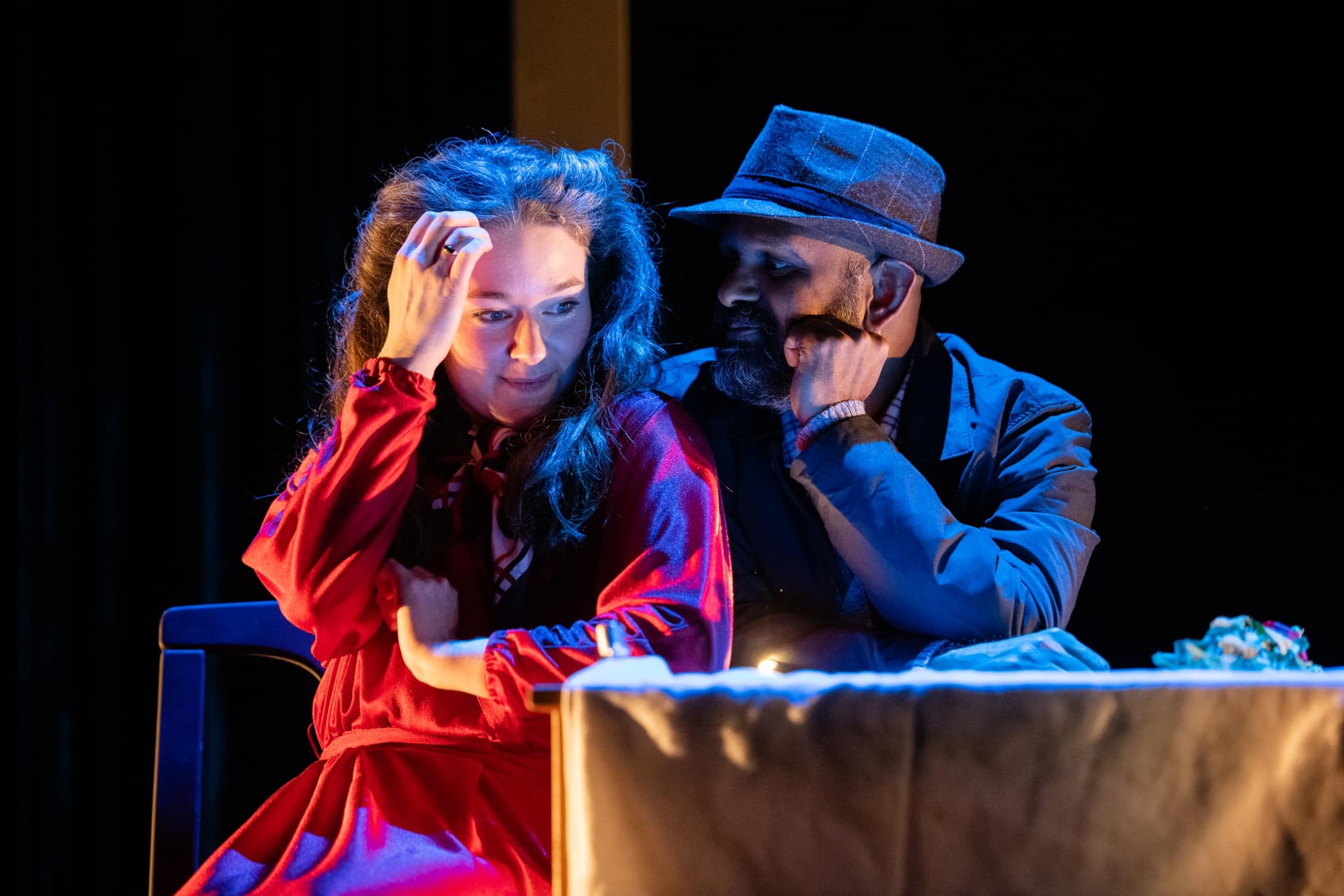
Amy Kennedy

Lear

05/06/25

Traverse Theatre, Edinburgh

It seems at first an act of incredible hubris: to take one of Shakespeare’s most accomplished works, chuck out all those pesky words and attempt to tell the story entirely through movement. But only a few minutes into Raw Material’s adaptation and I am beginning to appreciate what a clever idea this actually is – one that opens out the play’s central story to encompass a whole range of different interpretations. Anybody who has watched helplessly as an aging relative slips inexorably into the fog of dementia, for instance, will find plenty to identify with here.

Anna Orton’s simple set comprises mostly heaps of sandbags, which we will soon discover are stuffed with what look like ashes and which, when scattered around the stage, seem to accentuate the central character’s failing grasp on reality. When Lear (Ramesh Meyyappan) first strides confidently into view, he is fearless, energetic, reenacting his past conflicts for the entertainment of his three daughters.

But we cannot fail to notice that he is already jumping at shadows, reacting to every bump and thud of David Paul Jones’s vibrant score, every flash and flicker of Derek Anderson’s vivid lighting design. Director Orla O’Loughlin keeps him centre stage while his daughters move around its periphery, cooly observing as he begins a slow but steady decline. As his grasp on the war-torn kingdom grows ever more precarious, so he goes to his daughters seeking refuge. Regan (Amy Kennedy) and Goneril (Nicole Cooper) are not the grasping, cruel sisters of the source play, but rather two concerned siblings that strive their hardest to accommodate their Father’s eccentricities. Cordelia (Draya Maria) keeps to the sidelines, always giving way to her more manipulative sisters – but her affection for her father is evident, making it clear that she will love him unconditionally.

And then the fog really begins to take hold as Lear don’s his Fool’s old hat and adopts the gurning, slapstick attitude of his former jester, Meyyappan pantomiming exquisitely as he slips effortlessly between the two characters, bicker and competing with each other for the sister’s affections. His bewildered daughters try their best to cope with their father’s mounting instability but once taken hold, these changes cannot be denied. In Lear’s latter stages, stripped to his underwear and no longer able even to wash himself, the character’s ultimate tragedy really begins to hit home.

Lear’s story is also true of so many people as they begin to slip helplessly into their twilight years – as they succumb to drug addiction – as they are weighed down by advancing depression – the transformation witnessed by their partners and their children. This daring adaptation nails such experiences with considerable skill.

Despite my initial reservations, I have to raise my hat to a fearless and thought-provoking piece of theatre.

4.2 stars

Philip Caveney

The Girls of Slender Means

17/04/24

Lyceum Theatre, Edinburgh

Gabriel Quigley’s vivacious adaptation of Muriel Spark’s novel opens in the 1960s. Jane (Molly Vevers) is the editor of Elan magazine. Her bright young assistant, Bluebell (Molly McGrath), nervously pitches a feature, but Jane is distracted by news of a certain Nicholas Farringdon (Seamus Dillane)’s demise. Maybe she can write a piece about him? After all, she knew him, back in the day. And, just like that, she is hurtling down Memory Lane, back to 1945 and the months between VE Day and VJ Day, when she lived in the May of Teck…

The May of Teck is a pithily-straplined boarding house, “for the pecuniary convenience and social protection of ladies of slender means below the age of thirty years, who are obliged to reside apart from their families in order to follow an occupation in London.” The young occupants – who all work as secretaries – share everything: rations, deportment tips, clothes. One dress in particular, a Shiaparelli known affectionately as Scappers, is dear to all their hearts. They each get to wear it on special occasions; there’s a strict rota in place.

The first act is sprightly, frothy, almost determinedly light; the focus is on fashion and friendship, dancing and diets. Beautiful Selina (Julia Brown) carefully monitors her calorie-intake to ensure her hips don’t grow too wide to wriggle through the tiny bathroom window so that she can sunbathe on the roof. Live-wire Anne (Amy Kennedy) provides a caustic running commentary on everything and everyone, while angelic elocution teacher, Joanna (McGrath again), recites poetry and sews. Meanwhile, Pauline (Shannon Watson) never stops prattling about her love affair with famous actor Jack Buchanan, and our Scottish protagonist, Jane, forges fan mail to authors for her publisher boss, and dreams of being a poet herself one day. Her attempts to be taken seriously – her dowdy cardigan, her constant references to “brain work” – are undermined by her goofy awkwardness, wonderfully captured by Vevers.

There’s a tonal shift in the second act. As we get to know the girls better, we begin to see beneath the gilded surface. Their frivolity is revealed for what it is: a distraction from the horrors they have endured during the war. It shouldn’t come as a surprise; it’s been there all along in Jessica Worrall’s set design, the monochrome backdrop of bombed-out buildings a constant reminder that the girls’ colourful chatter belies a darker truth. But it shocks, providing an effective wake-up call. They are survivors. No wonder they cling so desperately to the fantasy Scappers provides.

Under Roxanna Silbert’s direction, the story has a clear contemporary resonance, and not just because we, like they, are living through the dying days of a Tory government, fearful of what might happen next. The production is impressive as a whole, but there are also some stand-out scenes, most notably the droll office sequence and the dance, where the girls’ boyfriends are represented by legless mannequins.

Spark’s lesson is clear. Don’t underestimate people because they seem shallow; you don’t know what’s concealed within their depths.

4.3 stars

Susan Singfield

Love Beyond (Act of Remembrance)

11/02/23

Traverse Theatre, Edinburgh

Love Beyond (Act of Remembrance) is billed as ‘a love story – but not a typical one’. And yet this play, by Ramesh Meyyappan is, like all tales of love and loss, at once unique and ubiquitous, quirky and commonplace.

We meet Harry (Meyyappan) as he moves into a care home. He has dementia, and he’s also deaf. His new carer, May (Elicia Daly), is sweet and attentive, but she doesn’t know sign language, although she is ‘going on a course’. Naturally, Harry’s disorientation is heightened by the pair’s inability to communicate. Matthew Lenton’s skilful direction ensures the audience is drawn in, as those of us who can’t sign miss much of what Harry says, while some of those who are deaf presumably miss May’s words. It’s nicely done: we’re all given enough information to understand what’s going on, while also experiencing a little of Harry’s alienation from his new home, and May’s frustration at not being able to do her job.

The set (by Becky Minto) comprises three moveable screens. At first these are mirrors, magnifying Harry’s discomfort: the reflection of the audience staring at him adds to the sense that he no longer has a private life, or much autonomy at all. Cleverly, the screens are also transparent: lit from behind, they reveal Harry’s jumble of memories. We get to know the young Harry (Rinkoo Barpaga) and his true love, Elise (Amy Kennedy): we see them meet and fall in love; we see their joy and their sorrow, their prime and their decline. There’s something spellbinding about the way these images appear and disappear, and Harry’s yearning for Elise is palpable and heartbreaking.

The strength of this piece lies in the movement, which is precise, slow and beguiling – a realisation of the phrase ‘poetry in motion’. There is a gentle earnestness here that defies cynicism, so that a simple swimming mime becomes a thing of beauty; the act of putting on slippers becomes profound.

Composer David Paul Jones’s soundtrack is integral to the piece. The music is by turns melodic and jarring, light and intense, reflecting Harry’s inner turmoil just as clearly as the mirrors.

This year’s Manipulate Festival has thrown up some absolute gems – and this is one of them.

4.4 stars

Susan Singfield