Alfred Hitchcock

Rope

20/07/24

Theatr Clwyd, Mold

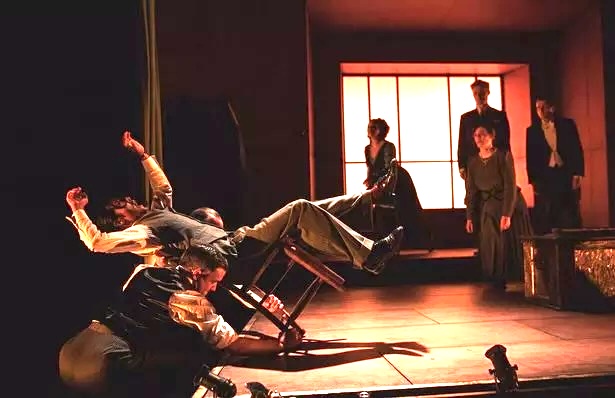
Patrick Hamilton’s 1929 play, loosely based on the Leopold and Loeb murder case of a few years earlier, is these days mostly remembered for Alfred Hitchcock’s 1948 movie adaptation, a film that famously changed the rules of cinema to incorporate its theatrical origins. This ingenious production – by Theatr Clwyd’s resident company – layers Hamilton’s (occasionally quite expository) script with slick movement sequences, which are mostly used to indicate the deteriorating psychological state of one of its protagonists.

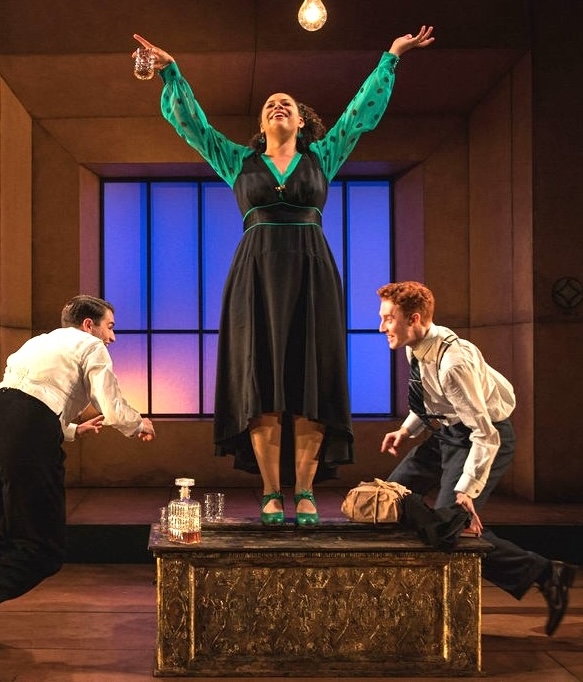
Jack Hammett (Wyndham Brandon) and his partner in crime, Granillo (Chorag Benedict Lobo), have kidnapped and murdered a young colleague, using that titular length of rope to strangle him – for no reason other than to see if they can get away with it. This isn’t a spoiler, by the way, because at the play’s start we witness the two of them placing their victim’s body into a trunk which stands centre stage throughout. Hamilton’s play isn’t so much a ‘whodunnit?’ as a ‘will-they-get-away-with-it?’

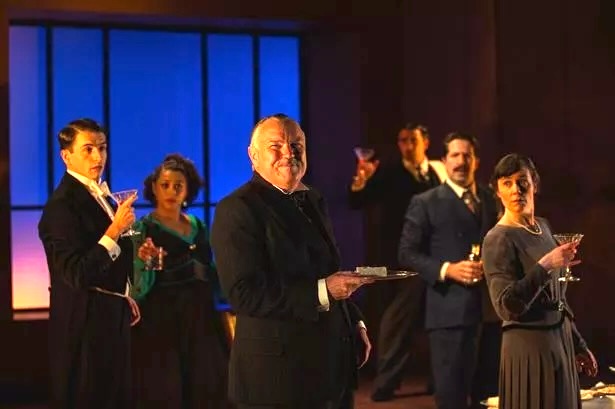
The smug and confident Hammett and the highly-strung Granillo have carried out the murder as a way of demonstrating their superiority over the rest of humanity – Hammett is a devoted reader of Nietzche – and, to further elaborate their point, they have planned to throw a little party for an odd assortment of guests, one of whom is Sir Johnstone Kentley (Keiron Self), the murdered boy’s father. The trunk will be used in place of a table to serve food and drink and Hammett will even jokingly tell his guests that it contains a dead body.

The play opens in almost total darkness, the two criminals making their plans by the light of matches, while the rest of the cast are already onstage, silent witnesses to their conversation. The party ensues and the guests enter one by one, greeted by the central duo’s faithful butler, Sabot (Felipe Pacheco), who knows nothing about the crime. The visitors include the nice but ineffectual Kenneth (Rhys Warrington) and chatty socialite Leila (Emily Burnett). Of course, there’s always one guest at a party who overstays his welcome and in this case it’s Rupert Cadell (Tim Pritchett), who has been around the block a few times and whose suspicions have been aroused. He’s clearly keen to have a look at the contents of that trunk…

This is an inventive production that explores the possibilities of the original play with flair. If it’s not entirely sure of itself in the first half, it certainly gathers strength in the second and I love the closing stretches where the compact performance space is steadily stripped bare of hiding places, the cruel intentions of the murderers finally exposed to the cold light of day.

Brandon is particularly impressive as the callous and self-possessed Hammett, a man so convinced of his own genius that he’s prepared to risk everything to prove a point. And I particularly enjoy Emily Pithon’s portrayal of Mrs Debenham, who makes the most of a tricky role which only offers her the occasional line and a series of sardonic expressions. Frances Goodridge directs the piece with skill and movement director Jess Williams’ Frantic Assembly-style sequences add verve and vigour to the proceedings.

Rope is an assured and intriguing piece of theatre, a slow burner that steadily builds to a powerful blaze.

4.2 stars

Philip Caveney

The Lady Vanishes

18/02/19

King’s Theatre, Edinburgh

Alfred Hitchcock’s 1938 film, The Lady Vanishes, is one of those perennial Sunday afternoon treasures, a rollicking spoof packed full of plucky Brits, braving the rise of the Nazis with a stiff gin and an even stiffer upper lip. The Classic Thriller Theatre Company specialises in translating such films into stage productions and here the original script by Sidney Gilliat and Frank Launder has been adapted by Anthony Lampard. The cast is headed by husband and wife duo, Juliet Mills and Maxwell Caulfield. At this point I should probably disclose that I have a tenuous connection with Mr Caulfield, as he provided the voice for the audio book of my 2007 children’s book, Sebastian Darke: Prince of Fools. He did a darned good job of it, too, and I’m pleased to say his performance here is also rather fine.

The action begins in Austria, where a motley collection of travellers are about to board a train for Switzerland. The station concourse is decorated with ominous swastika flags, while forbidding looking Nazis swagger importantly back and forth, as they enjoy their rising influence on the world’s stage. In the general chaos, young Iris Henderson (Lorna Fitzgerald), who is travelling back to London to meet up with her fiancée, suffers a blow to the head and is promptly taken under the wing of Miss Froy (Juliet Mills), a friendly older lady who helps her aboard the train, dispenses some of the special tea she always carries with her and then, just as it says on the can, rather mysteriously… vanishes. When Iris asks her fellow passengers if they have seen Miss Froy, they all claim there was never any such person. Iris, they insist, got on the train alone.

Only young musical historian, Max (Matt Barber), with whom Iris has already had a less than promising encounter, takes the trouble to help with her inquiries, but it soon becomes clear that the train is packed not so much with travellers as with crates of red herring. There are so many suspects here it’s frankly bewildering. Could it be the two British cricket enthusiasts, Charters (Robert Duncan) and Caldicott (Ben Nealon)? And what about the mysterious brain surgeon, Doctor Hartz (Maxwell Caulfield)? Why does he have somebody swathed in bandages in his compartment? And what’s going on with that secretive couple a few compartments down? We are soon in Agatha Christie territory as the train thunders ever nearer to the Swiss border.

The problem of setting a stage production aboard a moving locomotive is simply and niftily dealt with by an ingenious set change – and there’s no doubting the skill and expertise of the twelve-strong cast as they gamely set about convincing us that we really are aboard a train and this really is something that might happen.

If there’s an overriding issue here, however, it’s with the story itself. What doubtless passed for an amusing and in many ways groundbreaking tale in 1938, now feels faintly preposterous. We are asked, for example, to accept that many passengers on the train will deny the existence of a person, not because they’re involved in a plot, but because they just don’t want to be involved. Hmm.

Perhaps this could have been played more for laughs, but instead, the director has opted to do it straight-faced, even when events are bordering on the risible. And, try as I might, I cannot make every element of the convoluted story fall comfortably into place. What about the Italian illusionist, Signor Doppo (Mark Carlisle)? At one point he attacks Iris and Max with a knife, but even now, a day after I saw the play, I’m not entirely sure why.

Fans of the original film will doubtless have a good time with this. It’s a nostalgic recreation of the original, complete with that familiar feel-good conclusion. Hitchcock has many fans and this production is clearly aimed directly at them. However, whilst I enjoy several parts of the journey, I’m not, I’m afraid, a totally contented passenger.

3.6 stars

Philip Caveney


The 39 Steps

The 39 Steps 2016 tour - Olivia Greene as Pamela & Richard Ede as Hannay (c) Dan Tsantilis

21/06/16

Lyric Theatre, The Lowry

Poor Richard Hannay – framed for the murder of a mysterious young woman  he’s only recently met, he’s had to go on the run to a remote corner of the Scottish Highlands in order to prove his innocence. But danger lies in wait for him at every step…

Hannay is of course the great British hero of The 39 Steps. John Buchan’s classic novel was first published in 1915 and famously filmed by Alfred Hitchcock in 1935. This touring production, originally adapted by Patrick Barlow in 2006 comes direct from the West End and it’s easy to see the qualities that have pulled in packed audiences ever since. With a cast of just four actors, this is played primarily for laughs and conducted at breakneck pace with plenty of lightning-fast costume changes and a repeated motif of effects that go slightly wrong. It’s clear too that this is much more Hitchcock’s version of the story than Buchan’s – film fans will spot plenty of references to Hitch’s best known movies thrown into the mix. (In a shadow puppet sequence depicting a chase across the hills, keep an eye out for one particularly recognisable silhouette.)

Richard Ede makes an appealing pipe-smoking, Harris tweed-wearing  hero, while his three fellow actors virtually run themselves into the ground providing a whole wealth of supporting characters for him to interact with. In the cavernous setting of the Lyric theatre, it was sometimes a struggle to make out every line of dialogue (I would have loved to see this in the more intimate setting of the studio theatre, but you can’t fault the producers for wanting to pitch this to the biggest possible audiences) and there’s no doubting the consummate professionalism on show here, nor the wit of Barlow’s script. It’s probably also true to say that when this production first aired many of the staging techniques on show would have seemed ground-breaking – now, they are part of the everyday language of contemporary theatre.

That said, this offers a fun and entertaining night out for lovers of adventure and comedy alike. It’s on untilSaturday 25th June.

4 stars

Philip Caveney