Theatre

Woyzeck

Unknown-1

17/08/14

Gilded Balloon Teviot, Edinburgh

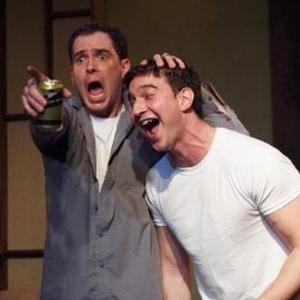
Splendid Productions’ version of Woyzeck is a real triumph. I have a head full of superlatives, and don’t know where to start.

Well, unlike Splendid, I’ll start at the beginning. The actors are on stage, not in-role, and interacting with the audience. They greet us, make sure we’re comfortable, ask someone to hold a mirror while they finish their make-up. They explain what they are doing (“We’re setting it up so that we can make a tonal change in a minute”), and there is such wit and warm-heartedness in the approach that it’s impossible not to smile.

And then they go to the end. The murder scene. There’s a numbered caption board telling us that this is scene 23, and what happens in it, and there are three actors and there’s a stage full of props. Sound effects are produced on stage in front of us. Costume changes too. The caption cards change with every scene, and the chronology is all over the place. There’s music and singing, and audience participation. We are made to feel complicit in the killing and in Woyzeck’s destruction; why don’t we intervene and stop it? And it’s marvellous, all of it. Brechtian brilliance. Fourth wall ripped away. Lively, confrontational, exciting and joyous. The best thing I’ve seen at this year’s Fringe.

Thank you, Splendid. I’ll be coming to see this again when you go on tour.

5 stars

Susan Singfield

Austen

Unknown

16/08/14

The Space on the Mile, Edinburgh

I’ll be honest; this one started at a disadvantage: I don’t really like musicals very much. It’s not a blanket prejudice (I think Matilda is delightful, Little Shop a lot of fun and Cabaret bloody brilliant) but it’s not my favourite theatrical genre. I’m also aware that a small Fringe production can’t be expected to have the same impact as those big-budget West End shows I’ve mentioned above, and yet… It could so easily have been much more than it was.

We saw a musical two-hander last year (I Need a Doctor), which was lively and charming and used its size to its advantage. Austen, with four actors, always felt too small.

The conceit has potential: two students researching Austen discover that the spinster author had a love life of her own. The action cuts between the students in the present day, and moments depicting Jane’s relationships in the past. Sadly, it doesn’t really work. The songs all sound the same as one another, with no shift in tone for the modern day. A single piano is used for each of the bland ballads, and the lyrics are oddly anachronistic (most of the dialogue is faux-Austen in style, but there’s a song which repeats the very modern refrain ‘You’re so special’ so often that it’s utterly nauseating, and makes you long for Radiohead to complete the idea). 

And the story itself is weak. It might surprise the two students to discover that Jane Austen had relationships, but it surely doesn’t surprise anyone who’s read her books or even looked her up on Wikipedia. She did live in the real world and enjoy some social interaction. And, in truth, her putative affairs weren’t really very interesting: a flirtation, a friendship and a rejected proposal. So what? Why do they care? What do they think it says to them?

There are spurious links made between the people Austen encountered and the characters in her books. We are not allowed to make these connections for ourselves, but have them pointed out to us in some clunky exposition: “Oh, he must be the inspiration for Wickham!” Mrs Austen is conflated with Mrs Bennett; it’s all just too pat and convenient.

It wasn’t all terrible; the actors did their best with the turgid script, and they could all sing rather well. The scene with the royal librarian was funny and engaging. But, all in all, this is one to miss.

0.5 stars

Susan Singfield

Product

Unknown

Assembly Hall, Edinburgh

14/08/14

When it premiered at the Traverse Theatre in 2005, Mark Ravenhill’s Product starred the playwright himself as a desperate Hollywood producer, pitching a dreadful script to an actor who is clearly never going to take the part. I missed that version, but was delighted to have the opportunity to see director Robert Shaw’s revival of this sharp satire, this time with Olivia Poulet (Leah) delivering the monologue.

Poulet is perfectly cast; she oozes flattery and fake sincerity, skewering a character who believes that – if she just keeps talking, if she just keeps pretending – she will somehow manage to save her career and convince the actor to take the part. But the actor is us – the audience – and we can see through Leah’s posturing; indeed, the humour derives almost as much from Leah’s lack of self-awareness as it does from the increasingly ridiculous details she reveals from the script.

And how deliciously ridiculous those details are: the script emerges as a sexually explicit rom-com about Al Qaeda (improbably named Mohammed and Me), and there are laughs a-plenty as Leah attempts to make the prospect tempting. She focuses on the costume (Versace), the accommodation (a Docklands flat) – as if the actor will be as beguiled as Leah herself by the promise of such vicarious luxury.

I love this piece: I love its humour, its bite and – ultimately – its simplicity. I love the way that Ravenhill has somehow managed to construct a wonderfully written play mainly by writing an appalling film, and I love the vulnerability that Poulet brings to what is essentially an unsympathetic role.  I’ve seen (and enjoyed) a lot of student productions during this year’s Fringe, but sometimes it’s good to see what a seasoned professional can do. Sterling stuff.

4.7 stars

Susan Singfield

Jekyll and Hyde

_2014JEKYLLH_T7

15/08/14

Spotlites at Merchants Hall, Edinburgh

I have recently written a novel involving Robert Louis Stevenson, so was initially drawn to this production merely because of its subject matter, but I soon found myself completely blown away by its sheer sense of style. In Headlock Theatre’s contemporary reworking of Stevenson’s classic tale, Doctor Jekyll is a young scientist working on clinical trials in order to develop a drug to combat depression. He’s spurred on by the fact that his own sister, Marta, suffers from the illness. Impatient to get the drug (C9) onto the market, he volunteers to test out its effects on himself… and quickly starts to go off the rails.

This fluid, energetic production utilises speech and physical theatre to tell a familiar story and in so doing, makes it fresh and riveting. Scenes flow effortlessly into one another, as the eight-strong team work superbly together to create all the locations with nothing more than two chairs and one clipboard as props.  In what is essential an ensemble piece there are of course, two standout roles: Nathan Spencer is a striking Doctor Jekyll while Tom Boxall, as a smirking, twitching Mr Hyde, manages to be absolutely terrifying.

It’s always exciting to discover new talent at Edinburgh and Headlock Theatre are surely destined for even greater things. Until then, Jekyll and Hyde is a triumphant calling card that satisfies on just about every level.

5 stars

Philip Caveney

Mojo

mojo

12/08/14

C Venue 34, Edinburgh

Set in 1950’s London, Mojo is Jez Butterworth’s Olivier Award winning play located in The Atlantic Club,  where pop singer Silver Johnny appears to be on the verge of the big time and the club’s various workers wheel and deal with each other, hoping for a slice of the action. But when the club’s owner, Ezra turns up dead in two separate dustbins, paranoia descends…

It’s a brilliant play – swaggering, macho, loaded with canny period detail and a homoerotic subtext – you have to remember that in the 1950’s, homosexuality was something that had to be kept clandestine. Mojo inhabits the kind of territory that Harold Pinter made his own back in the day and Butterworth excels at finding the dark humour in a brutal and unforgiving world. This is an amateur production, by the oddly named company My Son Tristan, but the actors rise to the challenge and submit excellent performances.

It’s hard to single out one player in particular, but Cody Maltby as the pill-popping Sweets, gets most of the funny lines and has a field day with them. The real tragedy is that on the night we visited, the production had attracted a crowd of just sixteen people and with hindsight, a more intimate venue would have been more appropriate. But we’ve seen packed venues presenting less assured performances and poorer material than is on offer here, so catch this before it’s gone. There’s plenty to admire.

4.4 stars

Philip Caveney

Lysistrata

09/08/14

C Venue 34, Edinburgh

ramin-sabi-1041-lysistrata-a3-lst145502

Christopher Adam’s loose adaptation of Aristphanes’ classic comedy – the tale of a prototype feminist who instigates a ‘sex strike’ in an attempt to gain more rights for women – brings the story bang up to date and sets it against Greece’s recent bailout by the IMF, an intriguing premise that really pays dividends (ha ha!). The four cast members work really hard to depict nine characters between them and largely pull it off, playing both genders with confidence, while Louisa Hollway is a striking, memorable Lysistrata, but if only they could have had the luxury of a couple more actors to take care of some of the minor roles! There were some problems on the night we viewed the play with the rather shonky set (a clothes drier that seemed to possess a life of its own and a rug on a polished floor that seemed like an accident waiting to happen) but these are minor niggles. Bringing contemporary issues like the economic crisis and trolling on social media into the action, breathe new life into the play and make it seem incredibly prescient. After a brief run of disappointments, this one redressed the balance.

4 stars

Philip Caveney

A Series of Increasingly Impossible Acts

secrettheatreforweb1-lst145458

08/08/14

Northern Stage at King’s Hall, Edinburgh

According to their publicity material, “The Secret Theatre Company is a 20-strong ensemble of actors, writers, directors and designers created to challenge the way theatre is produced and presented in Britain.” They promise exciting, dangerous, risk-taking performances, and “never the same show twice.”

In reality, this translates into a group of young actors dressed in their PE kits, sitting at the edge of a stage, until an audience member chooses that night’s ‘protagonist.’ This, it seems, is the extent of the risk: the actors don’t know which of them will be called upon to perform the lead role. Oh, and there are lots of improvised bits, where one actor has a list of questions to read, and another has to respond spontaneously. So far, so drama workshop exercise.

There isn’t much of a narrative, and ‘protagonist’ seems an odd choice of word to describe the main actor, as there is nothing so traditional here as a character. There’s just a name (tonight’s was Cara), and a series of barely linked scenes. OK, so there’s some pretty full-on wrestling, some clothes swapping, a decent soundtrack and a bit of Romeo and Juliet quite nicely spoken. And, of course, there’s those “impossible tasks” – bending an iron bar, licking your elbow, eating a whole lemon. All made easier, it is revealed, with a little help from your friends. “What was tonight’s show about, Cara?” asked one of the actors. “Exhaustion,” replied Cara, “Exhaustion and friendship.” These words were added to the other – equally bland – statements scrawled on a whiteboard at the back of the stage, presumably the themes ascribed to previous shows.

In truth, this didn’t seem to add up to much. It didn’t feel risky, dangerous, innovative or vital – or any of the other epithets quoted on the publicity posters. It all just felt a little bit… so what?

1 star

Susan Singfield

The Fair Intellectual Club

-2014FAIRINT-8X-300

07/08/14

Studio 2, The Assembly Rooms, Edinburgh

The Fair Intellectual Club is comedian Lucy Porter’s first foray into play writing, and it’s certainly a promising start. It tells the true tale of three young women who, in 1717 – at the dawn of the Scottish Enlightenment, set up an illicit club with the aim of studying literature, science and philosophy, determined not to be kept in ignorance merely by virtue of their sex. This was a risky venture, with social censure and reputations at stake, and Porter cleverly conveys a sense of genuine peril and brave rebellion.

The director’s light touch means that we focus on the actors (Samara MacLaren, Caroline Deyga and Jessica Hardwick), who convey their respective characters with exuberance and wit. The three girls have a convincing rapport, with all the love, anger, misery and jealousy of a real friendship beautifully portrayed. There are moments of real heartbreak – and of untamed laughter; this play is definitely one to watch. It has a contemporary resonance that should not be ignored.

4.6 stars

Susan Singfield

Lear’s Daughters

10563009_10204619914276405_6237848768087125705_n

01/08/14

C Nova Venue, Edinburgh

Lear’s Daughters (Footfall Theatre Company) offers an interesting premise. What would Shakespeare’s famous play look like presented from the point of view of his daughters, Regan, Goneril and Cordelia? Presented in the rather unprepossessing C Nova venue (complete with occasional distracting bleed-through from a raucous performance next door) the production delivered rather less than it promised. The performances were pretty good overall, with Goneril a stand-out, but the lack of a programme prevents me from identifying any of the four actors featured. Shakespeare’s dialogue (including lines by the play’s other characters) is assigned to the daughters, who constantly bicker about their father’s needs. Lear himself is represented by an empty wheelchair and the character of the Fool is now a nurse, who sings (seemingly unrelated) songs throughout the performance. This is either going to be A) a refreshing novelty or B) an irritation, and sadly I leaned towards the latter. When the Fool/Nurse continued to sing whilst being blinded, I started to feel disengaged from the proceedings. I think at the end of the day, if you’re going to mess with the bard of Stratford On Avon, you’d better have something pretty amazing up your sleeve and I’m not convinced that Lear’s Daughters actually did. But the performers acquitted themselves well under quite trying conditions, so I’ll be lenient.

3.2 stars

Philip Caveney

Wastwater

10584016_10204626301396079_1426510873915943317_n

03/08/14

C Nova Venue, Edinburgh

I’ve been a fan of playwright Simon Stephens ever since I saw Punk Rock at the Ed Fest a few years back. Wastwater is an early work, originally performed at the Royal Court in 2011. This new production is ingeniously staged in a promenade style ranging between two main rooms linked by a middle one where uniformed extras guide you along designated pathways, into the next piece of action. Wastwater is essentially three short plays, linked only by brief mentions of characters from the previous section. Although an amateur production, the standards of acting in each part are uniformly excellent and the simple but effective staging manages to involve the audience to such a degree that they feel as though they are part of the action. The overall theme is one of transience – nearly every character is on his or her way to somewhere else. One minor niggle – some of the actors are clearly too young for the roles they are playing, but in a production as accomplished as this, that’s easy to live with.

4.6 stars

Philip Caveney